

Filtering at the molecular edge
-
- from Shaastra :: vol 05 issue 02 :: Feb 2026
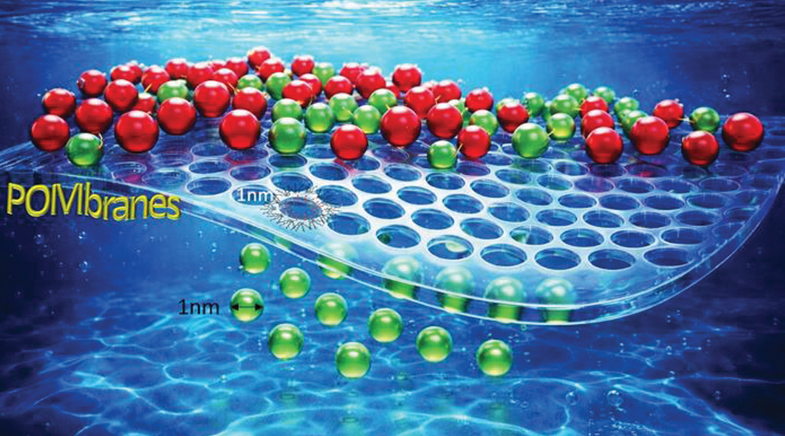
Saving energy by sieving molecules a nanometre wide.
Separating molecules lies at the heart of the chemical, pharmaceutical, and textile industries. Yet the methods used to do so — chiefly distillation and evaporation — are notoriously energy-intensive. Together, they account for an estimated 40-50% of global industrial energy consumption. As industries face mounting pressure to cut emissions and conserve resources, the search for more efficient separation technologies has taken on new urgency.
A team of Indian scientists has now unveiled a promising solution. Drawing inspiration from nature's finely-tuned filtration systems, researchers from the CSIR–Central Salt & Marine Chemicals Research Institute (CSIR-CSMCRI), Bhavnagar, and the Indian Institute of Technology (IIT) Gandhinagar have developed a new class of membranes capable of separating molecules as small as one nanometre across. Their work, reported in the Journal of the American Chemical Society (bit.ly/Molecule-Separate), points to a future in which separations can be achieved with far less energy.
The membranes, known as POMbranes, are fundamentally different from the polymer membranes commonly used today. Conventional membranes have poorly defined pore structures that can swell, degrade, or lose selectivity over time. This makes it difficult to separate molecules that are very similar in size and limits their durability under harsh industrial conditions.
POMbranes are fundamentally different from the polymer membranes commonly used today.
POMbranes are built from molecularly precise inorganic clusters called polyoxometalates, each containing permanent pores about one nanometre wide. When billions of these clusters assemble into a continuous, defect-free sheet, every molecule crossing the membrane is forced through identical, well-defined pathways. "This allows separations with near-molecular precision," says Shipi Kushwaha, a senior scientist at CSIR-CSMCRI and one of the study's authors.
The membranes form spontaneously when placed on water, as the clusters spread out and align into ultrathin films. By adjusting the length of attached molecular chains, the researchers can control how tightly the clusters pack together. "This forces molecules to pass only through the built-in nanometre-scale pores, effectively turning the membrane into a molecular sieve," IIT Gandhinagar Associate Professor Raghavan Ranganathan, another corresponding author, said in a statement.
In pharmaceutical manufacturing, POMbranes could enable highly selective separations without sacrificing throughput, significantly reducing energy consumption while meeting strict purity standards. In textile dyeing, membranes can block dye molecules while allowing clean water to pass, enabling on-site water recycling and reducing both freshwater use and chemical discharge.
As industries worldwide grapple with energy costs and environmental constraints, innovations at the nanometre scale may offer some of the biggest gains.








This sensor can sniff out hydrogen leaks
A sensor patch for detecting hydrogen leaks shows promise.
Oil's well that ends well
Used cooking oil is a renewable starting material for polymers.

Time for a reality check
The next platform war will be waged over immersive technologies. We peer into the AR/VR market and gauge its enormous potential.



Have a
story idea?
Tell us.
Do you have a recent research paper or an idea for a science/technology-themed article that you'd like to tell us about?
GET IN TOUCH