

Study strikes it rich
-
- from Shaastra :: vol 05 issue 05 :: May 2026
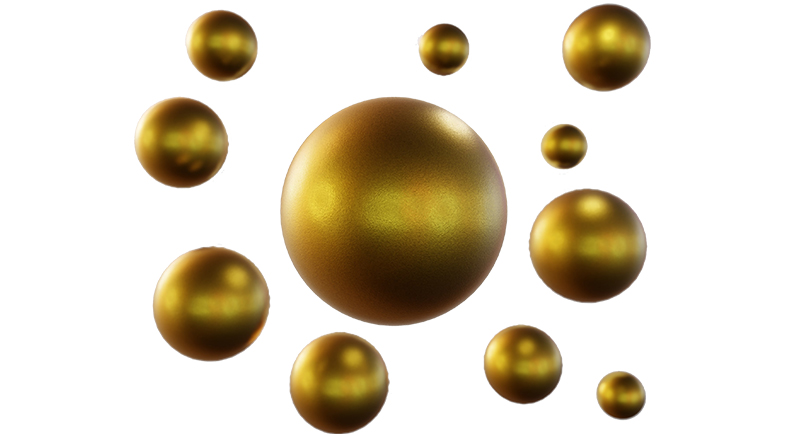
A team finds that an enzyme degrades gold in the body.
Scientists have in recent years developed tiny gold particles — nanomaterials — to deliver drugs, image tumours, and destroy cancer cells with laser light. Yet despite decades of research, gold nanomaterials have not been used clinically. And that is because it is still not known what happens to these particles once they enter the human body. Do they accumulate in organs such as the liver and spleen?
Researchers from the Indian Institute of Science Education and Research (IISER) Thiruvananthapuram may have a convincing answer to the question. They report in a study published in Small Science (bit.ly/Gold-Kurapati) in April 2026 that the body's immune system can break down and scavenge gold nanoparticles.
"Neutrophils, the abundant white blood cells present in the blood that clear foreign materials, including bacteria, can degrade gold nanomaterials," says Rajendra Kurapati, Assistant Professor of Chemistry at IISER and a corresponding author of the study. "These results are crucial for designing biomaterials based on gold nanomaterials and may help them pass through clinical trials, as the gold materials are biodegradable," he says.
The team, which included researchers from CSIR-Indian Institute of Chemical Technology in Hyderabad, found that neutrophils can degrade gold due to the presence of a powerful enzyme, myeloperoxidase. The enzyme is known to generate harsh oxidising chemicals that kill bacteria.
Gold nanosheets could efficiently absorb near-infrared laser light and convert it to heat, killing triple-negative breast cancer cells.
In a test-tube experiment, the scientists exposed a particular form of gold nanomaterial — flat, hexagonal or triangular nanosheets — to a purified human myeloperoxidase enzyme. Over 20 hours, the sharp-edged, crystalline sheets became irregular and fragmented, with smaller spherical nanoparticles forming around the debris. Multiple techniques confirmed that the gold had been chemically oxidised — converted from metallic gold to gold ions.
They then confirmed this in living cells. They coaxed human leukaemia cells into behaving like neutrophils and activated them to secrete the enzyme. After 14 days' exposure, the gold nanosheets similarly degraded. When the researchers chemically blocked myeloperoxidase activity, the degradation was suppressed — proving that the enzyme drove the breakdown.
The scientists also demonstrated that the same gold nanosheets could efficiently absorb near-infrared laser light and convert it to heat, killing triple-negative breast cancer cells — one of the hardest-to-treat cancers — while leaving normal cells unharmed.
The team now plans to carry out similar studies on macrophages — specialised white blood cells that engulf and digest pathogens. Macrophages carry peroxidase enzymes similar to those of neutrophils. Also on the cards are projects to demonstrate gold biodegradation in small animal models.








Diamonds as semiconductors: a cut above the rest
Lab-grown diamonds are proving to be superior to silicon as semiconductors in electronics and quantum technology.

When bacteria go brrr…
Cyanobacteria use their body clocks to sense oncoming seasons. Can this finding be used to mitigate algal blooms?
More for less
As AI adoption drives up enterprise costs, Indian companies are innovating to deliver more intelligence with less compute.



Have a
story idea?
Tell us.
Do you have a recent research paper or an idea for a science/technology-themed article that you'd like to tell us about?
GET IN TOUCH