

Is that a tiny black hole trapped inside a star?
-
- from Shaastra :: vol 05 issue 10 :: Oct 2026
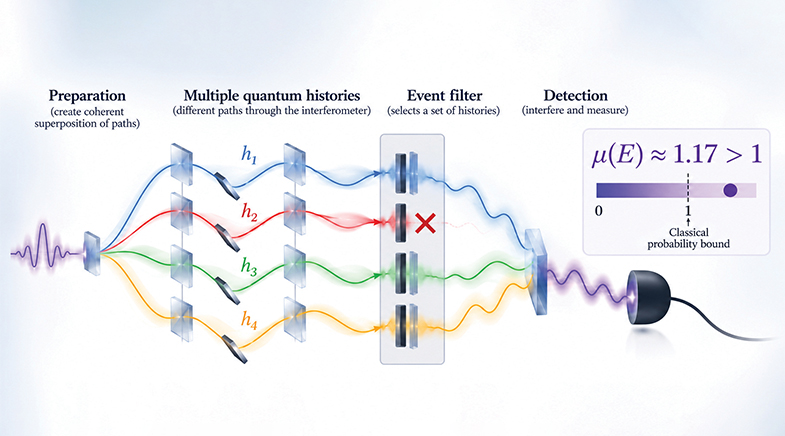
A study challenges the view that low-mass black holes evaporate.
Stephen Hawking's theory on low-mass black holes has been questioned — by researchers at the Manipal Centre for Natural Sciences in Karnataka. Hawking predicted that an isolated black hole would need a mass of roughly a billion tonnes (10¹² kg) or more to survive; anything lighter would have evaporated. But a study by Chandrachur Chakraborty, a theoretical physicist at the Manipal institute, and his student, H.A. Adarsha, suggests that a black hole weighing 40 tonnes could survive inside a white dwarf (bit.ly/low-mass). The researchers had earlier found gravitational-wave data indicating a sub-solar or near-solar-mass black hole. This led them to check whether even smaller black holes could form inside ordinary stars or stellar remnants.

To explore this possibility, Chakraborty collaborated with Sudip Bhattacharya of the Tata Institute of Fundamental Research, Mumbai, and revisited a hypothetical model proposed by Itzhak Goldman and S. Nussinov in 1989, which said dark matter trapped within a neutron star could create a tiny black hole. The researchers extended this idea to neutron stars and white dwarfs.
A white dwarf or neutron star in a region rich in dark matter could gradually capture dark-matter particles.
According to them, a white dwarf or neutron star in a region rich in dark matter — such as the galactic bulge — could gradually capture dark-matter particles. Over time, the particles could accumulate inside the star. In suitable conditions, they could collapse under their own gravity and form a tiny black hole at the star's centre. Once formed, the black hole would be affected by three competing processes. It could gain mass by absorbing ordinary matter from its host star and dark matter accumulated inside the star. At the same time, it would lose mass through a process known as Hawking radiation, in which a black hole slowly loses energy and mass and gradually evaporates. If the mass gained through accretion balanced the mass lost through Hawking radiation, the tiny black hole could survive and even grow. "We found a 40-metric-tonne black hole can grow. But if it is less than 40 metric tonnes, it will evaporate," Chakraborty says.
A tiny black hole could provide clues about dark matter. If dark-matter particles can collect inside a star and form a tiny black hole, whether that black hole grows or evaporates would depend on the properties of the dark matter. "If this is true, then that neutron star can act as a detector for dark matter particles," says Chakraborty.








Blinded by science
How science became disconnected from human experience.

AI and the brAIn
Computation is helping to diagnose and treat brain disorders, providing relief to patients through deceptively simple products.

Lighting the way
Scientists are harnessing photonics and metaoptics technologies — with game-changing impact.



Have a
story idea?
Tell us.
Do you have a recent research paper or an idea for a science/technology-themed article that you'd like to tell us about?
GET IN TOUCH

