

When the dawn is dull, dusk is clear far, far away
-
- from Shaastra :: vol 05 issue 06 :: Jun 2026
New insights into the nature of giant exoplanets.
Sagnick Mukherjee fell in love with the night sky as a schoolboy after observing Jupiter through the telescope at a stargazing camp in Kolkata. Years later, as an astronomer, he found himself studying another Jupiter-like planet — WASP-94Ab. Using data from the James Webb Space Telescope (JWST), he and other astronomers observed a dull dawn and a clear dusk on the giant gaseous exoplanet about 690 light-years away (bit.ly/Exoplanet-contrast).
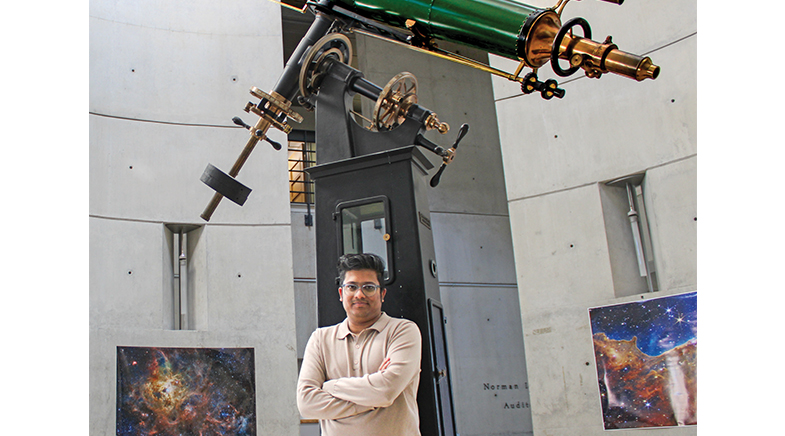
"I was surprised to see how different the two limbs of the same planet looked; (it was) like looking at two completely different planets," says Mukherjee, a postdoctoral fellow at Arizona State University and the lead author of the study. One side of WASP-94Ab permanently faces its star while the other remains in perpetual darkness. The exoplanet orbits WASP-94A, one of the two stars in the binary star system WASP-94.
When a planet passes in front of its star, a tiny fraction of the starlight filters through the planet's atmosphere. By studying this filtered light, astronomers can learn what the atmosphere is made of. Mukherjee and his collaborators used a new technique to examine different parts of the planet's atmosphere. In transit, a planet's leading edge enters first, corresponding to the planet's morning. At the end of the transit, the trailing edge leaves last, corresponding to the evening side. The team analysed the light from these two regions separately, and saw a cloudy morning and a clear evening. This allowed them to compare the atmosphere on the morning and evening sides.
A proper understanding of the weather will help researchers answer questions on how planets formed and evolved.
"As JWST is stable and precise, it can detect subtle differences between these phases and thus distinguish the spectra of the two hemispheres," he explains.
Initial analyses suggested the oxygen on WASP-94Ab was nearly 100 times that on the Sun, but accounting for the planet's uneven cloud cover reduced the estimate to about five times the solar value, showing that weather had skewed the original measurement. Additionally, it helped resolve a long-standing debate over whether Jupiter's aerosols were primarily clouds rather than photochemical hazes.
The study established that a proper understanding of the weather would help researchers answer questions such as how planets formed and evolved, and whether they might be capable of supporting life.








All set for Ocean 6,000
India's first aquanauts test the waters for an Indian Ocean mission.


For a healthcare revolution
With a large-scale Tech-enabled Health Workers programme, India can deliver world-class primary healthcare.



Have a
story idea?
Tell us.
Do you have a recent research paper or an idea for a science/technology-themed article that you'd like to tell us about?
GET IN TOUCH