

Blowing hot and cold
-
- from Shaastra :: vol 05 issue 05 :: May 2026
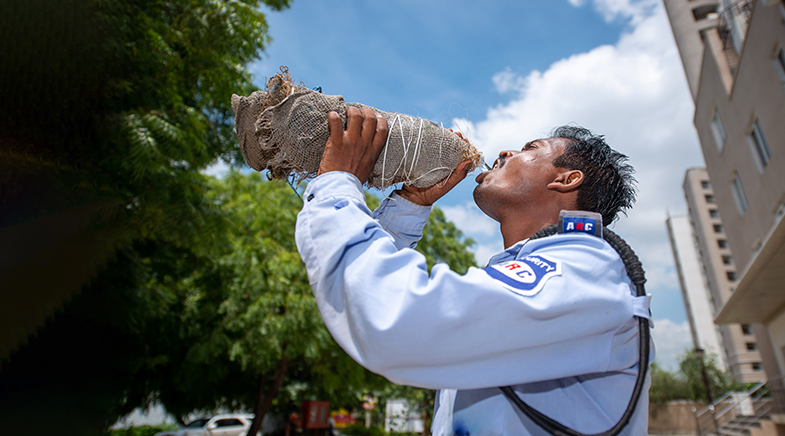
Dealing with a double whammy of El Niño and climate change.
Avast region — twice the size of India — lies some 15,000 km from the Indian coastline in the Pacific Ocean. It is called the Niño 3.4 box. The way this "box of water" warms up plays a significant role in determining India's monsoons. An anomalous warming of the box relative to the surrounding sea surface temperature triggers an El Niño event, one of the most significant determinants of the annual South-West Monsoon.
Meteorologists and climate scientists closely monitoring this temperature index believe that the slightly positive readings at present might increase over the coming months, and suppress monsoon activity in the latter half of the season. The India Meteorological Department (IMD) has predicted that the 2026 monsoon will see around 8% less rainfall than usual. In a normal monsoon year, India receives 89 cm of rainfall over the season.
Given the effects of El Niño, scientists are trying to predict its behaviour. But since studies are recent, the available data are insufficient for forecasting.
A strong El Niño year is a cause for concern. It is linked to droughts in India, wildfires in Indonesia, declining fish catches along the Peruvian coast, and dry weather in South and Central America. Given the vast ramifications, scientists are trying to predict its behaviour. The challenge, says palaeoclimate scientist Kaustubh Thirumalai, is that scientific studies on El Niño are so recent that the available data are insufficient for forecasting. "People began studying El Niño only around 50 years ago. During this time, there have only been four super El Niño events. We need much more data," explains Thirumalai, an Associate Professor of Geosciences at the University of Arizona, U.S.
The term El Niño goes back to the 16th century during the Spanish conquest of the Americas. Peruvian fishermen noted that when the waters around the coast were warmer than usual, it meant a bad year for fishing. They named the phenomenon El Niño de Navidad, literally the Christmas Child, as the warming peaked in December. However, it was only in the late 1960s that Norwegian-American meteorologist Jacob Bjerknes identified in detail the teleconnections — links between distant weather and climate anomalies — of this warming. He explained the link between El Niño, an oceanic phenomenon, and the Southern Oscillation, an atmospheric event. The Southern Oscillation is a large-scale alternating atmospheric pressure pattern across the East and West Pacific.
The West Pacific is normally warmer than the East. As the eastern flank begins to warm, the east-west temperature gradient weakens, reducing trade winds. The weakened winds suppress the surge of nutrient-rich cold water in the East (causing the drop in fish yield), further increasing the surface heat and reinforcing a positive feedback loop. This ocean-atmosphere coupling, called the El Niño Southern Oscillation (ENSO), feeds on itself, intensifying over 12-16 months, until it is naturally weakened by phenomena such as waves. El Niño is followed by La Niña, a reverse phenomenon caused by anomalous cooling.
VARYING OUTCOMES
"Every ENSO event is different," says IMD Director General of Meteorology Mrutyunjay Mohapatra. He recalls that 1997, a strong ENSO year, had a normal monsoon; 2002, a weak event, saw 20% below-normal rainfall; 2015, a medium event, had a deficit of 12%. "There are other dynamics at play, too, like the Indian Ocean Dipole (IOD), which can modulate the effect of the ENSO," he says. The IOD is the temperature gradient between the eastern and western flanks of the Indian Ocean. A positive IOD is associated with a good monsoon in India, though it causes drought in Australia. The year 1997 was a super El Niño event, and should have caused a devastating drought in India. However, a positive IOD helped counter many of the extreme effects, resulting in near-normal rainfall.
A negative IOD is associated with poor rains. In 2014, although the ENSO was weak and still in the developing phase, a negative IOD ultimately led to a 12% monsoon deficit. One of the strongest IODs was recorded in 2019, leading to above-normal rain, despite a weakly positive ENSO (bit.ly/IOD-strong). The IOD is currently in a neutral phase, but it will likely turn positive when the ENSO picks up. It is not known if it will negate the effects of the ENSO.
For India, the ENSO's behaviour has an economic impact. Preparing for a weak (or exceptionally heavy) monsoon due to the ENSO requires robust prediction. "With the current understanding, we can predict the occurrence of an ENSO up to two seasons ahead," says Gnanaseelan Chellappan, a scientist at the Indian Institute of Tropical Meteorology, Pune. "We need to plan for decadal-level forecasts. However, the data is not robust enough," he adds.
Scientists differ on how anthropogenic warming will impact future ENSO variability. According to Mohapatra, El Niño is about a change in the temperature gradient across different parts of the Pacific, not about the overall rise in sea surface temperatures. "El Niño is a natural mechanism to remove additional heat from the Pacific," says Chellappan. "Several climatological features also add to the heat in the Pacific, even without overall warming."
More than external influences, it is the intrinsic variability between the ocean and the atmosphere that has a great bearing on the outcome of an ENSO event. A study led by Kelly Hereid at the University of Texas focused on the Little Ice Age from 1411 to 1541. Using fossil records of corals, it showed that while the ENSO was relatively quiescent during this cool period, there was no direct relationship between its reduced activity and the reduced solar radiation (bit.ly/ENSO-LittleIceAge). A team led by the Georgia Institute of Technology in Atlanta found that the ENSO had high internal variability over the last 7,000 years. It noted there was no discernible influence of orbital changes on the ENSO, despite well-documented effects on monsoon circulation.
Researchers who believe that global warming impacts the ENSO note that warming will intensify the Walker Circulation, the east-west atmospheric circulation in the Pacific, and lead to ENSO events with greater amplitude and frequency. Thirumalai was associated with a 2024 paper in Nature that simulated scenarios over the last 21,000 years and found that, despite all the variability, the dominant factor influencing El Niño formation was the global mean temperature, which controlled atmospheric wind circulation. The authors noted that stabilising carbon dioxide concentrations to well below pre-industrial levels (560 ppm) is essential to mitigate the impact of extreme El Niño events (bit.ly/Mitigating-Impact).
The changes in El Niño over the past years are well documented. The Intergovernmental Panel on Climate Change notes that the ENSO was strong between the late 19th century and the first quarter of the 20th century, and has been strong again since 1950.
A study from China shows that the ENSO loop has shifted westward since 2000, leading to shorter ENSO cycles and reduced ENSO variability. Researchers from Beijing say this has led to less rainfall in the central and eastern Pacific and more in the western tropical region during ENSO years (bit.ly/westward-shift). They admit that such a short decadal observation is not enough to draw further conclusions. Typically, ENSO cycles occur every 2 to 7 years, with at least one very strong event per decade.
DOUBLE TROUBLE
Irrespective of the reasons behind increasing ENSO variability, there isn't much argument on the impact that strong ENSO-La Niña events will have in a warming world. Climate change is associated with extreme weather events. These, coupled with ENSO-related extremes, can cause large-scale droughts and floods, unless countries step up, says Vimal Mishra, Dean of Research and Development at the Indian Institute of Technology, Gandhinagar.
"India is lucky not to have experienced a nationwide drought since 2002," he says. "The focus should be on adequate water storage during the time of abundant rain, with a system of well-maintained dams and a focus on recharging groundwater. Surface water evaporates quickly with rising temperature," he points out. An efficient cooling plan by the administration that restricts work during the hottest part of the day, ensures passive cooling, provides steady electricity, and strengthens the public health response system may seem simplistic, but can succeed where high-tech solutions may not.









Bee-yond numbers
Scientists have a bee in their bonnet. And it's all beginning to add up.

Promising solutions
Start-ups are battling heat, excessive energy use, and impurities.



Have a
story idea?
Tell us.
Do you have a recent research paper or an idea for a science/technology-themed article that you'd like to tell us about?
GET IN TOUCH