

The desktop marvel
-
- from Shaastra :: vol 05 issue 07 :: Jul 2026
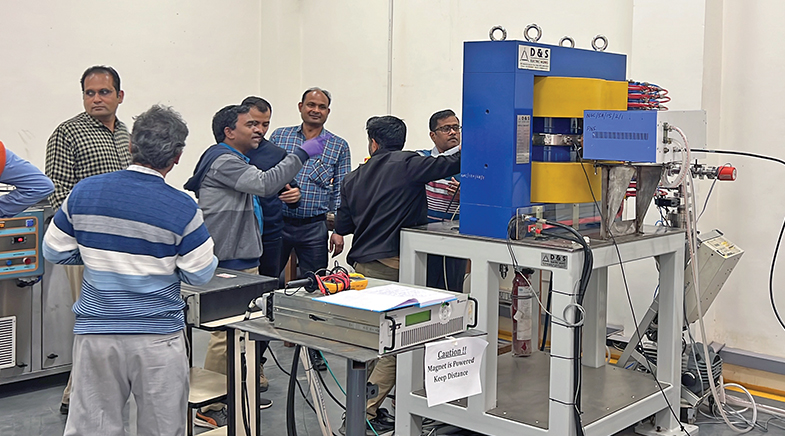
Tabletop cyclotrons to help in cancer diagnostics and therapy.
Pranawachandra Deshmukh had not given much thought to cyclotrons until he received a query from the Cancer Institute (WIA) in Chennai in 2007. Deshmukh, who then headed the Physics Department at the Indian Institute of Technology (IIT) Madras, is a theoretical physicist with a deep interest in atomic physics. A Japanese agency was going to gift a cyclotron to the cancer institute, and its doctors wanted to familiarise themselves with the equipment. Would IIT Madras help? M.S. Anant, who was then the Director, passed the query on to Deshmukh.
Deshmukh began reading about cyclotrons and came across the story of a student project to build one (see box: 'Beaming it up'). A cyclotron is a particle accelerator that accelerates charged particles — such as protons and electrons — for bombardment of an atomic nucleus. Such high-speed bombardment is useful for research, producing isotopes for medical imaging and cancer treatment, generating neutrons and gamma rays for security applications, and for industrial research. However, cyclotrons are large machines that require significant energy input to operate. India has a few nuclear research labs, such as the Bhabha Atomic Research Centre, and dedicated facilities, such as the Variable Energy Cyclotron Centre (VECC) in Kolkata. Smaller commercial cyclotrons are rare and expensive to procure.
The cyclotron produces focused beams of accelerated charged particles, which can be harnessed to generate radioisotopes used to treat cancers.
Deshmukh read about Rutgers University graduate student Timothy Koeth, who had built a small cyclotron with help from other students in the U.S. Built over six years, this machine could accelerate particles to one-tenth the speed of commercial machines. It was a good way to teach students the basics of accelerator physics, and Deshmukh set himself on the path of building a tabletop cyclotron. After four years of conversations, he received some assistance from G. Aravind, then an Assistant Professor in the Physics Department at IIT Madras; R.K. Bhandari, VECC Director; and V.S. Pandit, a senior VECC faculty member with expertise in accelerator design. With students and postdoctoral researchers, they submitted a proposal to the Department of Science and Technology for funding.
BEAMING IT UP
How a school project fuelled a dream.
In the fall of 1994, in his modern physics class, listening to his professor describe a cyclotron and being shown a picture of Berkeley Lab's 184-inch cyclotron, Timothy Koeth decided to build his own accelerator.
PHOTO: CYCLOTRON GROUP/IUAC
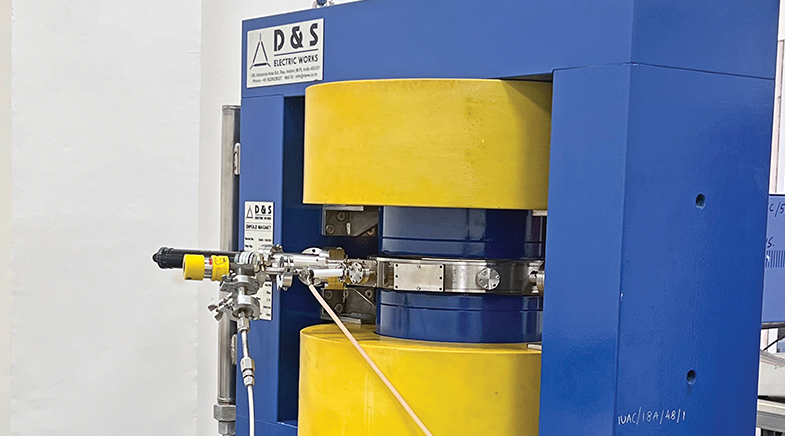
Five years later, on September 16, 1999, as Hurricane Floyd raged across the American East Coast, Koeth, then a PhD student at Rutgers University, put the finishing touches to the cyclotron, watching the green glow of the beam on the screen. He had designed a 12-inch cyclotron and needed to buy a 9-inch Varian magnet from the Rutgers surplus store. As a student, he could not afford it, so he negotiated it for $50 and a case of beer. Being a Ham radio enthusiast, he was able to locate the radio frequency system. His father, a heavy equipment mechanic, had walked over to a steel fabrication company, telling them that his "boy needed a stainless steel ring for a school project".
Koeth has now started a 'Guild of Cyclotroneers' to bring together like-minded amateur cyclotron-builders. His fondest memories regarding his cyclotron visitors include Pranawachandra Deshmukh's visits in 2008-10. "(The visits) solidified that a student-built cyclotron was feasible. I am so glad that he has had the drive and persistence to bring it back to and inspire the IUAC," Koeth says.
A few years went by. Deshmukh retired from IIT Madras and joined IIT Tirupati as a faculty member. He continued to pursue the project, but with no serious progress. In October 2023, Deshmukh met Avinash Chandra Pandey, Director of the Inter-University Accelerator Centre (IUAC) in New Delhi. They were at the annual convention of the Indian Association of Physics Teachers in Jaipur, and the conversation turned to building tabletop cyclotrons capable of accelerating charged particles to energies comparable to those of commercially available medical cyclotrons.
FABRICATING A PROTOTYPE
In 2024, Pandey decided to take up this project. He and a dozen IUAC faculty members began fabricating a prototype desktop cyclotron. They felt that once they had built the prototype, they could develop it for cancer therapy and diagnostics. The team was initially led by senior IUAC scientist Gerard Rodrigues. "We would all meet online twice a week, after work, late so that Tim (Koeth, now with the University of Maryland) could also attend," Deshmukh says.
Koeth shared drawings and design details, based on which they developed their own 2D and 3D models. "But it was the very first time IUAC was making a cyclotron so small in size," says Rodrigues. Even at night, if someone made a breakthrough, they would immediately share it with the others. "The IUAC faculty were extremely busy people, yet they worked on this in their spare time," says Deshmukh, who would visit IUAC periodically. The plan was first to build a 1 MeV cyclotron prototype with a budget of about `50 lakh, by sourcing technology and people from within IUAC. "Somewhere along the journey, the goals shifted from building a pedagogical tool to building something that could be used in cancer diagnostics and therapy," Pandey says.
Tabletop cyclotrons can be used to produce short-lived radioisotopes for cancer diagnostics and therapy. The cyclotron produces focused beams of accelerated charged particles. These beams can be made to slam into stable targets, triggering nuclear reactions, generating radioisotopes used to treat nearly 50% of cancers. The production and distribution of these isotopes are carried out at large centres. "Doctors should not have to struggle with large machines," says Pandey.
However, the more compact a system, the more difficult it is to fabricate and test it. The IUAC scientists found they had the necessary instrumentation expertise in-house, but building the ion source proved challenging. "This is the smallest part, and IUAC has no history of making a source that's so small," says Rodrigues. Building the cooling system and the radio-frequency components was challenging, too. "Still, we progressed very well at low power, though high power is still a challenge," he says. Shrinking the cooling system was difficult, but they adjusted it so that larger, off-the-shelf systems could be used.
BEARING FRUIT
Now, two years after they started, the group has a prototype cyclotron, essentially a toy model which can be used in college experiments. The design and development process may be shared with other institutes interested in starting their own projects. "It's wonderful to see it realised. I got the idea nearly two decades ago. Perhaps, the thought was a little ahead of its time," Deshmukh says.
The IUAC team — now led by Rajeev Mehta, with Rodrigues having retired — is building its next version, where it will use the cyclotron for simple experiments. The team is seeking an industry partner to help it manufacture a commercial-grade cyclotron for therapeutic use. The team is exploring a partnership with Panacea Medical Technologies near Bengaluru. Its Co-Founder and Managing Director, G.V. Subrahmanyam, has experience with linear accelerator technologies.
The machine, once ready, will generate radioactive elements such as palladium-103, iodine-125, and caesium-131, useful in the treatment of prostate cancer, ocular melanoma, pancreatic and biliary tract cancers, uveal melanoma, early-stage breast cancer, and bone metastasis. It also opens up opportunities at universities, where students can gain hands-on experience in accelerator physics.
On the cards is the development of a higher-level device for proton beam therapy, an advanced form of targeted cancer radiation. This is offered only at two places in India: the private Apollo Proton Cancer Centre in Chennai and the public Tata Memorial Centre in Navi Mumbai. An indigenous machine could spread access to this technology. "We first need to demonstrate beam extraction. Once we achieve the desired result, we will be able to make educated decisions. It's not a simple scale-up issue," Pandey says.









Get, set, gau!
The desi cattle class gets a genomic upgrade.


Clouds on Earth
A proposed cloud chamber can improve climate models, inform weather-modifying attempts, and control fogging in urban centres.


Have a
story idea?
Tell us.
Do you have a recent research paper or an idea for a science/technology-themed article that you'd like to tell us about?
GET IN TOUCH