

Out for drone delivery
-
- from Shaastra :: vol 05 issue 09 :: Sep 2026
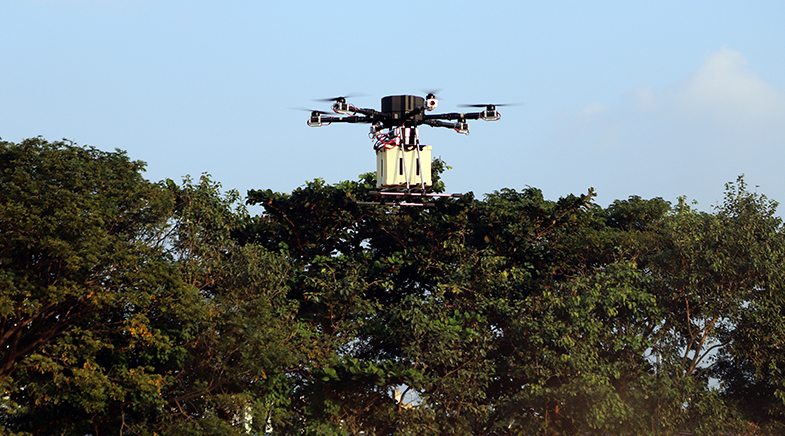
A flying machine to transfer organs for transplant.
A donor human heart has a life of about four hours – on ice – before transplant. Time is at a premium in organ transplant, and losing one to the snarl of city traffic or the logistics of sourcing it from another State can be devastating.
Sunil Shroff, a urologist and founder of the MOHAN Foundation in Chennai, has been a long-time advocate of multi-organ harvesting, especially after brain death in patients. He has often pushed for green corridors to enable traffic-free conveyance of organs. However, the everyday reality of traffic congestions in metro cities spurred him to explore alternatives to save time.
Drones were an option. A plausible idea five years ago is now closer to reality. In a paper published in the Indian Journal of Medical Research (bit.ly/organ-drone) in August 2026, Shroff and a team of engineers from the Indian Institute of Technology (IIT) Madras have showcased an innovation to transport organs using drones.
Shroff says, "It was not so much about flying a drone. What was more important was building the box to carry the organs."
The challenge was to design a box that catered to multiple requirements. It had to be lightweight, sturdy to withstand wind and crashes, maintain a temperature of 0-4° Celsius, and fly for at least 45 minutes. Shroff needed engineers to bring his vision to life, and Prabhu Rajagopal, Director, IIT Madras Zanzibar Campus, stepped in.
"Building something as simple-looking as a box turned out to be more complicated than we had imagined," says Rajagopal, who was at the time leading the Centre for Innovation at IIT Madras. His students worked part-time on the project.
Out of the box
To maintain the requisite temperature around the organ, Rajagopal and his students created a box-within-a-box design and inserted phase-change materials into the annular region. The materials absorbed latent heat from the outside while transitioning between states, keeping the inside temperature constant.
Various materials were stress-tested for strength-to-weight ratio; the team eventually chose a carbon fibre-reinforced polymer for the box, which was 3D printed with chamfered corners. The box could not be held with hooks or fasteners as that would concentrate stress. "We created a groove around the body so that the box could be held with two belts," says Rajagopal. The team dropped the box from 60-foot-high buildings to test durability.
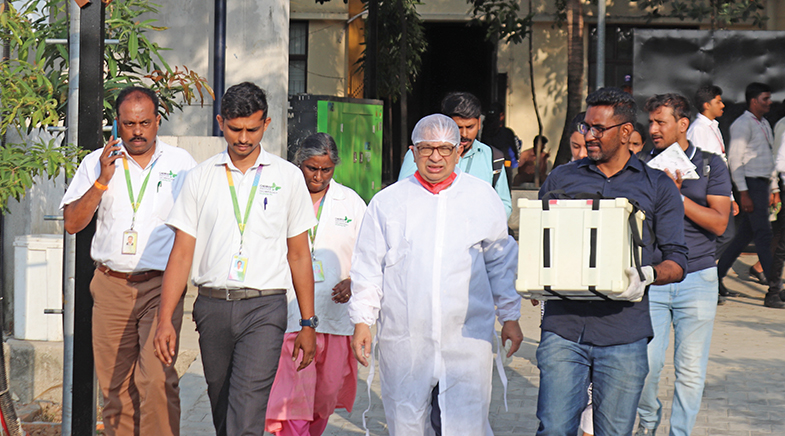
The organ inside the box in the first trials was a goat's heart. "I went to the butchers' a few times to get goat hearts as they are almost similar to human hearts in size and weight," says Shroff. The box-bearing drone was initially flown across a stadium at the IIT Madras campus. Field tests were subsequently done along the coast near Mamallapuram. "We wanted a trial in Chennai in association with a transplant hospital and cover a distance of about five kilometres. But we didn't get the permission," he says. The windy coastline, however, helped check for stability.
The team is currently working on the mechanics of drone transport; whether it should be automatic or piloted will be finalised upon commercial implementation.
Inter-city organ-carrying drones were tested in the U.S. and Canada in recent years. Flying them in India, however, brings unique challenges. The air traffic is different here; bird hits, electrical poles and looping wires, all of which are common, have to be considered, says Rajagopal. "We had dreamed up many scenarios," he adds. "An Uber for organs, for instance, where drones will crisscross the skies and you can book one to transport an organ on demand." He concedes they are far-out ideas for now as special permissions to fly drones in cities remain an administrative issue.
Parallel projects in many States in India are exploring drone-based transport of vaccines, medicines, blood and sputum samples. Shroff hopes these efforts will help evolve guidelines on the use of drones for medical purposes. "Our next step is to show feasibility in live settings — between tertiary care hospitals and organ banks. It's an exciting phase," says Rajagopal.
See also:









What's your gut feeling?
As scientists turn the lens on gastrointestinal microbes, a handful of tests offers ways to assess one's gut and ward off disease.

How scientists are harnessing the power of engineered living materials
Scientists are tapping living cells for their ability to synthesise complex molecules.


Have a
story idea?
Tell us.
Do you have a recent research paper or an idea for a science/technology-themed article that you'd like to tell us about?
GET IN TOUCH