

A galactic googly
-
- from Shaastra :: vol 05 issue 10 :: Oct 2026
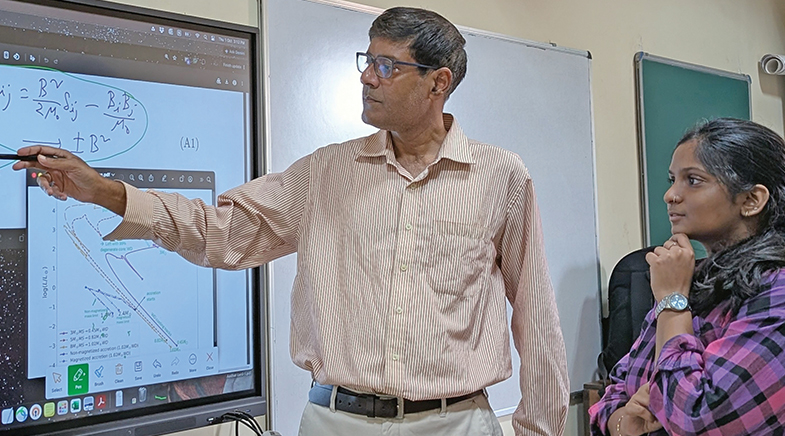
Some dead stars may defy the classical Chandrasekhar limit for the mass of white dwarfs.
On Zenia Zuraiq's desktop computer, 10 billion years in the life of a Sun-like star unfold in just 90 minutes. A software program designed to simulate the life cycle and eventual fate of stars runs on her computer, churning out numerical data. The numbers trace the star as it first fuses hydrogen into helium, then — as the hydrogen fuel in its core is depleted — swells into a red giant, before gravity compresses its remains into a dense remnant called a white dwarf.
At that point, Zuraiq, a research scholar supervised by Banibrata Mukhopadhyay, Professor of Physics at the Indian Institute of Science (IISc) in Bengaluru, casts a sharper eye on her data. She catalogues each white dwarf that remains stable and each white dwarf that, under the conditions created in the computer simulations, could potentially go on to explode as a supernova, the violent death of some stars in which much or most of their material is ejected into space.
Mukhopadhyay and his students have used simulations of stellar evolution to probe one of the most consequential numbers in astrophysics: the Chandrasekhar limit, the maximum mass that a white dwarf can support against its own gravity. Stars born with masses of roughly eight times that of the Sun or less generally leave behind white dwarfs — dense objects whose matter is packed into a sphere roughly the size of Earth. In a white dwarf, while gravity pulls the matter inward, quantum mechanics prevents matter from being squeezed into certain "forbidden" states. The India-born American astrophysicist Subrahmanyan Chandrasekhar had calculated in the 1930s that a slowly rotating, weakly magnetised white dwarf has a maximum mass of about 1.4 times the Sun's mass. Beyond that limit, gravity wins the tug-of-war. The limit has since become a key reference point in models of how white dwarfs can explode, including those that produce so-called Type Ia supernovae.
Now, IISc simulations have shown that white dwarfs, under particular strengths and geometric patterns of their magnetic fields, may remain stable at masses as high as about 2.4 times that of the Sun. The results bolster support for an idea that Mukhopadhyay has pursued through calculations for nearly 15 years: that magnetic fields could allow some white dwarfs to become substantially more massive than the classical Chandrasekhar limit.
White dwarfs that grow substantially more massive than the Chandrasekhar limit could complicate an important tool in astronomy: Type Ia supernovae.
"Our results do not imply that Chandrasekhar was wrong — not at all," says Mukhopadhyay. "But the classical 1.4 limit describes a white dwarf with no magnetic field, no rotation. In reality, white dwarfs will have magnetic fields and rotation." Different magnetic-field arrangements could allow the stars to support more mass, the simulations suggest. "It appears that there is no one universal Chandrasekhar limit," says Mukhopadhyay. "The limit depends on the physics of each star."
Previous theoretical studies had examined magnetised white dwarfs as already-formed objects observed at snapshot-like points in time. The IISc study approaches the question differently: it follows stars through their evolution and asks whether ordinary stellar evolution can produce white dwarfs that remain stable above the classical Chandrasekhar limit.
Over the past 15 years, Zuraiq is the third PhD scholar that Mukhopadhyay has encouraged to explore the fate of white dwarfs. She was enthusiastic, having been drawn to white dwarfs and neutron stars during her MSc Physics at the National Institute of Technology in Tiruchirappalli. Even more massive stars leave behind neutron stars, city-sized objects in which the star's remains are compressed into extraordinarily dense, neutron-rich matter. Even more massive stars can collapse to form black holes, objects whose gravity is so strong that not even light can escape and whose interiors present some of the deepest unresolved questions of physics. The exact outcome depends on how a star evolves and loses mass, including through interactions with a companion. "All three end stages of stars are fascinating," says Zuraiq. "They're places where both gravity and quantum mechanics become equally important — they're natural laboratories where we can explore the fundamental theories of physics."
For the simulations, the IISc researchers collaborated with Christopher Tout at the University of Cambridge and used a modified version of the STARS software, a program for modelling stellar evolution developed by Cambridge astrophysicist Peter Eggleton in the 1970s.
Mukhopadhyay introduced IISc undergraduate student Achal Kumar to the Cambridge group. Kumar, currently pursuing a PhD at the University of Florida, spent weeks familiarising himself with the code, refining it and helping Zuraiq make further changes to include magnetic fields in the simulations. In one series of tests, the researchers simulated a white dwarf extracting matter from a close companion star. In some simulations, the magnetic field allowed the white dwarf to remain stable as it gained mass beyond the classical Chandrasekhar value, reaching about 2.4 solar masses in the most extreme cases. A paper describing their study (bit.ly/chandra-limit) has been accepted for publication in The Astrophysical Journal Letters.
Astrophysicists not associated with the IISc study say the work opens a new avenue for investigating how massive white dwarfs might form. The paper shows that super-Chandrasekhar magnetised white dwarfs are "plausible in stellar evolution", says Jorge Rueda, a researcher at the International Center for Relativistic Astrophysics in Ferrara, Italy. The key question now, he says, is whether white dwarfs with the magnetic-field structures used in the simulations actually occur in nature — and how common they are.
For now, the super-Chandrasekhar white dwarfs exist inside simulations. Whether they exist in nature can be established only through observations.
Stefan Taubenberger, an astrophysicist in Germany who studies supernovae among other topics, views the IISc work as a valuable advance in a field that has received relatively little attention. "The paper provides numerical support to explosion scenarios that have not been discussed in much detail so far," he says. But he points to a limitation: the simulations assume an approximately spherical star, as is necessary for this kind of one-dimensional stellar evolution in simulations. "In reality, the accretion of mass will not be spherically symmetric, but happens through an accretion disc along the equator, followed by mass distribution towards the poles," says Taubenberger. A real white dwarf gaining material from a companion might therefore behave differently from the idealised white dwarfs described in the simulations.

Astronomers have already observed binary systems in which white dwarfs interact with companions. In 2025, a study led by astronomers at the University of Warwick identified two white dwarfs about 150 light-years from Earth with a combined mass of about 1.56 times that of the Sun. The study, published in Nature Astronomy (bit.ly/super-chandra), was the most massive double-white-dwarf binary confirmed at the time.
"Finding such a system on our galactic doorstep is an indication that they must be relatively common; otherwise, we would have needed to look much further away, searching a larger volume of our galaxy to encounter them," Ingrid Pelisoli, Assistant Professor at Warwick, said in a press release.
The implications of the work may extend beyond understanding how some stars die. White dwarfs that grow substantially more massive than the Chandrasekhar limit could complicate an important tool in astronomy: Type Ia supernovae. These explosions have served as useful distance indicators because their brightness follows a sufficiently predictable pattern to allow astronomers to estimate how far away they are. But if some white dwarfs can accumulate much more mass before exploding, they might produce Type Ia supernovae with properties that differ from those of the more familiar population. "If there are progenitor populations whose properties are significantly affected by strong magnetic fields, understanding them would improve our knowledge of the diversity of Type Ia explosions," says Fridolin Weber, Distinguished Professor of Physics at San Diego State University in the U.S. Understanding whether such objects exist — and how frequently — could help astronomers better account for the diversity of these explosions and refine techniques used to trace the expansion of the universe. Weber cautions, however, that he "would not interpret the present results as calling the established cosmological use of Type Ia supernovae into question".
For now, the super-Chandrasekhar white dwarfs exist inside the IISc simulations. Whether they exist in nature will have to be established through observations. Telescopes need to find white dwarfs with specific magnetic field configurations capable of supporting masses beyond the boundary that Chandrasekhar calculated nearly a century ago.
See also:









Shoot for the stars
The universe opens up as the world's largest optical camera swirls over the southern skies.

For the long haul
Efforts at building quantum computers and communications are taking root in India, overcoming the struggles of the early movers in the field.



Have a
story idea?
Tell us.
Do you have a recent research paper or an idea for a science/technology-themed article that you'd like to tell us about?
GET IN TOUCH

