

Matters of shape
-
- from Shaastra :: vol 05 issue 09 :: Sep 2026
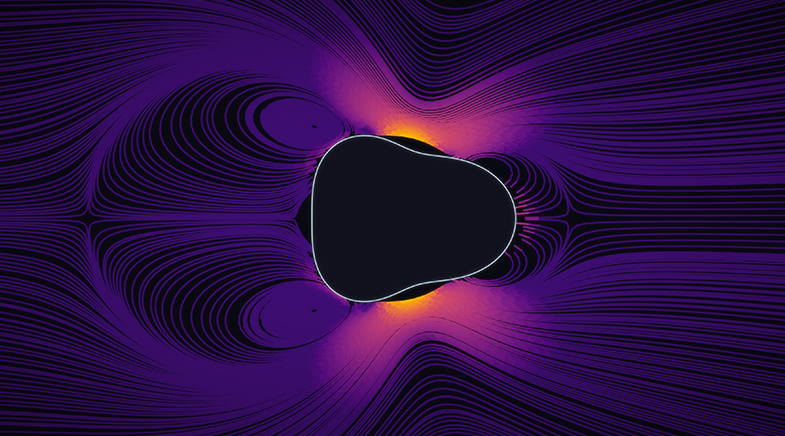
Artificial intelligence pitches in to solve an old fluid dynamics problem.
In the Autumn of 2024, chemical and biological engineer Ankur Gupta and his doctoral student Arkava Ganguly decided to take a stab at a century-old problem — the Smoluchowski limit. Introduced by Polish physicist Marian Smoluchowski in 1916, it deals with electrophoretic mobility — particle dynamics through a fluid in the presence of electric field. Electrophoresis has multiple practical uses, from separating DNA and proteins, to applications in drug delivery and environmental science.
The condition holds that particle movement in a fluid does not depend upon its shape — up to a limit. Variations beyond the limit have though kept scientists engaged. "No matter whether the particle is cone, sphere, cuboid or some other shape, they would always move at the same speed," says Gupta, Assistant Professor at the University of Colorado Boulder, U.S. But what of movement beyond the limit when particles are differently or irregularly shaped? The question intrigued Gupta, and he assigned Ganguly to work on it as part of his doctoral thesis.
The duo wrestled with the problem without making headway for a year-and-a-half. In February 2026, Howard A. Stone, Professor of Mechanical Engineering at Princeton University, visited Gupta's lab. Gupta posed the problem to Stone over dinner and sought his advice. Stone suggested they narrow down research to nearly spherical particles. These particles, explains Gupta, are not spheres; they could be of any shape, but were closer to a sphere. The idea was to take a sphere and perturb it to make a wavy shape or add deformations, and understand what happens after the Smoluchowski limit. It was still a daunting problem to solve.
After two years of research, Gupta and Ganguly have found that particle shape not only matters after the Smoluchowski limit, it also affects speed while moving through an electrolyte. The study, published in the Journal of Fluid Mechanics (bit.ly/Electrophoretic-mobility), reveals that minor anomalies — bumps, asymmetry, or pear-like features — have negligible effect on speed. But particles move faster when they are stretched to shapes such as a rugby ball, and moves slower when they are flattened or disc-like. The findings will help predict and control movement of irregular particles in applications such as colloid separation, microfluidics, and particle characterisation.
The AI system had made multiple correct moves, but it also went off the rails.
The researchers, however, were supported by an unlikely ally in the process – artificial intelligence (AI). Gupta looped in AI tools into research spurred by curiosity. Though sceptical, he posed their question to Anthropic's Claude, and watched nervously as the tool went through calculations like an expert. The AI worked for 18 hours, and eventually gave an answer. The researchers were stunned. They had been working on the problem for long, and to their knowledge, there was no literature on the result. The power of AI rattled them; but then, they began to analyse the findings, peeling back the calculations layer by layer for almost three weeks and found the AI result was wrong. The system had made multiple correct moves, Gupta says, but it also went off the rails. "AI became genuinely useful once the problem was correctly posed. No amount of prompting was going to rescue us from an ill-posed formulation," says Gupta.
He subsequently upgraded the AI model, issued clearer instructions, and worked step by step. The system solved the problem, although it repeatedly made mistakes, says Gupta. At last, with an AI companion, the researchers arrived at a solution in five weeks. One of the reviewers, adds Gupta, said the work "elegantly fills a long-standing gap in the electro kinetics literature".
The most important shape change, researchers found, was the simple squishing or stretching of a sphere. "It can alter how fast the particle moves in an electric field. But other deformations, such as making its surface wavy, do not affect its electrophoretic speed," says Gupta.
Their finding has relevance beyond the laboratories as micro- and nano-shaped particles are used in medical diagnostics, targeted drug delivery, and self-propelled "micro or nano swimmers" where controlling how a particle moves is the whole point, observes Gupta.









They're winging it
The butterfly's wings sure add colour to nature, but they also serve an evolutionary purpose.
All charged up
A nanomaterial promises faster charging and smoother energy flow.

The best of engineering and medicine
Emerging techniques from engineering are set to revolutionise the way medicine is practised and taught in the future.



Have a
story idea?
Tell us.
Do you have a recent research paper or an idea for a science/technology-themed article that you'd like to tell us about?
GET IN TOUCH