

More from ore
-
- from Shaastra :: vol 04 issue 11 :: Dec 2025
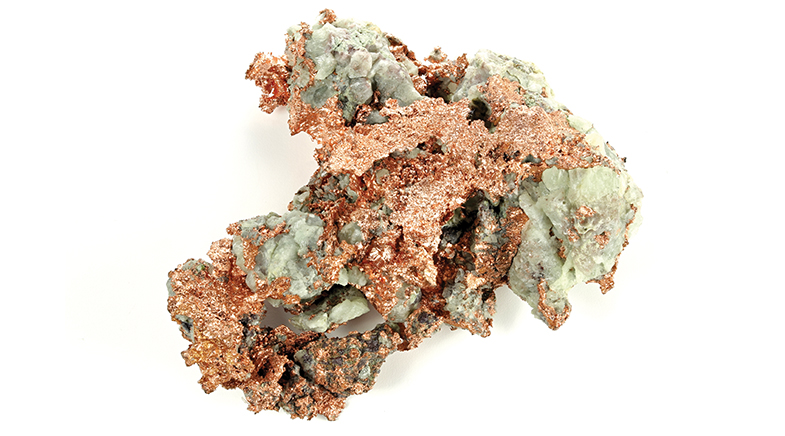
Valuable metals are being extracted from sea nodules in an eco-friendly process.
Ubaid Manzoor may have grown up far from the sea. But a technology developed by this young researcher from Jammu & Kashmir — currently a PhD student at the Max Planck Institute for Sustainable Materials in Düsseldorf, Germany — and his team may boost global efforts to harvest critical metals such as copper, nickel, and cobalt from the seafloor.
Since these metals, critical to the green energy transition, are rapidly depleting on land, researchers have been looking at alternative ways to meet the demand. According to one estimate (bit.ly/Metal-Needed), the world will need 60 million tonnes of copper, 10 million tonnes of nickel and 1 million tonnes of cobalt annually by 2050 to sustain this requirement.
Now, the team in Germany — Manzoor among them — has developed an efficient, low-carbon-dioxide (CO2) process for extracting these valuable metals from polymetallic nodules at the bottom of the ocean. The single-step process employs hydrogen reduction and could cut the associated CO2 emission by nearly 90% if green hydrogen and renewable energy are used, the scientists reported in the journal Science Advances (bit.ly/Sea-Ores) in November. Further, the process requires 20% less energy than in conventionally used technologies, and involves fewer steps.
They found that their process, which uses hydrogen plasma in an electric arc furnace, is more sustainable and efficient than a similar extraction process developed by a Canadian firm, which has also demonstrated a technology for extracting these critical metals from polymetallic nodules. "They use more or less traditional nickel and cobalt processing," says Manzoor, the corresponding author of the paper.
When hydrogen was allowed to flow into a furnace, an alloy of copper, nickel, cobalt, and other elements was produced.
In the conventional process, the ore is initially dried and roasted, using carbon monoxide and coke at 900° Celsius. It is then transferred into the electric arc furnace for melting, after which the metal and slag phases are separated. "As this multi-step process uses carbon-based reducing agents, CO2 emission takes place at almost every step. We, on the other hand, do not use any carbon source but use electricity to heat and melt the ore," says Manzoor, who studied at the National Institute of Technology Srinagar and the Indian Institute of Technology Roorkee before going to Germany for his PhD.
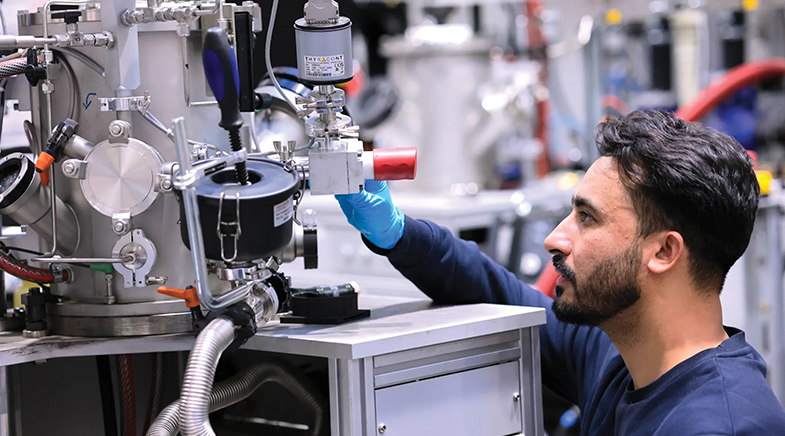
Using the novel process, the researchers recovered almost all the copper as pure metal by melting the ore and allowing the molten metal to cool. When they allowed hydrogen to flow into the furnace, an alloy of copper, nickel, cobalt, and other elements was produced, alongside various manganese oxides. In the alloy, the proportions of the minerals — which may be used in batteries — vary depending on the duration of the reduction. "Because we can separate copper first, it becomes easier to process the remaining alloy," explains Manzoor.
In an earlier study, Manzoor and his team presented a process very similar to that for extracting nickel from land-based ores in a sustainable manner. He adds that while the extraction of these nodules from the sea leaves an environmental footprint, there is a need to compare the environmental impact of land-based and sea-based mining processes. Current land-based mining operations for copper, nickel, and cobalt produce 4-5 billion tonnes of waste rock and tailings annually, often laden with toxic heavy metals and acids, posing severe environmental risks. Earlier, copper ores had an ore grade of 2% copper; now, due to over-mining, they contain only 0.06% copper. Moreover, each tonne of nickel produced results in an emission of 45-48 tonnes of CO2. One tonne of cobalt releases 28 tonnes of CO2, and 1 tonne of copper yields more than 4 tonnes of CO2.
Citing a University of Delaware study, the scientists showed that producing metals for 1 billion electric car batteries would generate 9 billion tonnes of rock waste if extracted from deep-sea ores. In contrast, 63 billion tonnes of unusable rock would have to be dumped if extracted from land deposits.
See also:










Passing the sniff test
With deep research into olfaction, scientists are on the scent of a way to digitise, map and predict odours.
Spirit of innovation
Three diverse start-ups showcase their entrepreneurial edge.



Have a
story idea?
Tell us.
Do you have a recent research paper or an idea for a science/technology-themed article that you'd like to tell us about?
GET IN TOUCH