

Pause before you leap
-
- from Shaastra :: vol 05 issue 08 :: Aug 2026
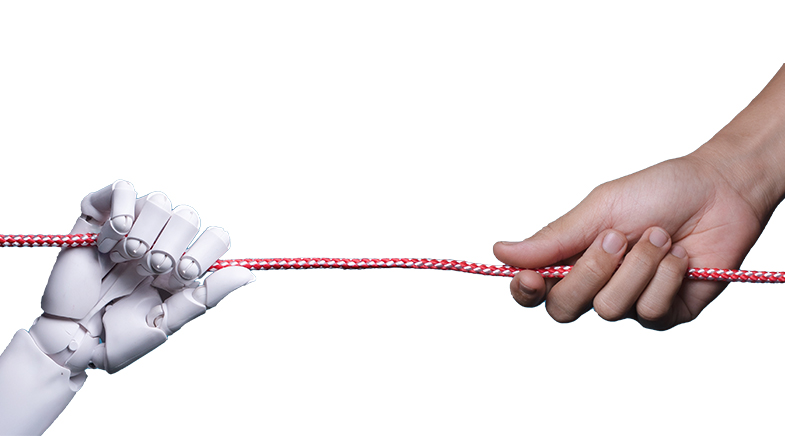
A global movement is challenging Big Tech's frenetic embrace of AI.
Marion Meyers was 17 when she discovered the crafting aspects of coding. It prompted her to study machine learning, data science and programming. "But very early on, I struggled with finding a sense of purpose in it," says the artificial intelligence (AI) researcher. When she was in her twenties, she felt that her education focused heavily on building technological solutions, but not enough on understanding their social implications. Increasingly concerned about the environmental and labour costs of the AI she was building, she pivoted to study tech policy and AI safety instead.
"There is a strong narrative that the AI train is unstoppable and there is nothing anyone can do," she says. Instead of popularising the many different types of intelligence and machine learning, AI is being put into one box, she believes. "Right now, the AI industry is pushing a very specific model of scale-at-all-costs machine learning built on massive data extraction," she says. Meyers wanted to fight against this model. She began freelancing for We and AI, a U.K.-based non-profit that seeks to promote critical AI literacy to increase public say in how the technology is built.
Some seek to restructure humanity's perspective of AI; reclaim AI technologies and build them to benefit workers, life, people, and society.
In May 2026, Meyers helped bring out a global database called The AI Resist List. Led by Karen Hao, author of Empire of AI, the list is a public platform of communities across the world pushing back against the monopoly of big AI companies. "We wanted to centre and show how wide the resistance already is," Meyers says. The list includes communities such as the Data Labelers Association from Kenya, which advocates fair treatment and better working conditions for data annotators. "Resistance often comes through grassroots movements. It doesn't have to be only through big campaigns that are highly funded," says Meyers.
MANY FACES OF RESISTANCE
The loudest voices against AI so far have been directed at data centre expansions, and often act as the face of resistance. In India, citizen groups concerned about water and power deficits have held protests, primarily in Mumbai and Visakhapatnam, where gigascale data centres by Amazon and Google/Adani, respectively, have been proposed. But data centres and their ecological consequences are just a part of the problem, according to Meyers.
Resistance, for instance, also aims at helping people move away from Silicon Valley's Big Tech and offering alternatives. Sovereign initiatives from countries such as India, China, South Africa, and Japan are pushing for indigenous models that do not depend on U.S. models. Another form of resistance offers legal assistance when personal data is infringed upon.
Yet another group documents instances of AI failures. In January 2026, when Microsoft CEO Satya Nadella urged the tech community to stop calling AI output "slop", there was a huge backlash, giving rise to the platform 'Microslop'. People began tracking and documenting how AI-generated content was corrupting user experience.
Discussions about AI literacy often revolve around how to use the technology, Meyers points out. She calls for the effort to be redirected towards highlighting what happens behind the scenes when someone interacts with a chatbot: the work that goes into making that interaction possible, and its implications. "If people were better able to connect their personal experiences with AI to the larger structures of power involved, they would have a better understanding of when to use it, what to use it for, and what considerations to make," she says. "It's not necessarily about refusing AI altogether."
OVER TO THE OTHER SIDE
Some of AI's biggest detractors today are researchers and engineers building those very systems. Tech workers globally are forming platforms such as WorkersDecide.tech demanding that employers consider their input before rolling out AI policies. WorkersDecide is supported by the international Tech Workers Coalition (TWC), which recently helped crowdfunding company Kickstarter's employees contractually protect themselves from being replaced by generative AI.
Berlin-based TWC member Simone Robutti stresses that companies across the software industry are pushing to adopt AI in their workflows, regardless of the quality of the output. "Managers see benefits in productivity in some short-term, small tasks, and then they generalise it to everything," Robutti says. "And despite poor output, workers pretend they are actually using AI to satisfy the management." He adds that managers are incentivised to adopt AI because investor money is being pumped into automating cognitive work that replaces workers.
AI pioneers Yoshua Bengio and Geoffrey Hinton have repeatedly warned of unchecked, hyper-intelligent systems that could pose existential risks to humanity. Concern over AI safety is one of the reasons behind multiple high-profile exits from companies such as OpenAI and Anthropic. Among those who resigned was Daniel Kokotajlo, who left OpenAI in 2024 to start the AI Futures Project.
In July 2026, Kokotajlo, along with Eli Lifland of AI Digest, Thomas Larsen of the Centre for AI Policy, and other researchers, drafted AI 2040. It looks at how, if governments and Big Tech companies work together, the arrival of general superintelligence can be delayed until 2040 to give humanity time to solve safety and alignment issues.
PUTTING A PIN ON AI
The idea of pausing AI developments until governments agreed on how to regulate them first took hold in 2023. The non-profit organisation Future of Life Institute, headquartered in the U.S., published a letter, signed by over 30,000 AI researchers, asking for a "pause" in all giant AI experiments. Around the same time, Utrecht-based engineer Joep Meindertsma began coordinating online with people interested in an international pause on the development of the most powerful AI systems. The online group eventually turned into PauseAI, a grassroots movement with chapters in 15 countries. Its volunteers organise conferences on citizen lobbying, raising funds and getting local organisations off the ground.
"AI is becoming an extremely centralised form of power, and people are resisting that," says Matilda da Rui, Head of Strategy at PauseAI. "I've long been influenced by the idea that technology is not neutral by default. It is developed by those with resources and power, and it can reinforce existing concentrations of power," she adds.

Acknowledging that AI technology can also improve medical processes, assist scientific discoveries, and ease drudgery, Rui underlines that the platform is not completely against AI. Instead, it is trying to prevent the development and deployment of highly capable general-purpose AI systems until they can be safely controlled. "Once control is lost, it may not be possible to regain it," she says. "Markets are very good at generating innovation, but they're not designed to ensure that innovation serves the public interest."
Detractors of PauseAI dismiss concerns of existential risk from AI as paranoia, claiming that the platform's supporters are adding to AI hype by exaggerating its implications. Rui, however, argues that "catastrophic risks" can already be seen by the use of AI in critical infrastructure such as defence, where malfunction could have severe consequences. A bigger concern, she adds, is the gradual disempowerment that happens as people lose their jobs to AI. "People often talk about AI creating a future where everyone receives a universal basic income. But if citizens no longer play meaningful economic roles, I worry they may also lose their political influence," she says.
For people such as Meyers and Robutti, the key is to restructure humanity's perspective of AI. They want to reclaim AI technologies and build them differently — to benefit workers, life, people, and society. Meyers hopes to nurture a vision of technology that is local, community-focused, and aimed at solving real problems rather than creating technological solutions for problems that don't yet exist. "We are not techno-pessimistic," says Robutti. "But we believe technology should be built with democratic accountability, where it does not just benefit a small number of people financially," he says.
See also:









Rest in pieces
The study of fragments is vital for industry and for everyday health and safety.


This glass may be scratch-proof
A graphene oxide-based coating promises to make glass scratch-resistant.




Have a
story idea?
Tell us.
Do you have a recent research paper or an idea for a science/technology-themed article that you'd like to tell us about?
GET IN TOUCH