

Rest in pieces
-
- from Shaastra :: vol 05 issue 01 :: Jan 2026
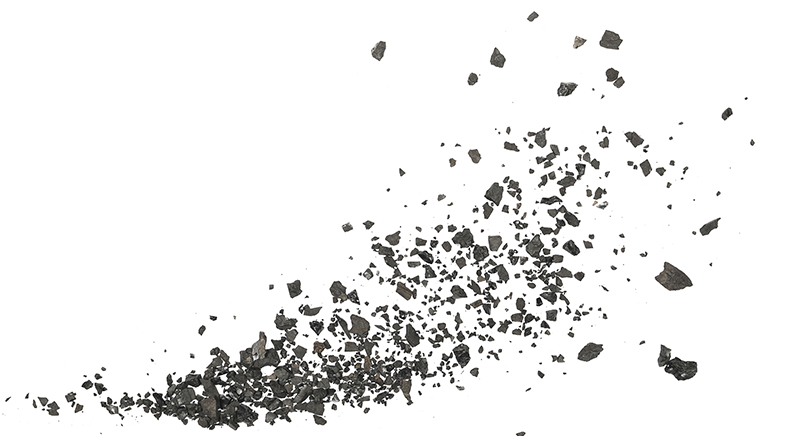
The study of fragments is vital for industry and for everyday health and safety.
It had been drizzling since the morning. Saptarshi Basu recalls how, as a PhD student at the University of Connecticut over 20 years ago, he sat at a window, mesmerised by the rain. He observed how the raindrops broke apart on impact: a drop spread, formed a crown, ejected tiny droplets, then retracted, and sometimes even lifted off the surface. Why did the droplets break the way they did, Basu wondered. The question led him to follow the science behind his observations. Now a Professor of Mechanical Engineering at the Indian Institute of Science (IISc) in Bengaluru, he studies the fragmentation patterns of liquids in his laboratory, using a high-speed camera.
Researchers worldwide have been delving into the patterns of fragmentation. Although the science is complex, it has a range of applications. The same rules of physics — stress, instability, and energy release — govern how things break, from a raindrop splashing on a counter to plastic crumbling in the ocean to a meteoroid exploding. "No matter the scale, whether it's a droplet in a kitchen sink or one inside a gas turbine or a hypersonic system, the basic idea is that droplets have to fragment," explains Basu.
PAST ISSUES - Free to Read









Tech tools to fight deepfakes
Tools to detect doctored media are being designed and honed, as companies and researchers battle deepfakes.

Enzymes and energy
Researchers are looking at cheaper power, better drug delivery, and breaking down plastic on an industrial scale.
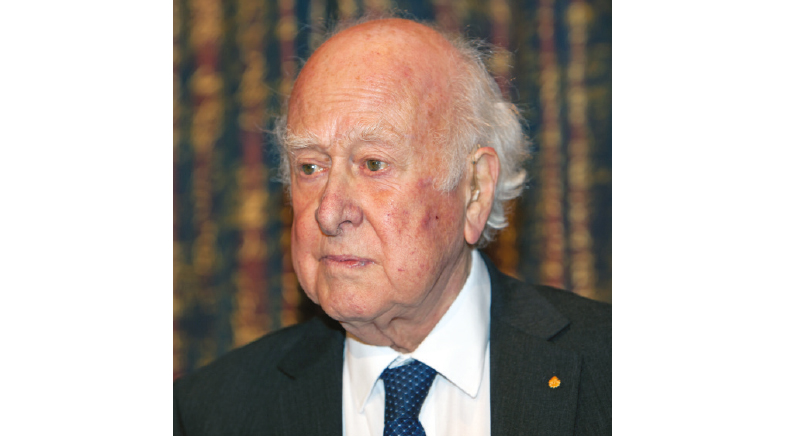
Peter Higgs (1929-2024): a classic and classical scientist
Peter Higgs gave humanity a 'jewel in the crown of knowledge'.



Have a
story idea?
Tell us.
Do you have a recent research paper or an idea for a science/technology-themed article that you'd like to tell us about?
GET IN TOUCH