

Sizing up
-
- from Shaastra :: vol 05 issue 07 :: Jul 2026
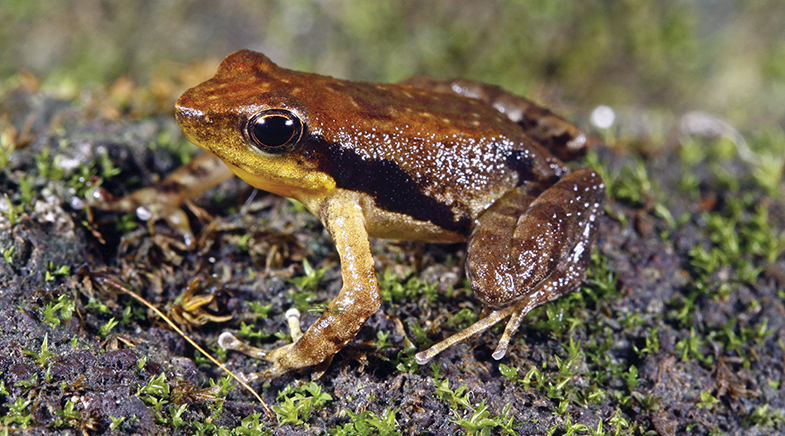
The secret to successful frog societies: size.
Frogs come in all sizes — from tiny ones the size of a fingernail to massive creatures bigger than the iPhone Pro Max. A frog's size confers certain advantages for the survival of its species. Smaller species, for instance, can avoid predators by hiding in leaf litter; the larger ones can hunt big prey. This size variation may have allowed multiple frog species to coexist in the aquatic habitats of the Western Ghats, according to new research.
India has a rich diversity of 68 genera of frogs and toads. Of these, 31 are found in the Western Ghats, whose peaks and valleys, rivers and streams have played a role in the evolution of an enormous diversity of frogs — many of which are found nowhere else. The Ghats are notably home to the endemic and wrinkle-skinned ‘night frog' genus Nyctibatrachus, which has 36 species described to date and several potential new lineages.
On a field trip to the Western Ghats about 20 years ago, ecologist Kartik Shanker first noticed that the Nyctibatrachus species of various sizes coexisted in stream habitats. "I started noticing this pattern of a medium-sized species, a large one and a small one," he says. Several years later, he observed a similar pattern in another genus, Micrixalus — popularly known as the ‘dancing frogs' because they wave their legs to woo mates and ward off rivals. The only big difference, says Shanker, is that, with Nyctibatrachus, four or five species of different size classes can be found in one location, whereas, with Micrixalus, there's just a bigger and a smaller species. Shanker and his colleagues set out to determine if the size assortment occurred by chance.
Rather than chance, there was competition at play, it turns out.
In addition to body size, the team collected fine-scale data on the distribution of frogs, and conducted genetic analysis.
The researchers hypothesised the various mechanisms that could have shaped these frog communities, including character displacement and ecological species sorting. When closely related species found in the same location diverge in characters such as size to minimise competition, it is called character displacement. "Ecological species sorting is when size differentiation has already happened across lineages, but they're now sorting themselves in space so that similar-sized species aren't in the same place," explains Shanker, Professor at the Centre for Ecological Sciences, Indian Institute of Science, Bengaluru. Here, competition allows only differentiated species to coexist.
The study, published in the journal Evolution in June 2026 (bit.ly/frog-size), found evidence of competition-driven species sorting having shaped the stream-adapted communities of Nyctibatrachus and Micrixalus.
While the researchers found size diversification in a third aquatic genus, Hylarana — the stream-dwelling group was larger than the pond-dwelling group — the size difference wasn't significant within communities. "Along with the size diversification, there's also been a clear habitat separation," says Shanker. The coexistence, as a result, has not come into play in this genus.
The study included 34 species of Nyctibatrachus, 24 species of Micrixalus and 10 species of Hylarana along with new lineages. In addition to body size, the team collected fine-scale data on the distribution of frogs and conducted DNA analyses.
For Nyctibatrachus, the genus with the most species of the three, size differentiation reflects the microhabitat its species occupy within a stream. The largest frogs are found in the fastest-flowing parts of the stream with heavy flow and large rocks; medium-sized frogs occupy shallow water; and the small and tiny species are found in leaf litter on the edge — meaning reduced competition for precious resources such as egg-laying sites and food.








Of mice and humans
Researchers are inventing novel ways to test drugs — and that's good news for patients, as well as lab rats and guinea pigs.

The quantum paradox
Hopes of a new era of computing are tempered by an existential threat to critical encryption.

Work from anywhere
The remote work revolution has forced leaders to embrace technology, and discover new ways of working.



Have a
story idea?
Tell us.
Do you have a recent research paper or an idea for a science/technology-themed article that you'd like to tell us about?
GET IN TOUCH