

Test the waters
-
- from Shaastra :: vol 05 issue 02 :: Feb 2026
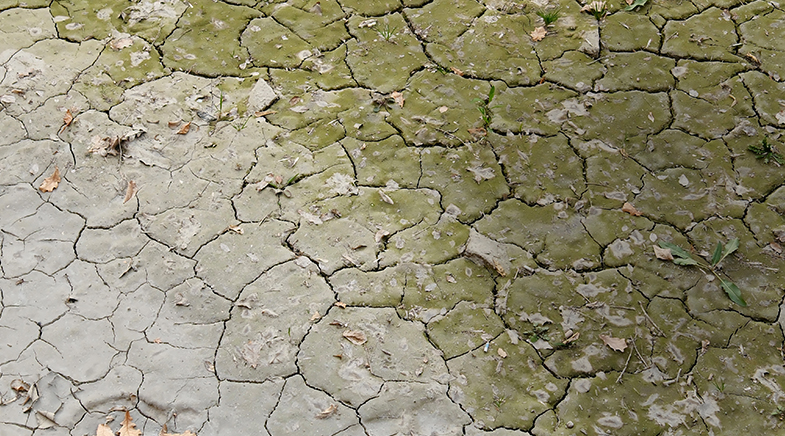
Safe and eco-friendly technologies are giving contaminated water a thorough rinse.
Sirshendu De cannot forget the villagers who stood before him, their palms scarred with raindrop-like pigmentation marks. Some had developed warts; others still had oozing sores. This was in 2012, and De, a chemist at the Indian Institute of Technology (IIT) Kharagpur, was on a field visit to Murshidabad district in West Bengal along with a team from his institute. The team realised that arsenic contamination in the villagers' drinking water had led to arsenicosis, which caused severe skin lesions and even cancer. "That incident stayed with me and strengthened my resolve to ensure that my research makes a real difference to people's lives," De recalls.
Arsenic is a naturally occurring element found in rocks and soil that can dissolve into groundwater under specific geological and environmental conditions. It becomes toxic when chemical reactions and human activities release it into the soil and water, allowing it to accumulate and enter the food chain. Arsenic contamination is a grave problem in many Indian States, including Assam, Andhra Pradesh, Gujarat, Rajasthan, Telangana, and West Bengal, underscoring the need to prioritise safe drinking water.
After use, the laterite material can be disposed of without the risk of arsenic leaking back into the soil.
New research developments have been transferred to industries for a mass deployment of technologies that remove arsenic and other toxic elements from drinking water. Researchers are now scaling up technologies and offering affordable solutions, including to those living in rural areas. New technologies not only remove arsenic but also eliminate other harmful elements such as fluoride and chromium.
De's IIT group has developed a suite of low-cost, scalable technologies to tackle critical water contamination and treatment challenges in India. One of its most widely deployed innovations is a treated laterite-based arsenic-removal technology. Fitted with a naturally available material that is rich in iron and aluminium, the filter can remove large amounts of arsenic from water, along with harmful microbes. It works well across different water conditions (such as variations in mineral content, acidity and arsenic levels), needs no electricity for household use, and can last three to five years. After use, the material can be safely disposed of without the risk of toxic leakage.
The technology has been approved by the West Bengal government's Arsenic Task Force and the Central government-instituted Mashelkar Committee. It has been deployed across 450 community-scale plants and 85 domestic units in eastern India, supplying arsenic-free drinking water to 9 lakh people at a cost of about 1 paisa per litre.
For decades, arsenic contamination in groundwater has been a matter of grave concern. "In fertile alluvial regions, intensive agriculture, phosphate fertilisers, and high microbial activity together trigger arsenic mobilisation into groundwater," De explains.
TURNING TO NATURE
Nature has its own solution to the problem. De refers to the absence of arsenic contamination in the South-Western districts of West Bengal. The districts are known for their red or laterite soil, rich in iron and aluminium oxides. These minerals naturally adsorb arsenic, providing what he described as a "natural shield" and the "first layer of protection" offered by nature. "We decided to mimic this natural protection mechanism," he says.
After treating natural laterite with simple chemical processes, the researchers developed a patented material that removes about 47 milligrams of arsenic per gram of water, performing better than activated alumina, a commonly used but costly synthetic material. The filter can efficiently remove the two major forms of arsenic found in groundwater, and performs better than any other natural material reported so far.
Climate change has led to a spike in arsenic contamination. Erratic rainfall patterns reduce groundwater recharge, causing water tables to fall and dissolved mineral concentrations, including arsenic, to rise. As a result, arsenic levels in many regions now exceed the World Health Organization-prescribed safe limit of 10 micrograms per litre of water.
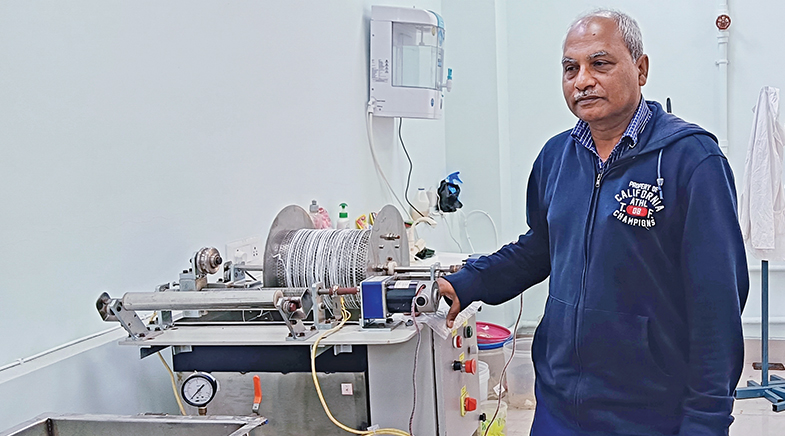
An essential advantage of treated laterite is its granular form, which allows water to flow easily through the filter without causing a significant pressure drop. After use, the material can be disposed of and even reused for road construction without the risk of arsenic leaking back into the soil.
De's group conducted laboratory experiments to understand how factors such as arsenic concentration, water flow rate, filter height, and the presence of other ions affected performance. The studies helped them develop a model that explains how arsenic is captured over time and predicts how long a filter will last. Using this understanding, the technology was scaled up into practical filter systems for households (using 100 litres of water a day) and communities (2 cubic metres per hour). "Technology alone is not enough: awareness, industry participation, and policy support are equally crucial for a large-scale impact," he adds.
TECHNOLOGY TRANSFER
Scaling up required moving beyond academic research and into industry. In 2015, De transferred his arsenic removal technology to Vas Bros. Enterprises, a start-up founded by IIT Kharagpur alumnus Saket Kumar. Kumar, who studied mathematics and computing, developed an interest in a nature-based economy that invests in healthy ecosystems and decided to focus on safe drinking water. "Water is the basis of ecology, so it is the basis of the economy," Kumar says.

Drawing from De's work on laterite-based adsorption and scalable filtration systems, the start-up uses an Oxide Absorption System (OAS) technology to effectively remove arsenic (III) and arsenic (V) from drinking water. It has installed around 50 community-scale arsenic removal filters in many areas of Bihar, Jharkhand and West Bengal. The filter uses a specially treated adsorbent medium derived from naturally occurring materials, a result of years of laboratory research and field testing. They operate without electricity, require minimal maintenance, and do not need regeneration or backwashing during their working life. Even when the incoming water contains high levels of arsenic, the OAS filter consistently reduces concentrations to within the WHO-prescribed safe limit. Two other companies — Mondal Precision and Technoquips Separation — are also producing arsenic removal filters based on De's research. Mondal Precision has installed more than 550 filters.
NOT JUST ARSENIC
Arsenic, however, is only one of the many toxic contaminants in India's groundwater. In many regions, communities have to deal with multiple contaminants, such as fluoride and chromium, in their drinking water. In 2022, De's group developed a fluoride-removal technology using aluminium-substituted hydroxyapatite carbon. With a fluoride adsorption capacity of 105 milligrams per gram of water, the filter also removes bacteria and operates without external power for domestic use.
Depending on the fluoride concentration, the filter lasts from six months to two years, and the spent material can be reused as fuel. Approved by the Fluoride Task Force of West Bengal, the technology has been deployed in community and domestic settings in Purulia and Bankura districts, providing safe drinking water to about 1 lakh people at a cost of roughly 1.3 paise per litre. Mondal Precision installed 32 community-scale fluoride removal filters. Technoquips has installed two community and 20 domestic-scale fluoride removal filters, and 35 community-scale iron and bacteria removal filters.
Tezpur University-based chemist Robin Dutta has been working on water safety for many years. Dutta and his group remove toxic chromium from groundwater in a safe, affordable, and environmentally friendly way. In a 2025 paper (bit.ly/Fluoride-removal), the group flags a simple treatment method in which iron and phosphoric acid are first added to water to convert chromium into forms that can be easily removed. The water is then passed through a crushed limestone filter that traps chromium and fluoride. The system removes about 99.5% of these contaminants. Laboratory tests show that the limestone filter works consistently over time without needing replacement or maintenance. The method is low-cost, easy to operate, and can clean water for ₹6-7 per cubic metre, making it suitable for large-scale use in affected regions.
De recalls how moved he was when villagers from Bagdah in the North 24 Parganas district expressed their gratitude to the IIT team for installing filters in their homes. When Cyclone Amphan wreaked havoc in 2020, the filters proved lifesaving, providing safe drinking water to the villagers when there was no electricity for an extended period. De's eyes turn moist as he recounts that. His research — as he had hoped — has indeed made a difference to people's lives.
See also:








All tanked up
A start-up is developing world-beating technology for the safe transport and storage of hydrogen.

Out of the box
Technology is helping researchers deal with microplastics.



Have a
story idea?
Tell us.
Do you have a recent research paper or an idea for a science/technology-themed article that you'd like to tell us about?
GET IN TOUCH