

On top of the world
-
- from Shaastra :: vol 05 issue 04 :: Apr 2026
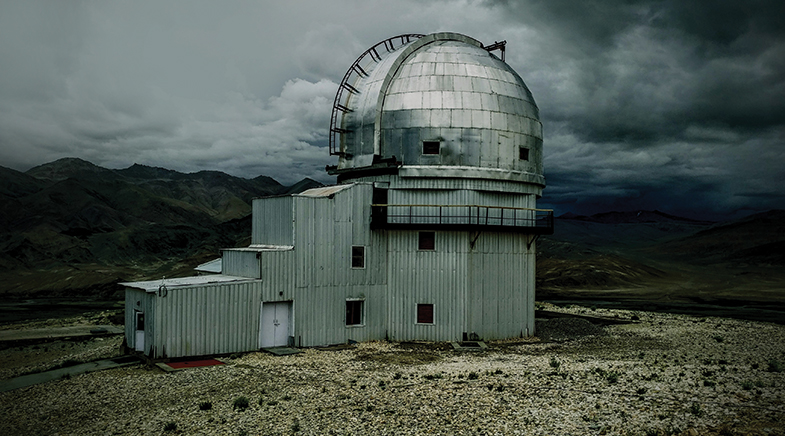
With the NLOT, Indian astronomy will open new windows to the universe.
In the cold desert of Ladakh, where the air is thin and the sky is exceptionally dark, an observatory at Hanle — a plateau perched at roughly half the height of Mount Everest — has watched the universe for a quarter century. The observatory's 2-metre Himalayan Chandra Telescope (HCT) has quietly gathered faint light from stars, exoplanets, and galaxies. Now, from this stark landscape, India is preparing a far more ambitious leap that could significantly expand its role in global astronomy.
Towards the end of February 2026, the government announced plans to support a larger, more powerful telescope, called the National Large Optical Telescope (NLOT), with a 10-metre mirror. The transition from the 2-metre HCT to a 10-metre-class telescope is a decisive shift in observational capabilities. Because a telescope's light-gathering power scales with the square of its mirror size, the NLOT will collect about 25 times as much light as the HCT, allowing astronomers to detect objects fainter than those currently visible from India and study them in far greater detail than possible now.
"In ten years, by the time the NLOT comes up, the (astronomical) landscape would have changed," says Annapurni Subramaniam, Director of the Bengaluru-based Indian Institute of Astrophysics (IIA), which set up the HCT and is leading the effort to establish the NLOT. A decade from now, she says, astronomers could be looking for specific molecules in the atmospheres of exoplanets, tracing how matter spirals into black holes or into the extremely luminous quasars that actively feed supermassive black holes at the centres of distant galaxies. The leap in mirror size will move astronomical capabilities from glimpsing the brighter parts of the universe to probing much fainter, most distant, and also short-lived phenomena.
With the new facility, astronomers could begin to examine the chemical composition of faraway galaxies and track the early evolution of cosmic explosions — tasks that, astronomers say, depend on capturing enough light to produce precise spectra.
Present-day astronomy is less the work of isolated observatories and more a set of complementary tasks shared across global networks of observation outposts. Survey-tasked telescopes such as the Vera Rubin Observatory in Chile scan the sky for transients — short-lived events such as exploding stars or colliding neutron stars. Other instruments follow up on detections, identifying their host galaxies and analysing their physical properties. The NLOT will help strengthen India's role in such networks, allowing it not just to observe events but to help characterise them.
The NLOT will open a big window for the study of transients, says Somak Raychaudhury, Vice-Chancellor of Ashoka University and former Director of the Inter-University Centre for Astronomy and Astrophysics, Pune.
The location of a telescope is as important as its size. Because the Earth rotates, no single observatory can continuously track a transient. Gaps in coverage can mean missing crucial phases. Telescopes distributed across longitudes are therefore essential. Positioned in India, the NLOT will fill a gap between comparable observatories in Europe and the U.S., enabling round-the-clock monitoring as night moves across the planet. This longitudinal advantage is particularly valuable for rapidly evolving phenomena, where changes might unfold over hours.
LOOKING AHEAD
The HCT, which saw first light in 2000 and can be operated remotely from the IIA Bengaluru campus, has become a workhorse of Indian astronomy. Yet, even at the time of its commissioning, it was clear that something larger would eventually be needed. The highest site in Hanle was left unoccupied in anticipation of a future telescope.

"The NLOT will (occupy) the highest site in the world (for a telescope) … And because it is above the clouds, you can do infrared astronomy, which you can't from the ground," says Raychaudhury. The NLOT is similar to the James Webb Space Telescope (JWST) of the National Aeronautics and Space Administration in its wavelength range — the near-infrared. "However, the JWST does not have to deal with atmospheric extinction and so can see much further and has better frequency coverage," he adds, explaining that while Ladakh is above many layers of clouds and moisture, it is still not as good as space.
The transition from the 2-metre HCT to a 10-metre class telescope is a decisive shift in observational capabilities.
The NLOT will occupy the long-reserved summit at nearly 16,000 feet above sea level. Even the darkest sky is far more transparent to near-infrared radiation than visible light in dusty regions, allowing astronomers to see through cosmic dust more effectively. The HCT can see newborn stars; the NLOT can go further.
Astronomers are already thinking about what such a facility could enable. According to Subramaniam, Indian astronomy has a good understanding of brighter objects that can be observed with smaller telescopes. She explains how the NLOT could help astronomers observe fainter objects and determine how elements are produced. "Hanle is one of the best sites in the world for astronomy," she says. It is operational throughout the year because it is above the monsoon clouds, and hence, there is no monsoon closure.
The NLOT will, however, differ from the HCT fundamentally in design. Instead of a single monolithic mirror, it will use a segmented primary mirror of 90 precisely aligned hexagonal segments arranged in concentric rings. This approach allows much larger apertures but requires constant adjustment to maintain alignment as the telescope moves. "This is disruptive (technology)," says Subramaniam. To gain expertise in this technology, astronomers plan an intermediate step: a 3.7-metre telescope with a segmented mirror to be constructed alongside the HCT. "The idea is to make another telescope next to the HCT, which, with its 3.7-metre, 7-segmented mirror, will be a pathfinder for the big one (the NLOT)."
RISE OF DOMESTIC INDUSTRIES
India is not starting from scratch. Its participation in the international Thirty Meter Telescope (TMT), a proposed project in Hawaii, has helped domestic industries gain expertise in developing mirror segments, actuators, and edge sensors that keep those segments aligned. Over the past decade, this effort has drawn in around 70 domestic industries. "About 15 of these are already qualified, and processes are ready," says Subramaniam, suggesting that the NLOT could draw on this expertise and become largely a home-grown telescope.
Projects of this scale also demand new ways of thinking about funding. Engagement in large international collaborations such as the TMT, along with plans for a local gravitational wave detector, underscored the need for funding and execution mechanisms to support mega-science projects. "COVID-19 actually helped," says Raychaudhury, reflecting on how travel restrictions during the pandemic accelerated planning for a Mega Science Vision document for 2035 with the NLOT among its stated goals.
Even as plans for NLOT take shape, Ladakh is set to host another major astronomical facility — a National Large Solar Telescope (NLST) that could become operational earlier, in about five years. "The NLST has been our dream project for over a decade now," says Dipankar Banerjee, a solar physicist and Vice-Chancellor of the Indian Institute of Space Science and Technology in Kerala. Designed to study the Sun's magnetic field and its evolution, it will complement space-based missions such as Aditya-L1, launched in 2023, which observes the solar corona from a stable point between the Earth and the Sun.
"While coronal mass ejections are captured by Aditya-L1, it cannot see what causes these, how many active regions are there and what is the magnetic field strength... that is why we need a combination of ground-based and space-based observations," says Subramaniam. Subramaniam and Banerjee stress the geographical advantage of having a large solar telescope in India. "There are no facilities coming up in the Asian region; the next one is in Europe. The NLST has the double advantage of being high up in the mountains and next to the Pangong Lake," Banerjee says.
Together, these efforts point to a shift not just in scale, but in intent. Indian astronomy is moving from making use of available windows on the universe to helping open new ones. Through the new telescopes in Ladakh, astronomers could track the universe's most fleeting signals night after night, and the Sun's shifting antics by day.









Microbes vs methane
Researchers are employing methane-eating bacteria to deal with the menace of the potent greenhouse gas.

In choppy waters
Marine ecosystems are under threat from a variety of sources. New technologies and policies hold out hope.

The python, the godwit and you
The wondrous physiological adaptations that animals make demonstrate how nature's diversity works, and hold lessons for humans.



Have a
story idea?
Tell us.
Do you have a recent research paper or an idea for a science/technology-themed article that you'd like to tell us about?
GET IN TOUCH