

Touring with Turing
-
- from Shaastra :: vol 05 issue 02 :: Feb 2026
The mathematician's pattern theory ignites ideas in diverse fields.
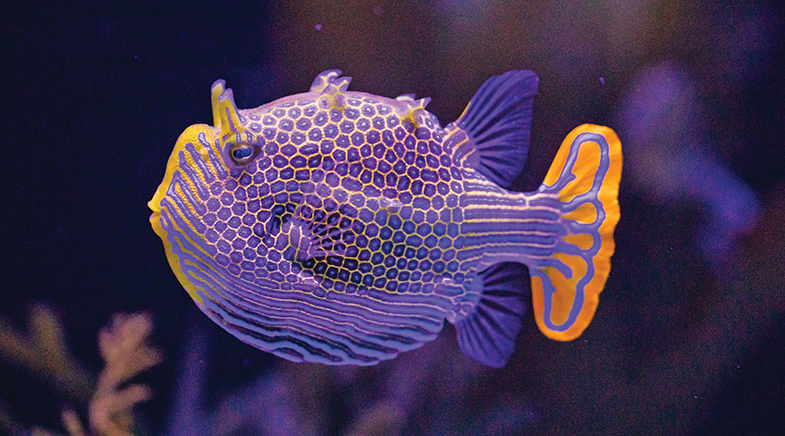
The dazzling colours of the male Ornate Boxfish at San Diego's Birch Aquarium caught the attention of PhD scholar Benjamin M. Alessio during a 2023 visit. Alessio, then a visiting researcher at the University of Colorado Boulder, shot off an email to Chemical and Biological Engineer Ankur Gupta at the university. The fish's purple, honeycomb-like hexagonal spots were strikingly similar to patterns in their lab's simulations — observed when two chemicals, present at different concentrations, interacted and spread. The two realised that they had serendipitously recreated a Turing pattern in their lab. "We were super excited," Gupta says.
A Turing pattern is a mathematical formulation of natural pattern formation proposed by British mathematician Alan Turing in a 1952 paper, exploring how living organisms form complex patterns such as zebra stripes, leopard spots, and the colourful designs of flower petals. Since then, researchers from diverse fields have been revisiting the formulation in search of answers to fundamental questions about the mechanisms of life. "Turing gave us a framework to understand the chemical basis of biological pattern formations... Over the past seven decades, many researchers have sought to explore different variations and effects in that framework to improve it and bring it closer to reality," says Gupta.
In living tissues, cells, protein clusters, or pigment-containing structures are not fixed in place, but can move in response to chemical differences.
Turing showed that patterns can emerge spontaneously when two chemicals interact and diffuse at different speeds. A uniform surface can break symmetry, leading to the emergence of nature's designs. Turing's theory is based on the reaction-diffusion process, which predicts the formation of clean, repeating patterns. But animal coats are often irregular: spots vary in size, stripes bend and break, and patterns change as an animal grows.
In their study published in Science Advances (bit.ly/Turing-pattern), Gupta and Alessio show that biological systems involve moving physical objects. In living tissues, cells, protein clusters, or pigment-containing structures are not fixed in place but can move in response to chemical differences through a process called diffusiophoresis, in which particles are pushed by surrounding chemicals. Reaction-diffusion creates chemical patterns, while diffusiophoresis causes particles to move in response to those patterns. Together, they help explain why natural patterns are complex and uneven rather than perfectly regular.
MICROSCOPIC PATTERNS
The paper drew a response from Beatrice Ramm, a biochemist at the Friedrich Miescher Laboratory, University of Tübingen. She contacted Gupta, suggesting that the computational results were well-suited for experimental testing. She said her own experimental work, published in Nature Physics in 2021, showed striking similarities to their computational findings. When Gupta, who was unaware of her paper, compared his team's simulations with her experimental data, they found strong qualitative agreement.
Ramm says she was fascinated by how just two proteins interacting on a membrane could produce dynamic, lifelike patterns that resembled those seen across nature. "I found it striking that such a simple set-up could look 'alive'... this fascination gradually turned into a deeper obsession."
In the 2021 study, her group reported a new transport mechanism inside cells. They studied a protein system called MinDE in the bacterium Escherichia coli. The MinDE proteins didn't just form patterns; they actively pushed and pulled other unrelated molecules along the membrane. The movement occurred through diffusiophoresis, as spreading particles pushed nearby particles. Larger particles felt this push more strongly, allowing patterns to separate molecules by size.
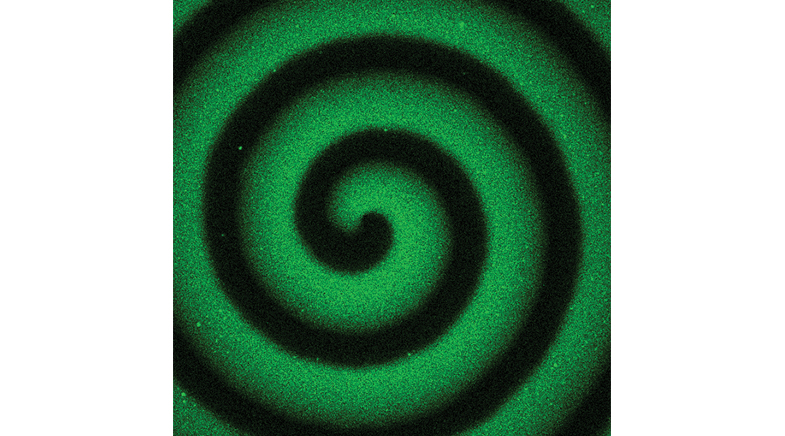
This transport system uses energy from adenosine triphosphate (ATP) but does not rely on special transport proteins. Instead, the self-organised MinDE patterns physically pull other molecules along as they form. This suggests that purely physical mechanisms play a bigger role in organising the insides of cells than previously thought. Such transport doesn't rely on specific interactions or motors, which means it may be common in simple cells and may have existed in early life.
Min proteins use energy to form waves and oscillating patterns on a membrane. Ramm's work established that Turing-like patterns didn't just mark space but could actively move material. Molecules attached to the membrane, even though they did not take part in making the pattern, were still pushed around by the MinDE protein patterns. Ramm explains that the molecules end up arranging themselves in opposite regions, making the patterns sharper and more distinct. "Understanding these processes could eventually help researchers engineer tissues and programmable materials by mimicking nature's organisational strategies," says Ramm.
HIDDEN MECHANISM
Closer to home, Subhabrata Maiti, a system chemist at the Mohali-based Indian Institute of Science Education and Research (IISER), has been exploring Turing reaction-diffusion ideas beyond visible patterns such as spots or stripes. His team demonstrates how the same ideas explain long-distance signalling in biology and can help create materials that communicate internally, much like living tissues. He gives the example of pain or discomfort, which can be felt far from its source due to chemical signalling and tissue diffusion. "Alan Turing's idea remains radical even today because of its extraordinary simplicity and ambition. This conceptual leap fundamentally changed how scientists think about pattern formation," Maiti says.
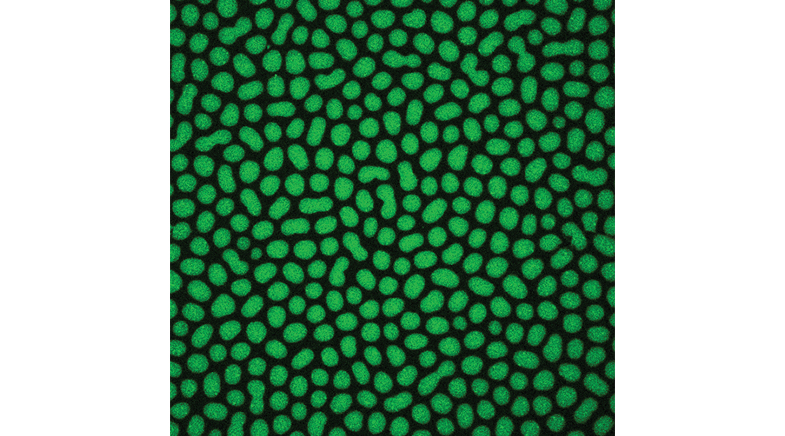
In a recent study (bit.ly/Reaction-distance), his team shows that adding chemicals to a spot can stop reactions nearby but spark responses at a distance. For this, the group designed a nanoparticle-infused hydrogel and used a "pro-activator" molecule that only became catalytically active after diffusing away from the point of introduction. ATP functioned as an inhibitor, while the diffusing molecule decomposed into catalytically active species away from the source. The reactions can start up to 4 mm away from where the chemicals were added, and both the distance and timing can be adjusted. Such hydrogels can better mimic the varying degrees of stiffness and signals found in real tissues. "The reaction-diffusion systems suggest a new way of thinking about computation in living systems," says Maiti.
In another study, chemist N. Sathyamurthy and his team at IISER Mohali show how the violet and white rings of a passion flower emerge by following a Turing-style model. The violet comes from anthocyanins, and the white from flavonols. As the flower blossoms, the two pigments compete to create its striking pattern.
BEAUTY OF IMPERFECTIONS
Turing patterns are stable, but nature prefers imperfections and instability. In a study published in Matter in January 2026 (bit.ly/Imperfect-pattern), Gupta and his research associate Siamak Mirfendereski show that imperfection is not a flaw but a natural outcome of how living tissues grow. Cells responding to chemical gradients don't just react and diffuse; they also move, crowd, collide, and compete for space. While the chemicals form Turing patterns, the cells respond to them and also interact with each other. This combination naturally creates patterns that look natural, with irregular shapes and sizes. Studying how imperfect patterns arise helps improve our understanding of how cells organise themselves and also points to new ways of designing smart materials and surfaces.
Studying imperfect patterns helps in a better understanding of how cells organise themselves and points to new ways of designing smart materials.
Mechanical Engineering researcher Sangwoo Shin at the University at Buffalo supports the idea of nature favouring imperfections. His group has demonstrated that inside living cells and developing tissues, chemicals are not distributed evenly. There are slight differences — a bit more salt here, a little less there — signalling there are more molecules in one region than another. Their study shows that such differences don't just send messages; they can physically move biological material. It also examines how molecular clusters can form in one place and move to where they are needed, guided simply by chemical gradients. At larger scales, it helps explain why animal patterns are uneven and irregular, and that such imperfections are natural and not flaws.
Shin believes that even without biological details, simple equations describing diffusion, reactions, and diffusiophoresis can produce the patterns seen in nature. Biology, he suggests, may be using these reliable physical rules. The so-called imperfections may arise from mutations or natural variation, but the patterns themselves are natural outcomes of physics, as small changes in conditions can lead to very different forms. Harnessing the 'physical intelligence' of patterning in nature may lead to responsive materials, chemical sensors, and microscale computing systems. Gupta thinks nature doesn't care about being perfect but has learned to be effective through evolution.









Get set for Dr Algo
The full transformative potential of AI in healthcare can be realised by adopting electronic health records.



Have a
story idea?
Tell us.
Do you have a recent research paper or an idea for a science/technology-themed article that you'd like to tell us about?
GET IN TOUCH