

Twin win
-
- from Shaastra :: vol 05 issue 10 :: Oct 2026
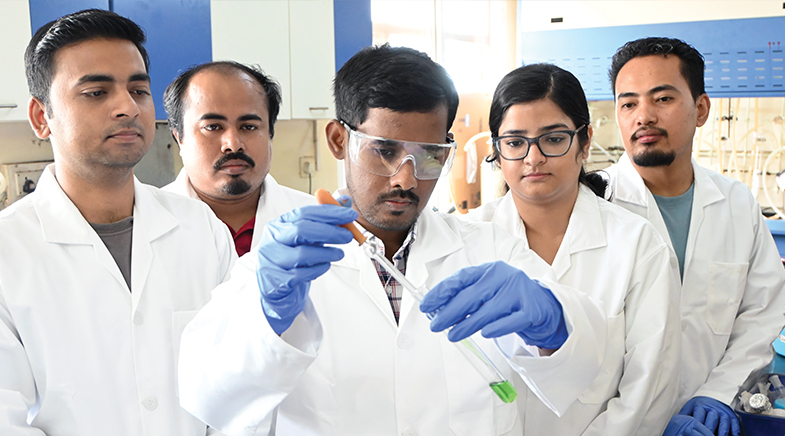
A catalyst converts toxic nitrite into useful ammonia.
A chemist at the University of Hyderabad has designed a molecular catalyst that does something nature has perfected over billions of years, but scientists have struggled to fully replicate in the lab: convert nitrite, a common and harmful water pollutant, into ammonia, a valuable industrial chemical.
In a precisely controlled, step-by-step process, a team led by Sujoy Rana built a nickel-based catalyst that functionally mimics cytochrome c nitrite reductase (CcNiR), an enzyme found in bacteria that performs the same transformation as part of the microbial nitrogen cycle. The team comprised collaborators from other institutions, including the Indian Institute of Science Education and Research (IISER) Kolkata and the University of North Bengal. The work was recently published in the Journal of the American Chemical Society (bit.ly/nitrite2ammonia).
The journey from nitrite to ammonia doesn’t happen in one leap. Nitrite passes through a sequence of short-lived, hard-to-detect intermediate molecules: nitric oxide, nitroxyl species, and hydroxylamine, before finally arriving at ammonia. Rana’s team generated and characterised each of these fleeting stops along the way, something no single molecular catalyst system had achieved so far. Rana points out that all these intermediaries are of biological, medicinal, and geochemical significance.
“Beyond demonstrating nitrite-to-ammonia conversion, our work provides a molecular-level understanding of how this transformation proceeds via biologically relevant intermediates. Overall, this study bridges the environmental chemistry, the biological nitrogen cycle, and the production of sustainable chemicals,” says Rana, who is at the University of Hyderabad on lien from the University of North Bengal. He adds that among the nitrite-reduced intermediates, pinning down the generation and characterisation of the nitroxyl/azanone species was the hardest. He explains that their chemical signatures were notoriously unstable.
The team’s earlier work with the same ligand system, in a different reaction, had hinted that this catalyst preferred to move electrons and protons one careful step at a time. “The slower reaction rate and the ability to carry out the reduction reaction via stepwise electron- and proton-transfer pathways led us to strongly believe that nitrite reduction can be achieved using this molecular nickel complex in a stepwise manner,” he says. That hunch turned into a systematic set of experiments under controlled chemical and electrochemical conditions.
Scientists elsewhere have tried iron, cobalt, and copper for the same work, with real scientific progress but persistent gaps. Rana says the recurring problem has been capturing the enzyme’s full intermediate sequence in one molecular system, as in nature. The nickel complex, built around a specially designed polypyridyl-quinoline ligand, solves that by letting the metal centre shuttle cleanly between two oxidation states, nickel(II) and nickel(I), as the reaction proceeds.
The ligand’s architecture, not the nickel alone, steered the chemistry to completion. When the team used a related nickel complex with ordinary pyridine donors instead of the quinoline-containing framework, the reaction stalled. “The quinoline-containing nickel complex was able to carry out the complete stepwise reduction of nitrite to ammonia, whereas the all-pyridine analogue produced only hydroxylamine,” Rana explains.
Pankaj Kumar Koli, Associate Professor of Chemistry at IISER Tirupati, who is not connected with the study, says the team has shown how ligand architecture can control the reaction pathway and product selectivity. “From an implementation perspective, however, the chemistry is still at the molecular-catalyst stage, and catalyst lifetime, turnover number, current density, energy efficiency, scalability, and performance in realistic nitrite-containing streams would need to be addressed before considering practical deployment,” he says.
Rana agrees that the method’s direct practical application is limited. “Although the molecular nickel catalyst demonstrates highly selective nitrite reduction to ammonia with high Faradaic efficiency, it exhibits a relatively low turnover number.”
The researchers have now developed a composite material by combining a molecular nickel catalyst with an electro-active solid support to enhance its catalytic efficiency, stability, recyclability, and ease of recovery. Rana hopes such a system will also be better-suited to real-world water-treatment applications.









On thin ice
A glaciologist flags the risks of Nepal-like natural disasters from Himalayan hanging glaciers.

Like greased lightning
The bandwidth capacity of a kilometre-long optical fibre cable can be increased 25 times, scientists say in a new study.

The push and pull of life
A rollicking account of the manifestations of force in our daily lives, which helps us understand how the physical world works.



Have a
story idea?
Tell us.
Do you have a recent research paper or an idea for a science/technology-themed article that you'd like to tell us about?
GET IN TOUCH

