

Working together
-
- from Shaastra :: vol 05 issue 11 :: Nov 2026
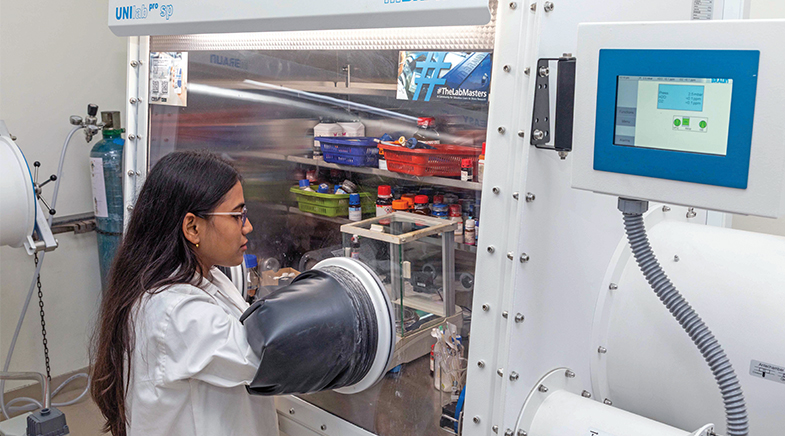
A breakthrough solution opens new possibilities for drug discovery and chemical synthesis.
Imagine changing a single brick in a finished wall without touching the rest. For organic chemists, who make and modify carbon-based molecules, that is an everyday challenge. A molecule has many bonds, and a useful reaction must pick out just one. In drug research, a small structural change can alter how a compound dissolves, behaves in the body, or binds its target.
Chemists at the Indian Institute of Science Education and Research (IISER) Pune may have solved a long-standing version of this puzzle. The team, led by Buddhadeb Chattopadhyay, an Associate Professor of Chemistry, has found a way to modify the far end of an aromatic carboxylic acid, a molecule commonly found in medicines, without disguising its acid group. Aromatic carboxylic acids pair a flat ring of carbon atoms with an acid group. The motif appears in medicines such as ibuprofen, naproxen, and mefenamic acid, and chemists can convert it into esters, amides and other groups.
The problem is that the acid tends to interfere with the metal catalysts used for such reactions. For their experiments, the IISER team used benzoic acid, a simple form of aromatic carboxylic acid, which has a flat ring of six carbon atoms and an attached acid group (—COOH). This building block appears in many drugs, such as the diabetes drug repaglinide and probenecid, prescribed for gout and high levels of uric acid.
PAST ISSUES - Free to Read





'We've neglected biology's capacity to solve problems'
Dr Tobias Erb on why he believes synthetic biology is a revolutionary technology.

Testing the waters
Companies are gauging how deep the AI waters are before they dive in.



Have a
story idea?
Tell us.
Do you have a recent research paper or an idea for a science/technology-themed article that you'd like to tell us about?
GET IN TOUCH