

It is rocket science
-
- from Shaastra :: vol 05 issue 06 :: Jun 2026
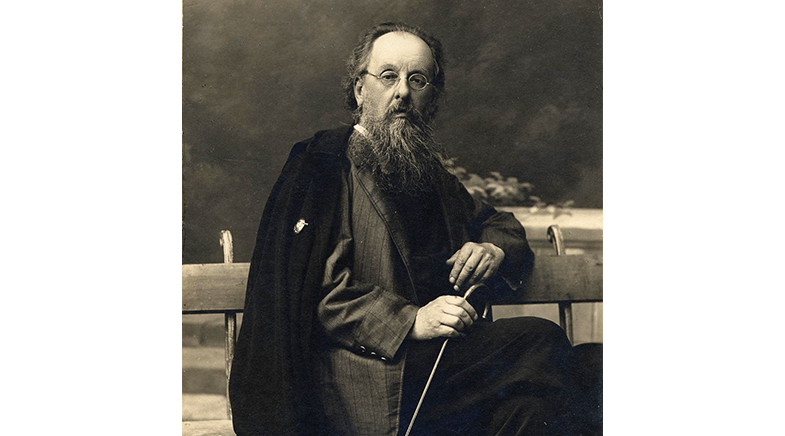
A self-taught schoolmaster seeded and boosted Soviet spaceflight.
Months before the Wright brothers' historic flight in December 1903, a reclusive Russian schoolteacher was laying the groundwork for sending humans into space.
Living in the remote town of Kaluga, about 200 km southwest of Moscow, Konstantin Tsiolkovsky had limited formal education. He had left school in his teens after losing his hearing following a bout of scarlet fever, and had picked up whatever scientific knowledge he could from spending time in a Moscow public library. His first scientific contribution was a paper on the kinetic theory of gases, but when he sent it for publication, he learnt that the idea had already been published years earlier. Undeterred, he turned his attention to aeronautics.
GOING UP
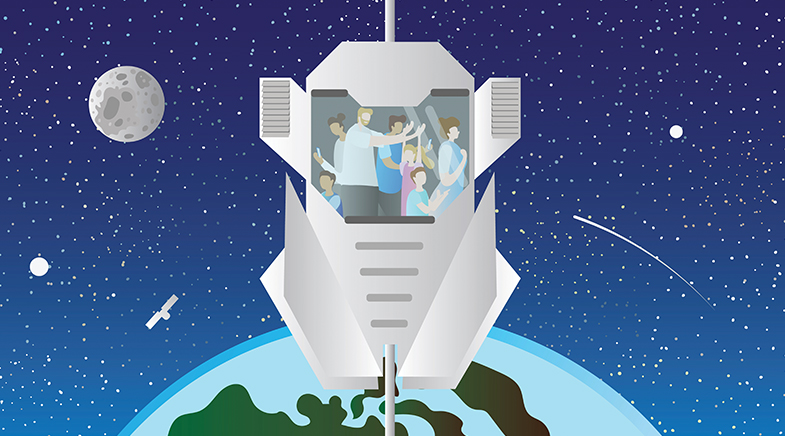
In 1895, inspired by the Eiffel Tower, Tsiolkovsky proposed a "space elevator" — a massive cable anchored near the equator and extending into outer space. He envisioned travelling along it, ferrying people and cargo between Earth and a space station. Scientists have explored the concept for over a century, but have met with no success (bit.ly/Elevator-Space).
In 1892, he accepted a maths teaching position at Kaluga and spent his spare time exploring aircraft design. He built several models, including a metal dirigible, as well as one of Russia's first wind tunnels — funded by his own savings — to test the effects of friction and airspeed on different kinds of aircraft.
INSIGHTS IGNORED
While Tsiolkovsky worked in obscurity, German scientist Hermann Oberth's ideas on rocketry sparked excitement across Russia, fuelled by extensive media coverage. Furious that Russians were ignoring his own earlier contributions (bit.ly/Space-Fad), Tsiolkovsky republished his older writings in 1924 to remind them that his ideas on space travel had predated Oberth's by two decades.

Tsiolkovsky, however, had his sights set even higher. Inspired by the works of Jules Verne, he dreamed of space travel and of humans living on other planets. In May 1903, he published an equation — later named after him — that described how much change in velocity a rocket could achieve, based on the speed of its exhaust gases and the ratio of its initial to final mass after burning fuel (bit.ly/Rocket-Equation). He calculated that a rocket would need a velocity of 8,000 m/s to reach a stable orbit around Earth. He said high-energy fuels, such as liquid hydrogen and liquid oxygen, could provide enough power to accelerate a rocket to that speed.
Tsiolkovsky didn't stop there; he also came up with designs for solar-powered space stations, airlocks, spacesuits, and life-support systems — all decades before spaceflight became a reality. His notions extended to the realm of science fiction (bit.ly/Fiction-Space); through stories, he explored the idea of astronauts experiencing weightlessness on the Moon, and of humans colonising space, believing that this would make the world more egalitarian.
Because he lacked formal education and connections, Tsiolkovsky initially struggled to gain his peers' attention and almost gave up on aeronautics. But his work was noticed and publicised by the new Soviet government, keen to promote its post-Tsarist agenda, and he became famous almost overnight. His ideas strongly inspired later engineers and helped shape the Soviet space programme.
In 1919, amidst the paranoia of the Russian Civil War, the secret police arrested Tsiolkovsky on suspicion of being a spy and imprisoned him for several weeks. He was released after a high-ranking official intervened, realising that the scientist posed no political threat. He returned to Kaluga, where he lived on a state pension until his death in 1935 at the age of 78.
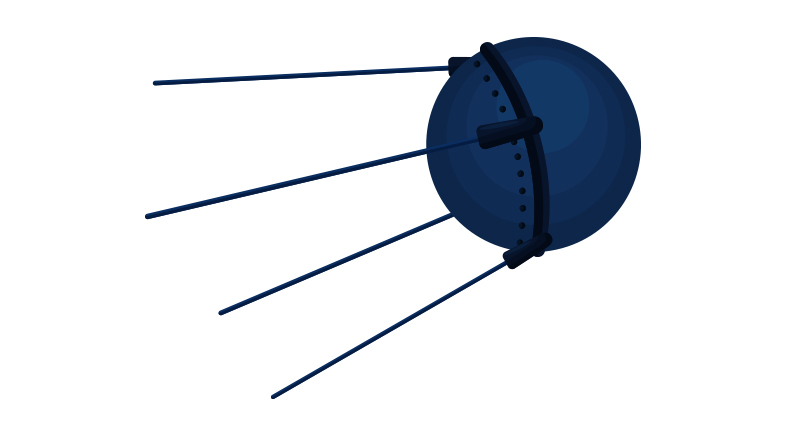
In 1957 — the year he would have turned 100 — the Soviet Union launched Sputnik, the first man-made satellite, kick-starting humanity's journey into outer space — just as Tsiolkovsky had imagined.








Innovate or perish
A provocative thesis on what drives – and stalls – technological innovation and growth.
A sound finding
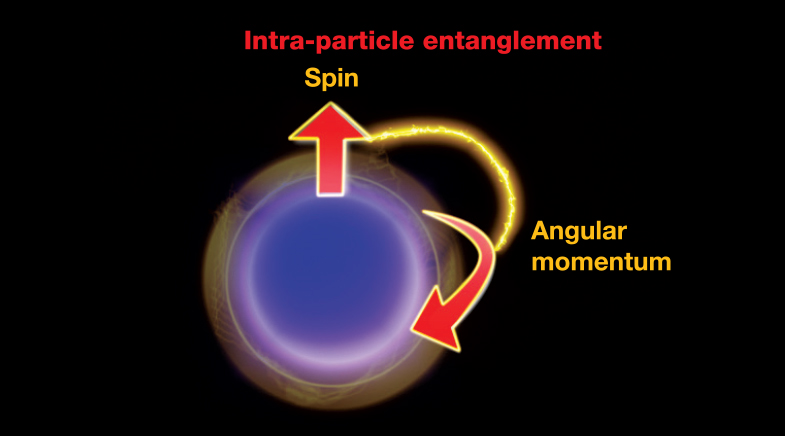
Working during the COVID years on the theory of how a quantum particle interacts with noise yields surprises for RRI researchers.

All set for Ocean 6,000
India's first aquanauts test the waters for an Indian Ocean mission.



Have a
story idea?
Tell us.
Do you have a recent research paper or an idea for a science/technology-themed article that you'd like to tell us about?
GET IN TOUCH