

More with less
-
- from Shaastra :: vol 05 issue 10 :: Oct 2026
American architect ‘Bucky’ Fuller built designs to benefit humanity.
Buckminster Fuller Jr. was dealt devastating blows in the 1920s. The American architect's daughter, Alexandra, died of polio and spinal meningitis in 1922, a death for which he blamed, at least partially, their draughty house in Chicago. The construction company he ran with his father-in-law failed, and he was fired from the post of president. Despondent, Fuller contemplated drowning himself in Lake Michigan. But he was stopped — Fuller recounts this instance often — by a voice that told him to apply himself to "converting" his experience "to the highest advantage of others".
After two years of self-imposed isolation following the epiphany, Fuller embarked on a "great experiment" to develop sustainable housing and transportation designs to benefit humanity. He developed futuristic prototypes, including a modular "dymaxion" house that could be airlifted; a large, three-wheeled car that could run on much less fuel; and a dome inspired by the compound eye of a fly, with openings for light, ventilation, and water circulation. His designs embodied his philosophy: "doing more with less".
As a child, "Bucky" Fuller had been rebellious, but also curious: he made designs with whatever materials he found. He was kicked out of Harvard twice, once for partying, and later for "lacking ambition". As punishment, his family sent him off to work in a Canadian textile mill, and later to the meat-packing industry. He worked briefly as a radio operator in the U.S. Navy.
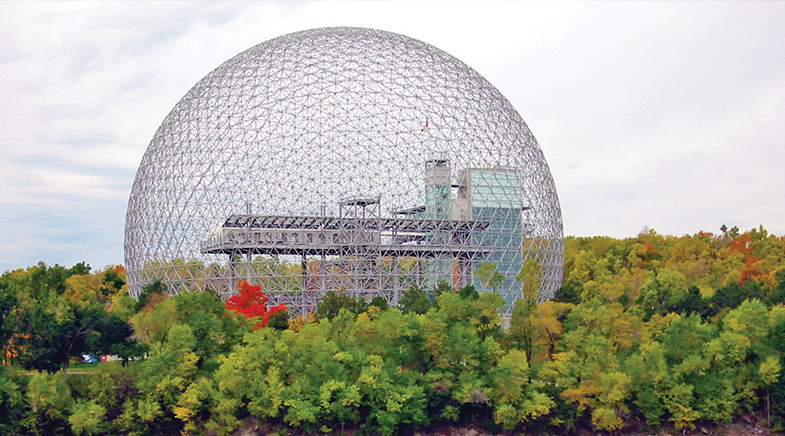
Fuller taught at Black Mountain College in North Carolina in the late 1940s. He came up with the design that made him most famous here: the geodesic dome, a lightweight, rounded structure made from a network of triangles. While heavy materials were not used, geometric principles were employed to distribute forces evenly and keep the structure strong. As a test, Fuller even made a couple of students suspend themselves from the frame. With the right materials, it also provided natural temperature control; geodesic aluminium domes installed in Ghana, for instance, were found to be cool even in scorching summer. After an initial lukewarm response, the design took off; the U.S. Marine Corps even used it to build Arctic radar stations.

Fuller also became famous for his theories on geometry as well as optimistic concepts like "Spaceship Earth", which imagined humans as co-passengers on a spacecraft where resources had to be shared equitably. For most of his life, Fuller remained optimistic that technology could help humanity create a better world where everyone experienced a high standard of living without depleting the planet's resources.
In 1985, two years after Fuller's death, researchers at Rice University vaporised graphite with a laser and discovered a remarkably stable molecule made up of 60 carbon atoms. Its hollow, soccer ball-like structure resembled Fuller's geodesic dome. They named it "buckminsterfullerene" (more commonly known as "buckyball") in honour of the futuristic designer.
Ranjini Raghunath is a Bengaluru-based science writer and editor.
DESIGN CREDIT
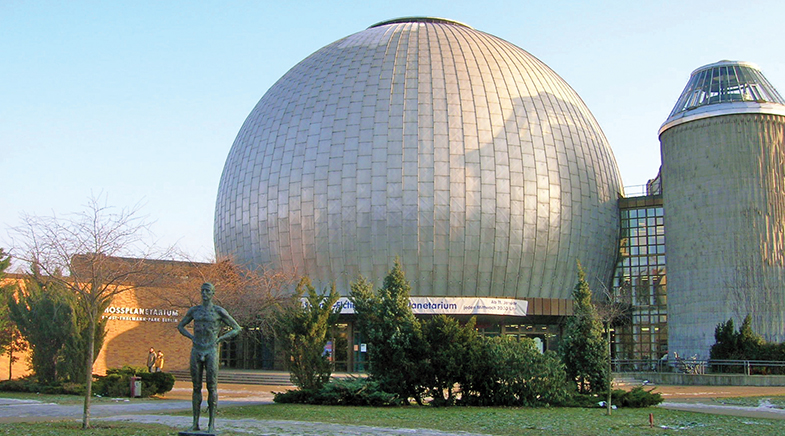
Critics have argued that Buckminster Fuller shouldn't get all the credit for the geodesic dome. Decades earlier, German engineer Walther Bauersfeld had built a similar dome for the Zeiss planetarium. He didn't pursue the design much, but Fuller developed a theory of its structural principles, experimented with configurations, and patented it.
PHOTO: WIKICOMMONS
ODD BITS
Buckminster Fuller had several quirky habits. He used idiosyncratic language, and coined new terms: "livingry" (a counterpart to "weaponry") and "tensegrity", which became a structural principle. Inspired by animals, he worked till he was tired and took short naps. Fuller also documented his life at 15-minute intervals.




Getting to know the brain
Researchers around the world are collaborating in an effort to understand the human brain in unprecedented detail.

World of research: September 2026
A round-up of some recent striking studies.

Planets' progress
A rare glimpse of a stage of planetary evolution may help fill gaps in some cosmic theories.



Have a
story idea?
Tell us.
Do you have a recent research paper or an idea for a science/technology-themed article that you'd like to tell us about?
GET IN TOUCH