

Son of the soil
-
- from Shaastra :: vol 05 issue 07 :: Jul 2026

Danish polymath laid the groundwork for modern geology.
In October 1666, fishermen sailing off the coast of Tuscany, Italy, caught a rare prize: a gigantic female white shark. Its body was cut up, and its head — instead of becoming food — landed on the dissection table of Niels Stensen.
PLAGIARISM PAYS
Steno's authoritative book on stratigraphy was initially overlooked. After his death, English naturalist John Woodward borrowed heavily from Steno's ideas to bolster his own theories about how the biblical flood shaped the Earth's geology (bit.ly/borrowed-book). Ironically, this ended up drawing attention to Steno's original work and renewed interest in studying rock and sediment formation, contributing indirectly to Steno's belated recognition.

Born in Copenhagen in 1638, Stensen — better known as Nicolas Steno — had made a name for himself as an expert anatomist. Growing up during a time of strife — Denmark was at war with Sweden, and a plague had claimed the lives of many of his classmates — Steno developed an interest in diverse fields, from maths to chemistry to alchemy. He finally pursued a career in medicine and made several important contributions. He identified the parotid duct that transports saliva from the salivary gland to the mouth, a discovery he had to fight with his supervisor to claim credit for (bit.ly/claim-credit). He also recognised that muscles contract through fibres instead of "ballooning", as originally believed, and challenged existing ideas about the brain and the pineal gland. After hopping across Europe, he landed in Italy, earning the patronage of the Grand Duke, Ferdinando II de' Medici.
ABOVE CRITICISM
Unlike Galileo, who was harassed by the Church for his "heretical" views on heliocentrism, Steno's ideas escaped criticism. His findings helped establish that the Earth was way older than what biblical chronology suggested. The fact that Steno never publicly disputed the accepted biblical age of the Earth may have helped (bit.ly/Steno-Church).

When Steno studied the dead shark's teeth, he found them identical to objects called "tongue stones" spotted across the country. People believed that these objects fell from the sky or were snake tongues turned to stone by a saint. Some naturalists speculated that they came from long-dead marine creatures, but could not explain why they also appeared in locations high up or far inland.
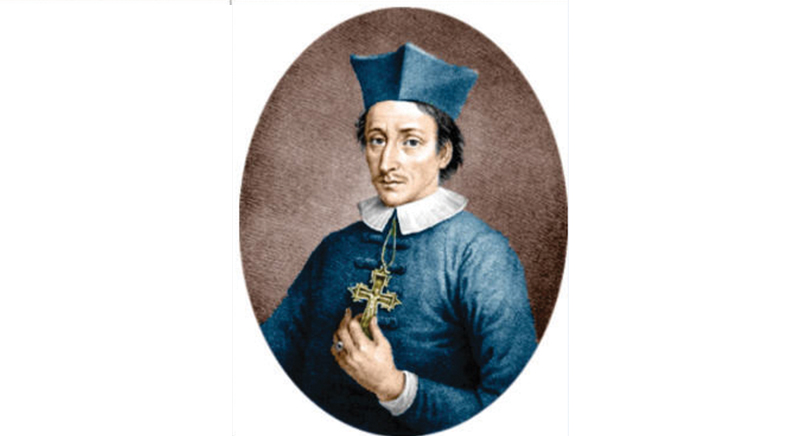
Steno had a simpler explanation: he argued that the tongue stones were indeed ancient animal teeth, but had been buried and transformed by the Earth's changing surface. This idea of fossils wasn't new, but Steno was among the first to confirm it.
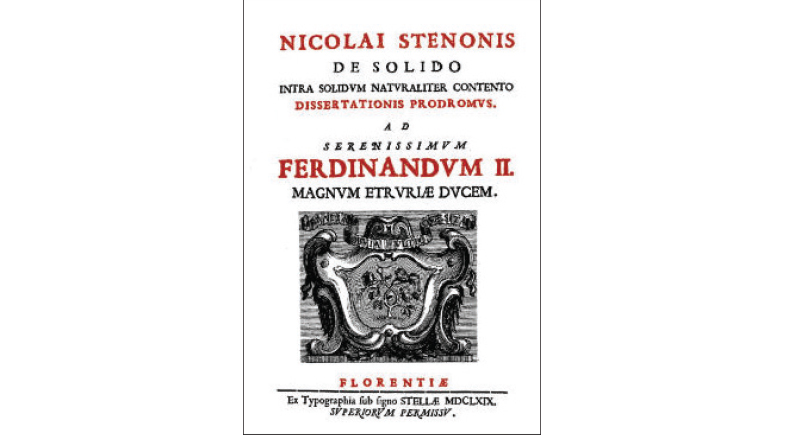
Still, Steno's curiosity wasn't sated. He began asking how fossils came to be buried deep within rock layers, and set out on a tour of quarries, mines, and caves across Tuscany to find the answer.
In 1669, he published his findings in a 78-page book. Steno put forth three principles (bit.ly/layers-time). One, sediments accumulate in horizontal layers over time, with older layers below younger ones, often preserving fossils within, essentially providing a chronological record of the Earth's history. Two, sediments settle into roughly horizontal layers even when deposited on uneven ground. Three, sediment layers extend sideways in all directions until they are blocked by an obstacle or gradually thin out. Although seemingly obvious today, these ideas were ahead of their time and eventually became the bedrock of stratigraphy: the study of rock formation.
Steno, however, would not remain a researcher for long. Raised Lutheran, he converted to Catholicism while in Italy and gradually gave up his scientific pursuits. He was ordained in 1675 and moved to Germany. Steno took his orthodoxy quite seriously — giving up food and possessions and living in poverty — and died at the age of 48. In 1988, he was beatified by Pope John Paul II, having earned the respect of researchers and religionists alike.








'Consciousness is THE central phenomenon of our brains'
Cognitive neuroscientist Anil Seth on his channelling of science to answer some foundational questions that border on philosophy.


A bird's-eye view of drones
A bird's-eye view of a nascent drone industry that is taking wing and is being harnessed in a variety of civilian and military applications.
Smothering the flames of instability
Scientists at IIT Madras channel an intuitive understanding of complex system dynamics to solve the problem of ‘combustion instability’.



Have a
story idea?
Tell us.
Do you have a recent research paper or an idea for a science/technology-themed article that you'd like to tell us about?
GET IN TOUCH