

Learning, unlearning
-
- from Shaastra :: vol 05 issue 06 :: Jun 2026
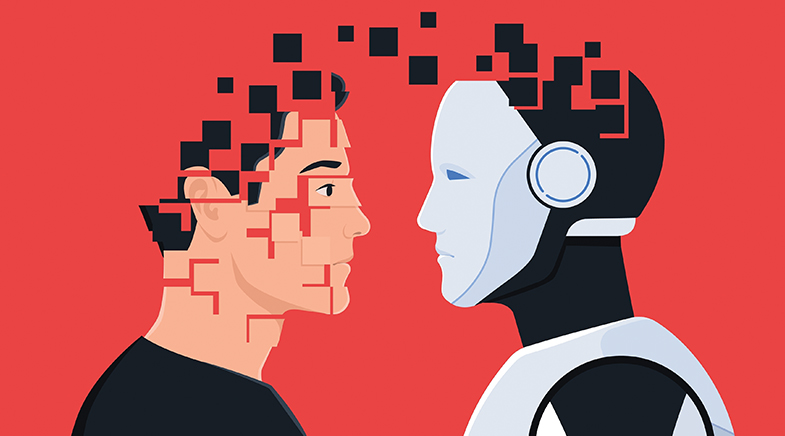
Every new tool — from a calculator to the GPS — has eroded human ability. Now, all eyes are on AI.
Olduvai Gorge in the middle of the Great Rift Valley in eastern Africa has been a hot favourite of archaeologists for nearly a century. Parts of its soil have been washed off by a river over time, exposing sediments deposited over millions of years, somewhat like the Grand Canyon. While the Grand Canyon is about 2 billion years old and exposes geological time, Olduvai shows early human history in its rock layers, from the time the human species left the trees and began walking on two legs.
Humans have developed specialised tools over 10,000 years, discarding older ones as they discovered newer tools, with corresponding changes in their skills. AI is the most disruptive tool of all.

The first to recognise its potential was the palaeoarchaeologist couple Mary and Louis Leakey. In 1931, the Leakeys discovered tools used by Homo habilis, the first human species that lived about 2.3 million years ago. They used stone tools, now called Oldowan, the first major creative act of the Homo genus on the way to sapiens. The tools were made in a large industrial belt in the Rift Valley, later covering most of Africa and moving into Asia and parts of Europe. The Oldowan tools allowed humans to butcher animals and access hard but nutritious parts, such as the bone marrow, which provided them with food rich in calories and protein. The tools were not easy to make. They demanded imagination, skill and coordination. They made cognitive demands that ultimately selected for larger brains.
The tools became increasingly sophisticated, creating a feedback loop that drove the evolution of larger brains in each new species. By the time sapiens originated, probably about 300,000 years ago, the brain size had increased by about 550 cubic centimetres (cc) to 1,500 cc. Human brains have now shrunk to about 1,350 cc. This drop could be because they are better organised. It may also be the result of a fall in the nutritive value of food after the birth of agriculture. It may be because humans are so interconnected that they don't need a larger brain.
Humans have developed specialised tools over the last 10,000 years, discarding older ones as they discovered newer tools, with corresponding changes in their skills. Writing, believed to have been discovered in Mesopotamia around 5,500 years ago, was a landmark tool. It let humans record what they thought and did, thereby expanding knowledge. On the other hand, over time, it is thought to have reduced people's ability to memorise facts and passages. Such erosion occurred whenever a new tool appeared. Calculators made slide rules and abacuses obsolete, but people lost the skills of estimation and speed of calculation along with them. Physicians once diagnosed diseases by using subtle techniques such as tapping a body part and listening to the sound it made, but modern tools have made such skills obsolete.
The Global Positioning System, or GPS, killed the knowledge of navigation gained through studying stars. Along with it, it also reduced the skill-building spatial models of the environment. The computer further eroded some of these skills. Design software obviated the need for spatial imagination. Digital texts have, over time, got people to scan rather than read deeply. Computational software removed the need to learn complex algebraic manipulations. And so on, across several domains and activities. The effect of these losses is now partly apparent, but scientists are not yet sure whether the gains are commensurate with the losses. As artificial intelligence (AI) becomes the most disruptive tool of all, our Cover Story explores the current thinking and research on the topic.
This is a story that is yet to have a denouement. The impact of human activity on evolution is hard to discern over short timescales. It will have several potential paths, blind alleys and reversals, much splintering and regrouping. Unlike other animals, humans can see and respond to what happens. Scientists may identify serious skill loss, and educators may try to reverse it. Or AI may turn out not to be as useful as people have imagined, and therefore not as widely used as expected or feared. As a science and technology magazine, Shaastra explores the current thinking on the topic. Several such explorations are likely to follow as scientists learn new facts about AI and the brain.
See Also:








Pigment power
Melanin is being used in a host of fields — from beauty and biology to chemistry.

Power to the people
Renewable energy generation in India is on a high. And grids are gearing up.
The space race
India is reaching for the stars, but success hinges on its ability to create a strong private sector in space technologies.



Have a
story idea?
Tell us.
Do you have a recent research paper or an idea for a science/technology-themed article that you'd like to tell us about?
GET IN TOUCH