

One mind, many ideas
-
- from Shaastra :: vol 05 issue 06 :: Jun 2026
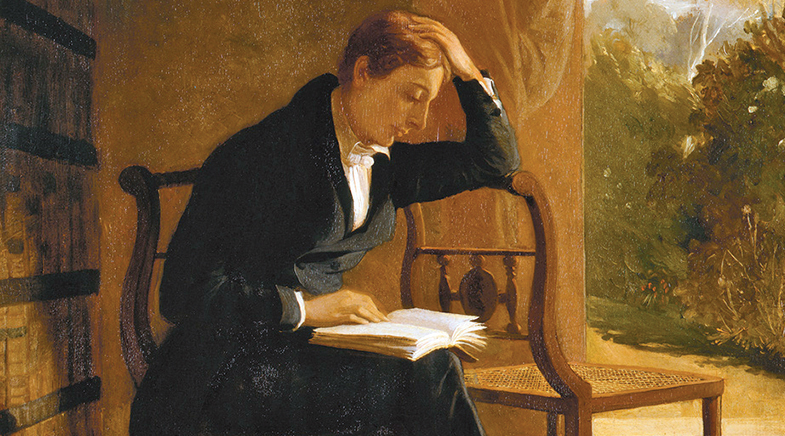
The human brain is built to deal with ambiguity. In most cases, AI is not, and it has consequences.
In 1927, at the University of Cambridge in the U.K., a young man called William Empson regaled his teacher I.A. Richards for a while with multiple interpretations of a Shakespearean sonnet, Th' expense of spirit in a waste of shame. After they were finished, as Richards wrote later, Empson asked his teacher: "You could do that with any poetry, couldn't you?" Richards, a leading critic of the day and among those who established the English department at Cambridge, asked his student to go ahead and do it. In a few weeks, Empson showed Richards the draft of a book which became one of the defining works of English criticism in the 20th century. Called Seven Types of Ambiguity, it presented poetry as complex structures with multiple meanings, at a level no one had done before. What began as a literary game had morphed into a grand theory of poetry, and by extension of all literature. It was the beginning of an academic movement called the New Criticism.

Richards and Empson were of a different stock from the literary critics of the day. Richards had studied moral sciences, which was then a combination of psychology, ethics, economics, and analytical philosophy. He had developed a fascination with the human mind, with the methods of the sciences, and with English literature, which he had not studied in college. He was especially interested in psychology and had investigated reading as an experience. He had also thought about the effect of reading on the mind. Empson was a mathematics graduate from Cambridge who pursued a second degree in literature, to the dismay of his math professors, who thought he was talented in mathematics and should have continued in their department. Both Richards and Empson brought a multidisciplinary perspective to the analysis of literary works, a perspective that has been expanded and extended — to often ridiculous lengths — by postmodern scholars of the late twentieth century.
The human brain doesn't need certainty to function; it can easily confront and resolve ambiguity.
Empson's Seven Types of Ambiguity acknowledged the possibility of multiple meanings in a literary text. There was no one right meaning, it asserted, and good readers can hold several ideas — sometimes contradictory to each other — in their minds for long periods without choosing one. Although not a psychologist, Empson was remarkably intuitive in his analysis. As cognitive psychology grew as a discipline, scientists discovered what Empson felt in his bones: that the human brain is an ambiguity-processing machine. It doesn't need certainty to function; it can easily confront and resolve ambiguity. In fact, there are times when the brain does not resolve ambiguity either. It holds multiple meanings and nourishes them, despite the process being expensive in terms of metabolic energy spending. This ability of the brain enables human beings to take decisions during uncertainty, consider alternative possibilities in some situations, develop moral reasoning, and engage in long-term planning. It helps people to read complex texts. It makes them creative.
Away from the field of aesthetics, the first such suggestion came from George Kelly, one of the founders of clinical psychology in the twentieth century. Kelly himself is a prime example of those hoping to establish the value of holding different kinds of information, skills, and ultimately ideas in one brain. He studied mathematics and physics as an undergraduate. Then he did a Master's in sociology from The University of Kansas, focusing on labour relations. In 1929, he went to The University of Edinburgh for a second Bachelor's degree in education, returning after two years to finish a PhD in psychology from the University of Iowa. Such a broad education gave him a ringside view of how practitioners thought in different disciplines, bringing an unusual eclecticism to his work. His book The Psychology of Personal Constructs, published in 1955, was quite unlike a book on psychology, as it wandered far off — in his own words — the beaten paths of psychology. He threw away established terms, phrases, and ideas in psychology. He had written the book for those not afraid of "thinking unorthodox thoughts about people".
Working in social groups was essential for survival, but it also drove brain evolution. The genesis of speech added another layer of complexity.
Inadvertently, perhaps, Kelly had transferred multiplicities of textual meanings to a multiplicity of ideas in people's minds. He argued that people are always constructing and revising models of reality, and that everyone is a scientist of sorts all the time. This system of thoughts or meanings, organised from experience, determines how a person thinks. Although Kelly is not considered in the same class as the great psychologists William James or Sigmund Freud, he had set in motion a way of thinking that posited cognition as a complex phenomenon. By the time Kelly published his book, another American psychologist, James Bieri, had developed a measure of cognitive complexity, based on Kelly's ideas on personal constructs, or mental representations of reality.
Through the 1960s and 1970s, psychologists investigated how people think about the world around them and form models. Walter Crockett at The University of Kansas studied the mental constructs people use to describe other people. Philip Tetlock, now a professor at the Wharton School, studied the communications of political leaders from 1914 to 1950 and concluded that the complexity of their messaging goes down before a major war (bit.ly/war-messaging). In psychological terms, the leaders exhibit a decline in integrative complexity, the ability to see more than one perspective and how different perspectives relate to each other. In practice, integrative complexity leads people to avoid making absolute judgments or seeing a situation in binary terms. Is drinking coffee healthy? Is it right to impose tariffs? Is artificial intelligence (AI) good or bad?

The answers to these questions are not straightforward and often come with caveats and tradeoffs. Higher integrative complexity creates the ability to see the value of tradeoffs. Artistes had seen it intuitively before. In 1817, English poet John Keats coined the term negative capability to describe the ability of artistes to pursue beauty even if it results in confusion and uncertainty. It gives people the capability of "being in uncertainties, mysteries, doubts, without any irritable reaching after fact and reason". Premature certainty stops continuous learning. It kills creativity.
COGNITIVE COMPLEXITY
Ideas of cognitive complexity had inspired, directly and indirectly, several lines of research in the late 20th and the 21st centuries. Brant Burleson at Purdue University studied how people communicate, especially how they respond to those in distress. Crockett and others used it to study political behaviour. Karl Weick at the University of Michigan showed how complexity affects organisational behaviour, noting that complex organisations operating in difficult situations require people who can hold multiple opinions at the same time. Clinical psychologists drew on cognitive complexity in their practice. Cognitive complexity echoed in the ideas of Niklas Luhmann, the enormously influential German social theorist. It inspired the fields of education and creativity research. Now it excites AI researchers.
COMPLEXITY AND CERTAINTY
In the 1950s and 1960s, Frank Barron, one of the founders of modern creativity research, brought together a set of highly creative individuals to the University of California, Berkeley, and studied their habits during weekend retreats (bit.ly/barron-imagination). This set included architects, writers, mathematicians, and scientists. Barron watched them, talked to them, studied them, sometimes to the amusement and irritation of a few participants, eliciting a sarcastic piece from the poet Kenneth Rexroth, one of the participants. Over time, Barron had found some constant features running through very creative people, one of which was their comfort with complexity and uncertainty. In fact, highly creative people showed extraordinary tolerance to unresolved complexity. Subsequent research has only strengthened this notion. "The test of a first-rate intelligence," wrote American novelist F. Scott Fitzgerald in an essay in the book The Crack-Up, "is the ability to hold two opposed ideas in the mind at the same time and still retain the ability to function."
It takes time to hold multiple ideas in the head, chew them over, relate them, and then come up with new ideas. Therefore, creative people do not rush to complete their projects. Adam Grant, Professor at the Wharton School at the University of Pennsylvania, had this to say in one of his most celebrated papers and a widely watched TED Talk. Grant and his student Jihae Shin — now Professor at the University of Wisconsin-Madison — found that those who are most creative procrastinate a bit but not too much. Grant called himself a pre-crastinator, psychology-speak for those who obsessively finish tasks as soon as they get them, till he was challenged by Jihae. Their initial experiments did not convince Grant immediately, but later data did, forcing him to try not making progress on his tasks. Delaying work on something is not directly related to cognitive complexity, but one can put two and two together. Research does seem to corroborate what intuition tells us (bit.ly/research-intuition).
When an LLM is used wisely, as a sparring partner rather than as a problem-solving machine, it is capable of increasing ambiguity.
The environment in which the human brain developed was remarkably varied and fluid. Several million years ago (see graphic on pages The making of the human mind), when human ancestors descended from the trees and started walking on open ground, they needed to form close-knit social groups to survive. Forming social groups requires the use of multiple models in the brain. Can I trust this person? Is he selfish? Is she selfish in one way and trustworthy in another way? This person may be my rival in some ways but is also useful in other ways. Binary thinking does not work in such environments. Working in social groups was essential for survival, but it also drove brain evolution. The genesis of speech added another layer of complexity as ambiguity was built into language. Human situations needed ambiguous language. Later, as humans began painting and writing, ambiguous language added layers of richness to artistic work.
Now, if AI provides answers easily to human questions, if it always sees certainty instead of ambiguity, what will happen to human brains? Researchers have recognised this problem and taken the question in several directions. One set looks at what happens when AI provides certainty instead of ambiguity; so is it a threat to human cognitive complexity? Another set of researchers looks at how AI systems can tolerate ambiguity. A third set is trying to create AI that can tolerate ambiguity, just as humans do. Yet another group of researchers is looking for signs of cognitive complexity in AI systems. A few researchers are also trying to find ways of working ambiguity into AI systems (bit.ly/AI-ambiguity) to support managerial decision-making in uncertain environments.
Large language models (LLMs) are built differently from the human brain, as they are statistical engines that try to eliminate ambiguity. An LLM does not hold multiple opinions within itself; it chooses the most probable answer and presents it confidently. This is what the systems were built to do. And yet, when used wisely, as a sparring partner rather than as a problem-solving machine, it is indeed capable of increasing ambiguity. It can question a user's belief by framing questions differently, letting them know of alternative ways of thinking. It can also cut down on ambiguity where it matters least: in procedural matters and when tackling information overload. A skilful user of AI maintains a creative tension between the two ways of using. Probably, in the future, between the digital and analogue worlds as well.
Also See :








Grounded by gravity
An 'accidental physicist' on a fundamental force of nature.
Wave or particle?
MIT researchers throw new light on an old debate.

Colour me amazed!
Structural colours were behind laboratory doors for long. They are now making a splash in the market.



Have a
story idea?
Tell us.
Do you have a recent research paper or an idea for a science/technology-themed article that you'd like to tell us about?
GET IN TOUCH