

Secret lives of leaves
-
- from Shaastra :: vol 05 issue 07 :: Jul 2026

Life on Earth is sustained by leaves' ability to capture sunlight and convert it into biologically usable energy.
Leaves are everywhere we look – up, down, sideways – except in deserts and in our concrete jungles. Where did they come from, how are they made, and how do they work? Much of life on Earth is sustainable because of one remarkable ability: capturing sunlight and converting it into biologically usable energy. Leaves do this job, through photosynthesis, for the rest of us. Photosynthesis is the process by which an organism uses light energy to build organic molecules – sugars – from inorganic starting materials. The earliest forms of photosynthesis, still practised by certain bacteria today, do not produce oxygen. These organisms draw electrons not from water but from hydrogen sulphide, ferrous iron, or hydrogen gas, leaving behind sulphur or oxidised iron but no oxygen. They work, but are confined to particular niches – sulphur springs, iron-rich sediments, oxygen-free lake layers – because their raw materials are not abundant everywhere.

former Principal Scientific Adviser to the Government of India, is emeritus professor at the National Centre for Biological Sciences, Tata Institute of Fundamental Research.
Oxygenic photosynthesis, the version that changed everything, uses water as its electron source. Water is essentially unlimited on a planet covered in oceans. The light reaction tears water molecules apart to extract the electrons needed to fix carbon. The leftover fragment, after the electrons have been stripped away, is molecular oxygen or O2. Oxygen is therefore not the point of oxygenic photosynthesis; it is the waste product. The sugars produced are loaded into the plant's phloem, a network of transport tubes, and carried under osmotic pressure to every growing part: root tips, swelling fruits, unfurling shoots. The leaf feeds the whole.
Leaves constitute evolution's most elaborate solution to the problem of how to catch light.
ANCIENT CHEMISTRY
This chemistry arose in the ancestors of cyanobacteria at least 2.7 billion years ago. When cyanobacteria began releasing O2, it initially reacted with dissolved iron in the oceans, precipitating as the rust-coloured banded iron formations visible in ancient rocks worldwide. Only once the oceanic iron sink was saturated did free oxygen accumulate in the atmosphere, around 2.4 billion years ago, in what is now called the Great Oxidation Event. For most anaerobic life, this was catastrophic. For the lineages that could exploit oxygen, it was the enabling condition for all complex life. The chloroplast in every leaf today is a cyanobacterium captured by a eukaryotic cell roughly 1.9 billion years ago, enslaved, and retained as an internal power station, its ancient chemistry still running, unbroken, inside each green cell.
We know from fossilised spores that the earliest land plants appeared around 470 million years ago. Tiny bud-like proto-leaves appear in the fossil record about 400 million years ago, but the widespread appearance of full-sized flat leaves came only around 350 million years ago. Why this 50-million-year gap?
Leaves are not just a product of planetary change; they are one of the engines.
The answer lies in carbon dioxide (CO2) and temperature. In the Early Devonian, roughly 400 million years ago, atmospheric CO2 stood at perhaps 4,000 to 8,000 parts per million (ppm), 10-20 times the pre-industrial level of 280 ppm. By the end of the Carboniferous, around 300 million years ago, it had crashed to as low as 100 ppm. Two processes drove this extraordinary drawdown. When calcium and magnesium silicate minerals in rock meet rain and soil water containing dissolved CO2, they react to produce bicarbonate, which washes into rivers, reaches the ocean, and is buried as carbonate sediment. Plants accelerate this enormously. Roots and their associated fungi excrete acids that dissolve rock, and in dissolving rock, they consume CO2. When forests first covered the Devonian landscape, the silicate weathering rate jumped and remained elevated for tens of millions of years. Simultaneously, the carbon plants fixed by photosynthesis stopped cycling back to the atmosphere. In the great Carboniferous coal swamps, waterlogged forests of giant lycopsids, tree ferns, horsetails, and early seed plants, dead vegetation was buried faster than it could decompose. Without oxygen penetrating the saturated sediment, aerobic decomposers could not function. Carbon that fell in simply stayed. Today, we are releasing into the atmosphere in a few centuries the carbon that it took 60 million years to bury. Every coal seam is fossilised atmospheric CO2 that plants pulled down and the swamp kept.
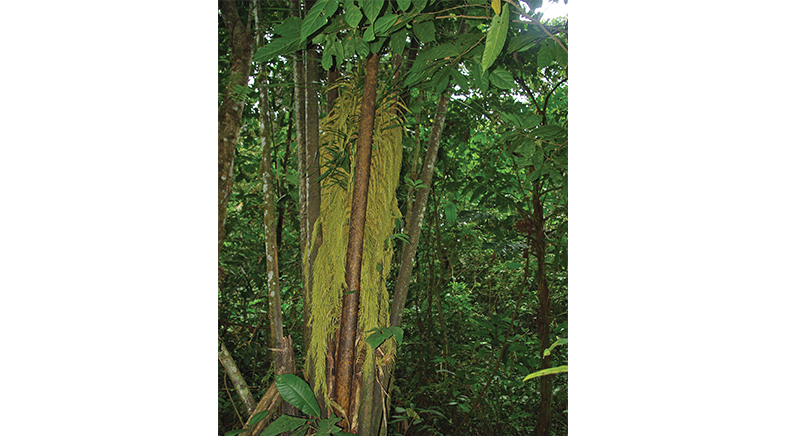
Flat leaves did not exist when CO2 was high, not because there was too little carbon – there was plenty – but because of heat. A broad, flat leaf is an efficient solar collector, which is its value. But every absorbed photon deposits heat into the tissue, and unless that heat is shed, the leaf cooks. Heat is lost in two ways: by convection across the leaf surface, and by transpiration, the evaporation of water through stomatal pores, much as we sweat to cool down. A narrow stem or needle intercepts less sunlight per unit of tissue and loses heat more easily by convection. Modelling studies have shown that a planate leaf with the sparse stomata typical of an Early Devonian plant would have suffered lethal overheating.
Stomatal density – the number of pores per unit of leaf surface – responds developmentally to ambient CO2. When CO2 is high, fewer pores are needed for photosynthesis, so plants make fewer. When CO2 is low, plants make more. This is not a slow evolutionary change but a plastic developmental response within a single plant's lifetime. At 4,000-8,000 ppm, plants had sparse stomata; a flat leaf with sparse stomata cannot transpire fast enough to cool itself. When CO2 fell, stomatal density rose, and the flat leaf became thermally viable for the first time.
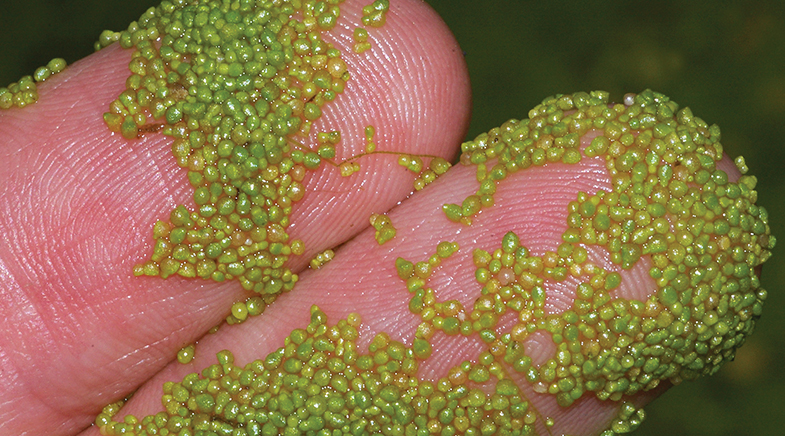
There is a circularity here. Plants caused CO2 to fall; falling CO2 increased stomatal density; higher stomatal density made flat leaves thermally viable; flat leaves drove more efficient photosynthesis, more plant growth, more carbon burial, and more silicate weathering, thereby depressing CO2 further still. The leaf was not just a product of planetary change; it was one of its engines. Those leaves now range from Wolffia, a floating aquatic plant whose entire body is a frond just 0.6 mm long, to Raphia regalis, an African palm whose compound leaves reach 25 metres in length.
METHOD IN THE PATTERNS
The flat leaf, once viable, came in an astonishing variety of shapes: entire-margined, lobed, serrated, and compound. These are not decorative accidents. Serrated and toothed margins are characteristic of plants in cool, seasonal climates; smooth-edged leaves dominate in the tropics. Toothed margins disrupt the boundary layer of still air that clings to the leaf surface, enhancing gas exchange and allowing the leaf to track ambient temperature more closely, an advantage when a short spring growing season rewards rapid warming. Fossil floras record this: global cooling episodes reliably shift whole floras towards more serrated leaf forms, a relationship that palaeobotanists now use to reconstruct ancient temperatures from leaf impressions alone.
At the molecular level, serration is generated by a precise spatial interplay between the hormone auxin and a transcription factor called CUC2. As the leaf margin grows, a protein called PIN1 pumps auxin towards incipient tooth tips, where it accumulates above a threshold and triggers a local burst of growth. Between the teeth, auxin drains away, and CUC2 represses further growth, creating the indentation. The flatness of the blade itself is equally an active process. Work by Utpal Nath at the Indian Institute of Science, beginning with a landmark 2003 paper on the CINCINNATA mutant of snapdragon, established that without a family of transcription factors called CIN-TCPs, themselves regulated by the microRNA miR319, leaf margins grow excessively and the blade curls into a ruffled surface. CIN-TCPs enforce flatness by progressively arresting marginal cell division from tip to base. Nath's subsequent work has shown that the same proteins suppress leaflet formation: dismantle them together with a second gene family, and a simple leaf transforms into an indefinitely branching compound structure. Leaf shape is a continuous negotiation between growth and restraint.

Humans have been conducting their own experiments in that negotiation for at least 10,000 years. The most dramatic illustration is Brassica oleracea, a weedy Mediterranean cliff plant from which human selection has produced kale, cabbage, broccoli, cauliflower, Brussels sprouts, and kohlrabi, all within a single species, each pushing a different part of the leaf and shoot architecture to an extreme. The ancient Egyptians were cultivating lettuce by 4500 BCE, selecting for larger, less bitter blades. On the Indian subcontinent, fenugreek, curry leaf, amaranth, and drumstick leaves have been selected over millennia for palatability, yield, and nutritional density. In each case, what was selected was the leaf itself.
GEOMETRY IN NATURE
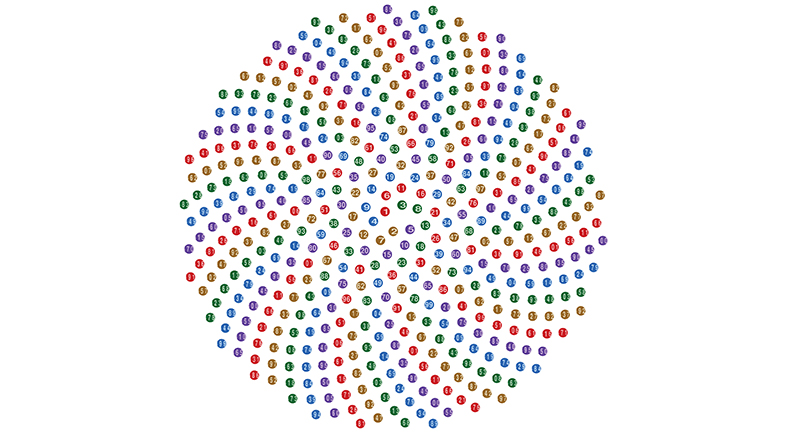
Look down at a rosette lettuce, a sunflower, or a pine cone, and you see a striking pattern: organs arranged in spirals, with each successive leaf placed at roughly 137.5 degrees from the last, the golden angle, related to numbers described two millennia ago by the Indian mathematician Pingala and rediscovered in the West as Fibonacci numbers. This is not a coincidence. At the shoot apical meristem, the dome of dividing cells at the plant's growing tip, PIN1 pumps auxin towards the point where the next leaf will arise. Once auxin crosses a threshold, a new primordium is triggered. That primordium drains auxin away through its developing midvein, creating a depletion zone. The next leaf can only arise where auxin accumulates afresh, always at the point geometrically furthest from existing drains. This simple inhibitory rule, iterated as the meristem grows, generates the golden angle automatically. Computer models using only auxin, PIN1, and the geometry of a growing dome reproduce every known spiral pattern in plants. The plant does no mathematics; the mathematics is embedded in the physics of the molecular network.
As days shorten in autumn in temperate zones, auxin levels in the leaf decline. The plant responds by increasing production of ethylene, a simple gaseous hormone, which triggers cell-wall-degrading enzymes in the abscission zone, a thin layer of cells at the base of the leaf stalk. The vascular connection is progressively sealed, nutrients are retrieved, and the leaf falls. Nitrogen, phosphorus, and other minerals locked into the leaf's photosynthetic proteins are too valuable to abandon; a single deciduous tree may recover from its autumn leaves enough nitrogen to supply a substantial part of the following spring's canopy growth. The yellows and oranges were always there, masked by chlorophyll. These are carotenoid pigments unmasked as the green dismantles. The reds are newly made. As sugars become trapped in the leaf after its phloem connection is cut, the leaf's metabolism shifts and anthocyanin pigments are synthesised. A transcription factor called ApMYB1, activated by the plant stress hormone abscisic acid, throws the switch for the entire anthocyanin biosynthetic pathway. The anthocyanins appear to act as a sunscreen, protecting the nitrogen-retrieval machinery from photodamage during the leaf's final days. The spectacle of autumn is a leaf using its last metabolic resources to protect its own orderly deconstruction.
A monthly column that explores themes on nature, nurture and neighbourhood in the shaping of form and function.
From cyanobacterial ancestor to chloroplast, from leafless Devonian stem to the megaphyll forests that crashed the planet's CO2, from the molecular golden angle to the chemistry of autumn red, the leaf is evolution's most elaborate solution to a single problem: how to catch light.









How the brain works
Understanding how we have such extraordinary cognitive capabilities seems impossible, but studying the brains of other animals helps.
Fun with numbers
The Abel Prize 2026 winner Gerd Faltings on mathematics, AI, and the importance of competition.

Pause before you leap
A global movement is challenging Big Tech's frenetic embrace of AI.



Have a
story idea?
Tell us.
Do you have a recent research paper or an idea for a science/technology-themed article that you'd like to tell us about?
GET IN TOUCH