

They're winging it
-
- from Shaastra :: vol 05 issue 09 :: Sep 2026
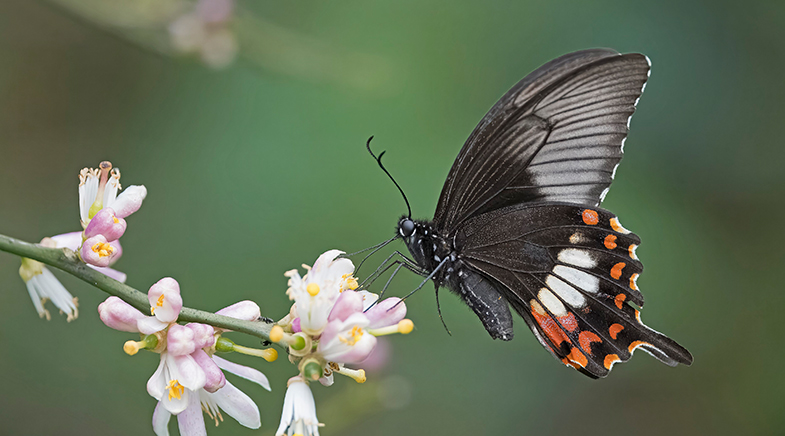
The butterfly's wings sure add colour to nature, but they also serve an evolutionary purpose.
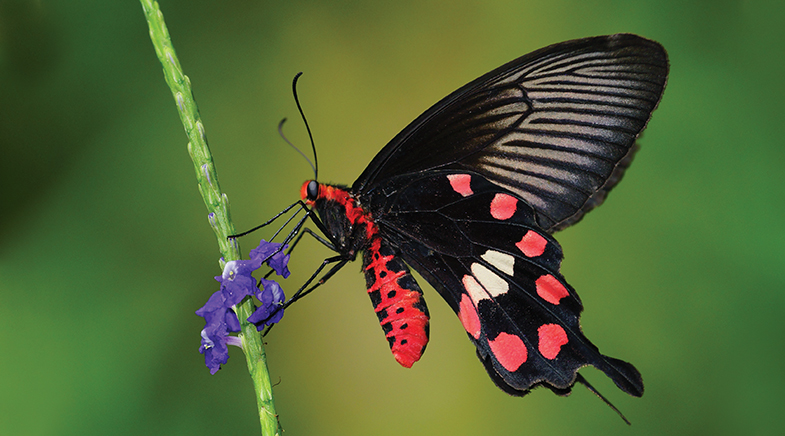
Deception runs riot, especially after the rains, in gardens all over India. A Common Mormon butterfly, Papilio polytes, settles on an invasive lantana plant. The male Mormon butterfly is black, with a neat band of white spots, and every male looks like every other male. Some females look like their male siblings. Others carry red crescents on the hindwing and a rearranged white patch, and in that avatar they are a close copy of another species, the Common Rose, Pachliopta aristolochiae, whose caterpillar feeds on the toxic Aristolochia plant. The Common Rose is distasteful to birds, which learn to leave it alone.
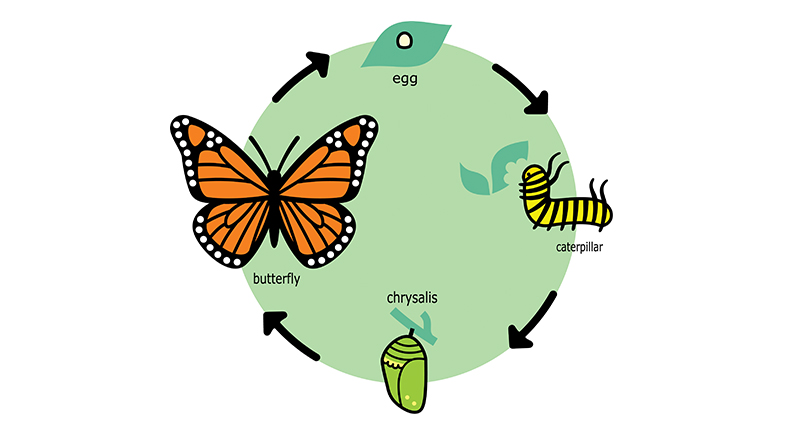
How are the vividly patterned adult wings manufactured during the lives of voracious caterpillars, and in the immobile chrysalis that transforms them into a flying insect? When, in evolution, did butterfly wing patterns arise, and what 'purpose', or adaptive advantage, are they thought to serve? And how do deception and mimicry arise?

former Principal Scientific Adviser to the Government of India, is emeritus professor at the National Centre for Biological Sciences, Tata Institute of Fundamental Research.
The fertilised egg laid by a female butterfly is a single cell, surrounded by layers of other cells and a protective shell. Following instructions delivered to it by the mother, it divides rapidly and repeatedly within the shell. The dividing cells of the embryo are partitioned into multiple sets. One set gives rise to the caterpillar, with a head, multiple segments, and tiny leg-like appendages. Another set, called imaginal cells, is set aside in the embryo for future use in the making of the adult's external structures, called the imago. Yet another set of cells in the embryo forms the internal parts of the caterpillar: its gut, the nervous system, brain, blood, and muscles. Here, too, cells that will make the corresponding parts of the adult butterfly are set aside, increasing in number during larval life, to be used during metamorphosis in the chrysalis to make the internal parts of the butterfly.
The advantage of mimicry falls as mimics become abundant, holding both forms at intermediate frequencies.
The cells set aside to form the adult wing, the wing imaginal discs, are tucked inside the caterpillar, attached to its internal epidermis. These cells divide during the multiple stages, or instars, of the caterpillar's life. Driven by the moulting hormone ecdysone, and by insulin signalling, the caterpillar goes through five instars, feeding constantly and growing enormously in size. During this period, the wing imaginal disc cells increase in number from a few dozen in the embryo to tens of thousands in the fifth instar. After the fifth instar, the caterpillar stops feeding, attaches itself to a leaf or stem and undergoes metamorphosis in what is called the chrysalis, emerging as a butterfly that spreads out its beautiful wings and flies away.
MARKED PATTERNS
During its growth in the caterpillar, the wing imaginal disc forms sheets, attached to form an open pocket. As the cells increase in number, they do not appear distinctive even when observed under a microscope. Yet, when they are examined using tools that can detect and label the expression of specific genes or their protein products, stunning features appear progressively. The sheets are first partitioned by the expression of a gene that marks them into anterior and posterior. It is as if you took a pencil and drew a line on each of two sheets of rectangular cloth, dividing them into left and right along the long axis. Next, one sheet is marked to form the top (or dorsal side) of the wing, and the other the ventral (or bottom) side. On each sheet, the lines where the veins will later form are then marked.
Next, the places where spots and stripes will appear need to be marked. Here, the veins do more than carry air and blood. Evolutionary biologist Fred Nijhout recognised in the 1970s that a butterfly pattern is formed semi-independently within each compartment bounded by veins, using the veins and the wing margin as boundaries. This is why eyespots appear one to a compartment, centred between veins, and why stripes that cross the wing shift or kink at every vein. All of this charting of what will become of the imaginal disc is done as a tailor might mark a sheet of cloth that will finally become an elaborate coloured tapestry. In the developing wing, there is no tailor, but molecular signals, which progressively come on with each step of compartmentalisation, and cause finer elaboration of pattern. The position, intensity, range, and timing of these signals are orchestrated by an intricate network of interactions between cells, effected by the switching on and off of genes.
This marking out concludes in a sheet whose cells have almost stopped dividing. By the time the caterpillar seals itself into the chrysalis, the number of cells in the wing is close to fixed, and everything that follows is done by cells translating patterned instructions to a final form. The pocket everts from the body wall and flattens, and the two sheets come to lie back-to-back. They touch, but the two surfaces of a wing can carry entirely unrelated final patterns, a dead-leaf brown below and a colourful advertisement above, as the dorsal and ventral interpretations of patterning vary due to context.
Within each sheet, scattered cells are singled out to become scales by a process of mutual inhibition. A cell that commits to the scale fate, somewhat randomly, silences its neighbours from taking on that fate. Each chosen cell divides once, into a cell that builds the scale, and a cell that builds its socket. The builder cell flattens and lays down bundles of the filament protein actin along its length. Cuticle is secreted into the grooves between the bundles; the actin is then withdrawn, the cell dies, and what remains is a hollow dead husk with a smooth floor and a roof of parallel ridges.
THE SCIENCE OF COLOUR
Colour arrives by two routes, laid down in the last days inside the chrysalis. The first is chemistry. Melanins, made from tyrosine (an amino acid), give the blacks and browns; ommochromes, from tryptophan (another amino acid), give the reds and oranges; pterins give the brilliant whites and yellows of Grass Yellow butterflies and 'albatross' butterflies. Swallowtails add a class of their own, the papiliochromes; and a few lycaenids simply steal flavonoids from the plants that their caterpillars ate. All are deposited in the dead husk of the scale. A butterfly's colour is fixed when it emerges, and can only fade.
The second route is physics. Where the architecture of a scale repeats at a spacing comparable to the wavelength of light, reflections from successive surfaces interfere and produce colour without the use of pigment. The elaborate three-dimensional structures on the roof of the scale are spectacular. Researchers Rachel Thayer, Frances Allen and Nipam Patel showed in 2020 (bit.ly/junonia-colour) that in the pansies and buckeyes of the genus Junonia, the colour is controlled by the plain flat floor of the scale, working as a thin film, like a soap bubble. If the film is thickened, the brown becomes blue. Selective breeding of buckeyes for blue over 12 generations thickened that floor by about three-quarters. Black melanin under a blue film makes the blue look saturated, by soaking up the stray light that would otherwise wash it out. Structural colour dominates the blue end of the spectrum and is nearly absent at the red end. If a butterfly is blue, green or silver, the colour is likely structural; if it is red, that is due to pigment.
Scales with light-scattering periodicities have been recovered from fossils roughly 200 million years old, arranged in overlapping cover and ground layers essentially as in living primitive moths. Butterflies themselves are far younger. A study of more than 2,000 species, published in 2023, places their origin at about 101 million years ago, derived from nocturnal, plant-eating moth ancestors. Eyespots arose about 90 million years ago.
THE IMITATION GAME
Thus, the founding event was not the invention of colour when a nocturnal animal moved into daylight, into a world filled with flowering plants and with birds and lizards that hunt by sight. A patterned wing became of adaptive value, catering to conflicting demands. Invisible at rest, unmistakable if genuinely toxic, to be recognised by a mate, and to absorb enough sunlight to fly on a cool morning. Charles Darwin held that where males and females look different, sexual selection has generally exaggerated the male. Naturalist and explorer Alfred Russel Wallace, who watched Indo-Malayan swallowtails closely, proposed the opposite – that here it is the female who has been driven from the ancestral pattern by natural selection for protection, being slower, heavier with eggs, and more exposed as she searches for host plants on which to lay. Krushnamegh Kunte, now at the National Centre for Biological Sciences-Tata Institute of Fundamental Research, in Bengaluru, reopened the question, earlier settled in favour of Darwin, in 2008 by mapping mimicry and dimorphism onto a molecular phylogeny of Papilio. Sexual dimorphism in these swallowtails is strongly associated with female-limited mimicry, and it is the female pattern, not the male, that has departed from the ancestral condition, pushing this argument in favour of Wallace's view.
What makes one Common Mormon female a mimic and her female sibling not? In 2014, Kunte and his colleagues reported the answer. The switch sits in a stretch of about 130,000 bases in the butterfly's DNA, containing a single gene, doublesex, which across insects is the master regulator of sexual differentiation. Two versions of that stretch circulate in butterflies, differing at more than a thousand positions and each inherited as a block, because shuffling between versions is suppressed. One version is dominant and produces the mimic; when that version is absent, there is no mimicry. Males carry and transmit these versions, but doublesex is read out differentially in the two sexes, and only in females does it impose the disguise.
If the disguise works, why do non-mimetic females persist? Birds learn to avoid the Common Rose only if most black-and-red butterflies they try are genuinely unpleasant, so as mimics grow common relative to models, the education fails, and the protection erodes. The advantage of mimicry falls as mimics become abundant, holding both forms at intermediate frequencies. Field data from the Ryukyu Islands in Japan, where model abundance varies from island to island, broadly support this.
A monthly column that explores themes on nature, nurture and neighbourhood in the shaping of form and function.
A second explanation has been popular for 60 years: that males prefer non-mimetic females, who look like themselves, so the mimic pays for her protection in lost matings. Here, the evidence is unsettled. Kunte reviewed the theory in 2009 and argued that it does not carry the weight placed on it. Male Mormons court whichever female is moving, and weigh her activity far above her wing pattern; a four-year field study of the related Papilio memnon found no difference between mimetic and non-mimetic females in mating rate or in how often they were inseminated.
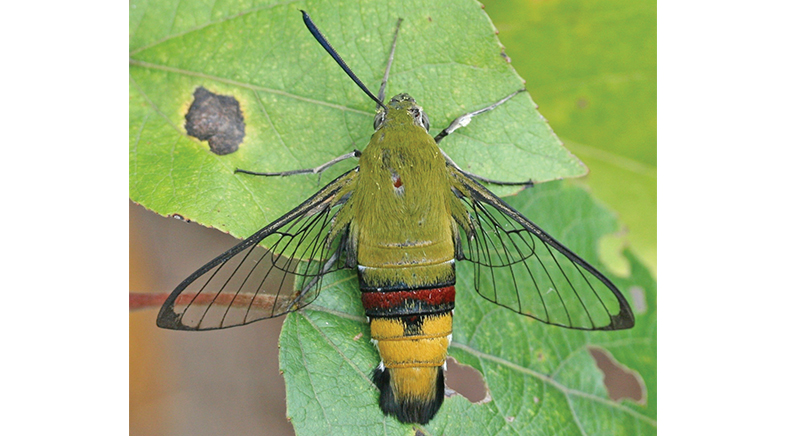
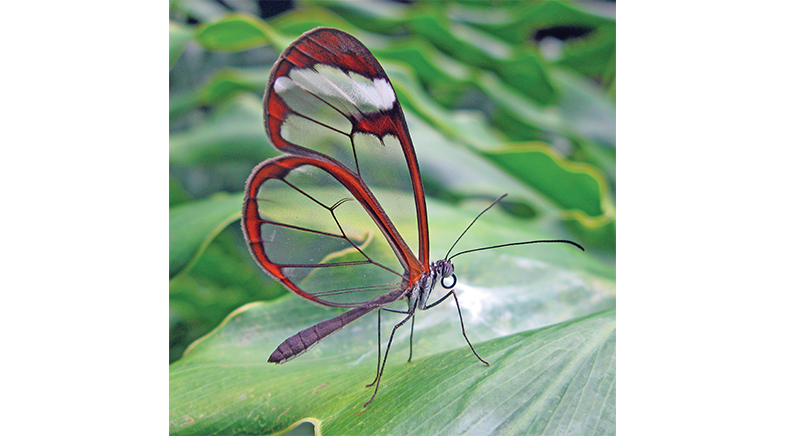
Clearwing butterflies, and the hawk moths of the genus Cephonodes that visit Indian gardens, have wings you can read newsprint through. Transparency is not the absence of the apparatus but a great deal of extra work. Patel's group showed that in the glasswing Greta oto, fewer cells are recruited as scales, and those remaining are built as thin bristles rather than flat plates; pigment is withheld, and the bare membrane carries a coat of nanoscale pillars suppressing the surface reflection that would otherwise betray the insect. It takes several coordinated inventions to be colourful or invisible.








The wondrous world of water
New research in India and elsewhere is turning the lens on the many avatars and possible applications of ice and water.
Out of season
With global warming, El Niño and the way India’s summer monsoon responds to it may be changing.

More for less
As AI adoption drives up enterprise costs, Indian companies are innovating to deliver more intelligence with less compute.



Have a
story idea?
Tell us.
Do you have a recent research paper or an idea for a science/technology-themed article that you'd like to tell us about?
GET IN TOUCH