

'Most dam failures in India happen with small dams'
-
- from Shaastra :: vol 05 issue 02 :: Feb 2026
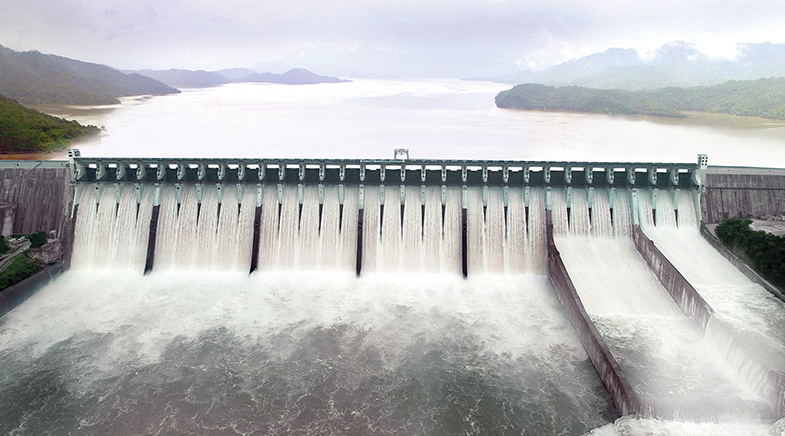
An expert speaks on the mechanics and challenges of building and maintaining dams for maximal safety.
On August 11, 1979, following unexpected heavy rainfall in the parched Saurashtra region of Gujarat, the Machchhu Dam breached, flooding the nearby town of Morbi and killing over 20,000. Shaken by the event, the Indian government first thought of legislation on dam safety. It took over four decades for that thought to culminate in the Dam Safety Act, 2021. A year later, the National Dam Safety Authority (NDSA) was established, with statutory and regulatory powers to oversee the safety of reservoirs. Over the years, the number of dams in India has risen to 6,545 (with 83 more under construction), making it the country with the third-highest number of dams, behind the U.S. and China.
Anil Kumar Jain, who began his career in the Central Water Engineering Services in 1992, has worked on dams for over 30 years. He was involved in the design of, among others, the Koteshwar Dam in Uttarakhand and the Garudeshwar Dam in Gujarat, and headed specialist teams to rebuild damaged reservoirs. As NDSA Chairperson, he oversees the monitoring of an ever-increasing number of weirs, barrages and reservoirs across India. Excerpts from an interview:
Ensuring the safety of 6,545 dams is a huge responsibility.
Yes. That's why we want to maximise the use of technology for the various mandates that the Dam Safety Act has given us. The first was to create a national database. Dams in India are owned by different entities: State governments, the Centre, the military, and even private. The data about them was scattered. We started by optimising the Dam Health and Rehabilitation Monitoring Application (DHARMA) portal, and digitising information, from fixed specifications to updates on inspections. The latest updates on reservoirs are now readily available.
Second, we wanted to know the pattern of inundation in case of a dam breach. With manual computation, assessing a single dam can take several months. We automated the process. The Centre for Development of Advanced Computing, Pune, created a tool and is conducting the first round of dam-breach analysis for us. The task began in August 2025, and we already have the analysis for 2,000 dams, showing where and how far floodwater could spread, and which populations and important infrastructure are at risk. Such information is essential for disaster management authorities to make judicious, informed decisions.
Another mandate was to create a risk profile of each dam. A quantitative analysis, which requires us to perform mathematical calculations with all the data, will take a long time. We decided to do the first level of screening through a qualitative assessment with our web-based tool, the Rapid Risk Screening of Specified Dams. Dam operators have to fill in a detailed form that encompasses structural, maintenance and operating details. Based on the data, we categorise dams. Category I dams are the most vulnerable and require immediate attention. Category II dams require major rehabilitation, while Category III dams only require minor repairs. Through such digital inspection alone, we have slotted two dams in Category I – Bokaro Barrage (Jharkhand) and Lower Khajuri Dam (Uttar Pradesh) – and 225 in Category II.

Globally, what are the best practices for monitoring the safety of dams?
The world over, dam health assessments are conducted using a number of technologies. The first assessment is always visual, conducted by experts; the second is through instrumentation. Monitoring the output of various sensors helps operators make decisions. While we deploy the same technology, in part at least, in India, we are weak on instrumentation. Because of poor maintenance, sensors get faulty and are not replaced. The NDSA is documenting the condition of sensors in every dam.
Do you use satellite data to monitor the health of dams?
Satellite imagery shows the spread of water in the reservoir, which we use to estimate how much freeboard it has at a given time. It can also be used to track siltation, monitor the dam's coordinates to check for deflection over time and the development of slides on the rim. We need to use satellites more effectively for dam management.
How has climate change added to the risks to dam health?
The loss of the Chungthang Dam in Sikkim in October 2023 was an outcome of climate change. A GLOF (Glacial Lake Outburst Flow) event upstream triggered by a landslide caused the massive flood. After that incident, the NDSA was asked to assess which dams in India were likely to be affected by GLOF incidents. We identified 47 dams in the upper reaches of the Himalayas for assessment and found that 10 of them needed immediate attention. Subsequently, the National Disaster Management Authority carried out expeditions to the glacial lakes in the catchment area of each of the 47 dams and installed early-warning sensors.
Given India's geographical spread, what are the other big threats to dam health?
Hydrology and rainfall intensity are changing. Due to this, the design hazard, or what we call the design flood, is also changing. A dam is constructed to hold a certain volume of water and release any excess gradually. With heavier rainfall, the calculations for the volume it can hold and the volume it should release are changing. So, we need to reassess the extent to which a dam should keep its reservoir level lower before the rains in order to safely accommodate the increased volume later.
Earthquakes are also a natural hazard, but not to all dams.
The biggest hazard to dam safety in India, however, is faulty operation and poor maintenance. We lose many of the dams because of poor upkeep. However, our dam failure rate of 2.3% is below the global average of 2.8%.
As a dam safety expert, would you recommend large or small dams?
Large and small dams are not rivals; they complement each other. Climate change is causing drastic fluctuation in rainfall, which smaller dams cannot manage. Larger ones can adjust storage based on rainfall intensity forecasts, thereby mitigating floods and avoiding droughts. Small dams are useful for serving the needs of a very specific region.
Contrary to the perception that large dams are a risk, most dam failures in India have happened with smaller dams. Large dams have good design, better construction and last longer. Smaller dams are often constructed without the same diligence; it should not be this way, but unfortunately, it is so. Thus, we lose smaller dams.
In India, many dams of antiquity are still in running condition. What are your observations on their safety?
We have 291 dams that are over a century old. The oldest, Kallanai in Tamil Nadu, is 2,000 years old and was built by the Cholas. It continues to serve the nation well.
There is a wrong perception, even among decision makers, that dams should be decommissioned after 100 years, as they may no longer be functioning properly. If these dams are maintained well, they can continue to function for centuries, as we can see.
What would you say about the safety threat to dams from forces beyond the borders?
We were asked to assess this aspect of dam safety. We can provide data about dams that are located close to the international border or are in regions facing high internal security threats. We can share information about the structural vulnerability of these dams, too. But assessing their security threat perception is not our expertise.
What approach do you plan to incorporate in future for better reservoir safety?
Our intention is to work towards integrated dam management. We want to define dams by their basin/hydraulic boundaries, and not by State boundaries. We hope to have a command centre for every basin which can balance the water between dams in a coordinated manner.
In public perception, dams are mostly considered a threat. How many of them do we really need?
Only dams can guarantee water security in this time of climate change. India has harnessed only 40% of its potential for dams, for irrigation and hydroelectricity generation. We need many more, and we need large dams.
Dams, when built and maintained well, are very safe. We have newer materials, such as asphalt concrete and geosynthetic membranes, and newer technology. The design philosophy has changed, encompassing a probabilistic approach rather than the previous deterministic one. We should wholeheartedly embrace these developments and not place undue emphasis on precedent.
In over four decades of your association with dams, which memories stand out?
In August 2010, the Garada Dam in Rajasthan was washed out during its first filling. It was a huge setback for the State. In 2017, I was asked to rehabilitate it. For the first time in India, we used geosynthetic material and a geosynthetic membrane in the construction of an earthen dam. In 2021, it was filled again and is functioning well. Since it is in my home State, I have an emotional attachment to this dam.
In 2012, the Indira Sagar Dam in Madhya Pradesh, which has the highest storage capacity in India, developed breaches in the spillway. We took over the project and redesigned the entire energy dissipation arrangement in 2016. That same year, there was a flood, and the dam was able to handle it.









Up in the air
From the albatross to the featherwing beetle to the dandelion, the physics of flight is the outcome of evolution over millions of years.

That vape puff is not safe at all
Food-grade flavours in a vape puff may deal a nasty blow to the lungs.

Peace of mind
Understanding of schizophrenia has improved vastly in the past decade. New research and novel methods offer hope.



Have a
story idea?
Tell us.
Do you have a recent research paper or an idea for a science/technology-themed article that you'd like to tell us about?
GET IN TOUCH