

Tiny matter, giant steps
-
- from Shaastra :: vol 05 issue 08 :: Aug 2026

Nanomaterials are driving the light-product revolution.
In 1991, when Sumio Iijima peered at carbon soot through the high-resolution electron microscope he had developed, he wasn't aware that he was looking at a tiny material that would one day be an ingredient in everything from sunscreen to satellites and socks to ships, making them lighter. Iijima, then with Japan's NEC Corporation, had heated graphite rods using electricity and condensed the vapours to form carbon soot to produce fullerenes — a new and popular carbon allotrope. While looking for fullerenes under the microscope, he noticed tiny hollow tubular structures made of carbon embedded in the fullerene-rich soot. These hair-like carbon fibres — he named them carbon nanotubes — were exceptionally stiff, and had higher electrical and thermal conductivity (bit.ly/carbon-fibres).
While academia took note of the discovery in the 1990s, the world witnessed the magic of this material a decade later. In the early 2000s, sports companies such as France-based Babolat and U.S.-based Wilson Sporting Goods added 1-2% of carbon nanotubes at strategic locations in tennis rackets, increasing stiffness and vibration damping. Star players including Roger Federer, Serena Williams, Venus Williams and Lindsay Davenport played with these rackets, and their game improved. The companies also realised that with increased stiffness, some materials could be eliminated, making the products lighter and easier to use. Meanwhile, graphene had been discovered as a new form of carbon. Graphene and carbon nanotubes together revolutionised light products by adding strength to the materials used. Other nanomaterials, such as nano silica, nano alumina and nanocellulose, followed suit.
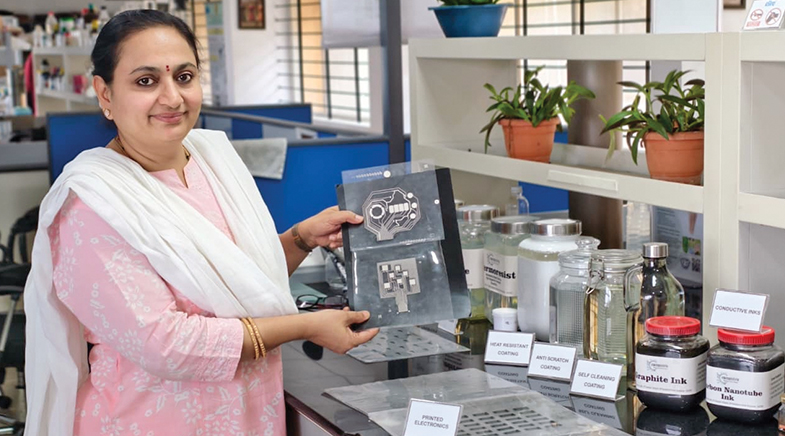
"Nanomaterials have different kinds of properties which can be harnessed for different applications," says Uma Ullas Pradhan, a Professor at the Bengaluru-based Centre for Incubation, Innovation, Research and Consultancy, and Co-founder of the nanotechnology start-up Nanosentrix. Nanomaterials can help increase the stiffness and durability of diverse materials, from thermoplastics, nylon, polypropylene, metals and ceramics to rubber, elastomers, aerogels, and concrete, making them useful for almost all industries — and leading to their high demand. The global nanomaterial market size was estimated at $16.3 billion in 2025 and is projected to reach $50.8 billion by 2033.
Many such products are already in the market. Companies such as the U.K.-based Haydale are developing graphene-enhanced polymers and carbon nanotube composites to make automotive interiors lighter. The Bhabha Atomic Research Centre in Mumbai has designed a light bulletproof jacket — carbon nanotubes enable weight reduction and increased impact resistance. The Hyderabad-based start-up Nanospan has developed a graphene admixture that increases the strength of concrete, leading to thinner slabs and lowering cement use by 10%. The American start-up Lyten is developing graphene-enhanced lithium-sulphur batteries that are 30% lighter than the usual lithium-sulphur batteries.
ADD-ON PROPERTIES
Nanomaterials reduce the weight of devices by increasing the strength of a material. They also add functional properties to existing light materials to expand their applications. Nasimul Alam Syed, an Associate Professor at the National Institute of Technology, Rourkela, wanted a substitute for aluminium used in aircraft landing gear. Syed's team added three nanomaterials — hexagonal boron nitride, multi-walled carbon nanotubes, and graphite nanoplatelets — to aluminium. By optimising the ratios of these materials, the team decreased the wear loss of the landing gear by 70%. While hexagonal boron nitride and graphene nanoplatelets lubricate the gear to prevent cracking due to friction, carbon nanotubes provide high strength, acting as a "reinforcing bridge" within the material. "... it grips these aluminium grains across each other and toughens it (the material). So, you cannot pull them (aluminium grains) apart and separate them because carbon nanotubes are holding them across the grains," says Syed.

Rajendra Kurapati, a chemist and Assistant Professor at the Indian Institute of Science Education and Research Thiruvananthapuram, looked at how nanotubes could improve the functioning of titanium implants. He observed that microbes often adhered to titanium, forming biofilms that were difficult to treat as they were multi-drug-resistant. So, his team created micro holes on the surface of implants, which were sealed by a coating of antibiotics mixed with graphene oxide. The graphene oxide acted as a carrier, allowing a slow and gradual release of antibiotics, keeping the implant infection-free. "Nanomaterials undergo degradation in the body," he says, stressing the benefit of nanomaterials in medicine.
Nanomaterials aren't just making materials lighter and better; they are also reducing the need for bulky protective layers, insulation, and reinforcements. Pradhan, who founded Nanosentrix in 2021, develops and sells different types of nanomaterial coatings, including anti-corrosive, anti-scratch, high-temperature, heat-resistant, and UV-blocking coatings. She has also developed a nanocoating that, when added to plasters, provides thermal insulation and fire resistance to building walls, replacing the need for bulky thermal insulating material such as fibreglass, polystyrene and polyurethane foam.
PRINTED ELECTRONICS TO THE FORE
While nanomaterials are being used as additives, they have enabled a full-scale disruption in electronics by enabling the manufacture of printed electronics that are lighter, more flexible, and portable. As a postgraduate student in communication engineering at the Technical University of Munich, Yash Goliya was fascinated by printed electronics while screen-printing silver nanowire antennas that were super-thin, transparent, and flexible. "You're able to have a printout of electronics from a regular printer, which I thought was amazing," he exclaims. This interest led him to found Suryudey Plastic Electronics in Mumbai in 2021. He got his first grant from the Ministry of Defence for developing a lightweight printed antenna, useful to soldiers for communication.
The start-up has also developed a heater for jackets. For this, he screen-prints conductive silver carbon ink onto flexible thermoplastic polyurethane films, which are then integrated into the jacket. When a power bank is plugged into this thin-film heater, the outfit heats up. The temperature can be regulated. To trap the heat, the jacket also has lightweight aerogel-graphene insulation. "It is 50% lighter (than regular jackets). A regular jacket might weigh 1 kilogram and this jacket is less than 500 grams with the heating element," he says.
Nanomaterials reduce the weight of devices by increasing the strength of a material. They also add functional properties to existing light materials.
Nanotechnology-enabled conductive inks are at the core of this printed electronic revolution. These inks are made by mixing nanoscale silver, copper, graphene, and carbon nanotubes with binders and solvents. Unlike large metal particles that have to be melted at high temperatures to make circuits, these nano-inks melt and fuse at lower temperatures, allowing printing of circuits on plastic, paper, textile and flexible films, instead of only high-temperature-resistant ceramics. This makes them ideal for wearables, sensors, radio-frequency identification, printed batteries, flexible displays and solar cells.
The high demand for flexible electronics has also increased the demand for conductive ink. The market, valued at $2.96 billion in 2025, is projected to grow to over $4.3 billion by 2034 (bit.ly/ink-market). Pradhan also develops conductive inks and printed electronics, and has developed a paper strip that measures blood glucose from saliva samples. "Sugar monitoring devices, which are handheld, use paper strips. These strips can now be printed and developed to monitor any other parameter of the body as well," she says. Conductive inks, she explains, can turn paper into a sensor.
Printed electronics that are easily manufactured and transported at low costs are ushering in a connected world where electronics are embedded in almost everything — from clothes and packaging to walls and even the skin. However, one major barrier remains. "The decrease in the cost of these inks would actually determine how widespread these printed electronics would become," says Goliya. "If the benefits and the pricing don't match, no one will pay extra for something just because it's more advanced," he adds. In the future, the low cost of nanomaterial manufacturing and the shift from precious-metal inks to carbon-based nanomaterial inks could enable low-cost printed electronics on a massive scale.
See also:









Promising therapies for Alzheimer's
Scientists are looking at novel ways to stop the progression of Alzheimer's.

Shaastra will be the tech voice of India
Shaastra is an attempt to build a platform where Indian industry and academia can meet, converse and collaborate.



Have a
story idea?
Tell us.
Do you have a recent research paper or an idea for a science/technology-themed article that you'd like to tell us about?
GET IN TOUCH