

Cool, yes, but not kewl
-
- from Shaastra :: vol 05 issue 10 :: Oct 2026
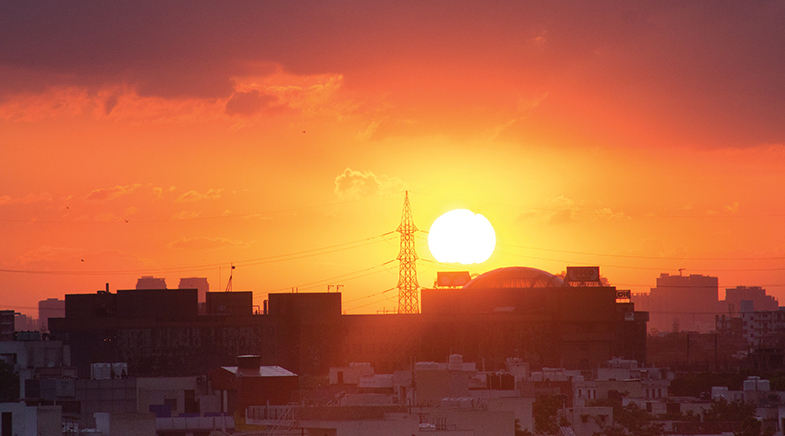
Aerosols and clouds are behind India's cooling paradox.
First the good news: scientists have shown that India is not warming as much as other countries because of its polluted skies. Now for the bad news: the pollutants haven't gone anywhere — they are just hanging around.
Using 24 years of satellite and ground-based observations from 2001 to 2024, researchers at the Space Physics Laboratory of the Vikram Sarabhai Space Centre in Thiruvananthapuram tracked changes in aerosols, cloud cover, incoming sunlight, and surface temperature across India. According to the study, led by Vijayakumar S. Nair, a thickening blanket of aerosols and increased low cloud cover blocked sunlight before it reached the ground, creating a “surface dimming” effect. This has masked a substantial share of the warming that greenhouse gases would otherwise have caused.
The study, which appeared recently in Ocean-Land-Atmosphere Research (bit.ly/cooling-aerosol), states that increased cloud cover — particularly lower-level clouds that are more effective at blocking sunlight — suppressed warming over India by about 0.083° Celsius (C) per decade. Aerosol changes reduced the warming further by 0.042°C per decade. These effects contributed to some, but not all, of the decreased surface warming experienced in and around India in the past three decades.
The study points out that cutting aerosol emissions could unmask the full extent of greenhouse warming.
The figures are strikingly close to the warming trend that India has recorded. “This enhanced dimming has resulted in significant surface cooling (-0.125°C per decade), with an absolute magnitude comparable to the observed warming trend (+0.138°C per decade),” Nair says.
However, the underlying greenhouse warming remains; it has just been masked. India is already facing urgent public-health pressure to clean up its air, since aerosol pollution, particularly fine particulate matter, is linked to serious respiratory and cardiovascular illness. The study points out that cutting aerosol emissions could unmask the full extent of greenhouse warming, potentially causing surface temperatures to rise faster once the atmospheric haze lifts.
The scientists also point out that aerosols and clouds were probably not the only reasons for the cooling effect. Factors such as shifts in atmospheric moisture, changing weather patterns, natural climate variability, and the region's underlying climate sensitivity may also play a part.









A whole new way of looking at medicine: Siddhartha Mukherjee
A deeper understanding of the cellular basis of disease raises hopes of curing hitherto-incurable diseases, says Siddhartha Mukherjee.

Raising their generics game
Complex drugs going off-patent in the U.S. means more hoops for Indian pharma companies to jump through. But they are up for it.
Clean chemistry at work
Chemists decode greener ways to produce olefin, diene molecules.



Have a
story idea?
Tell us.
Do you have a recent research paper or an idea for a science/technology-themed article that you'd like to tell us about?
GET IN TOUCH

