

Overcoming Boltzmann
-
- from Shaastra :: vol 05 issue 08 :: Aug 2026
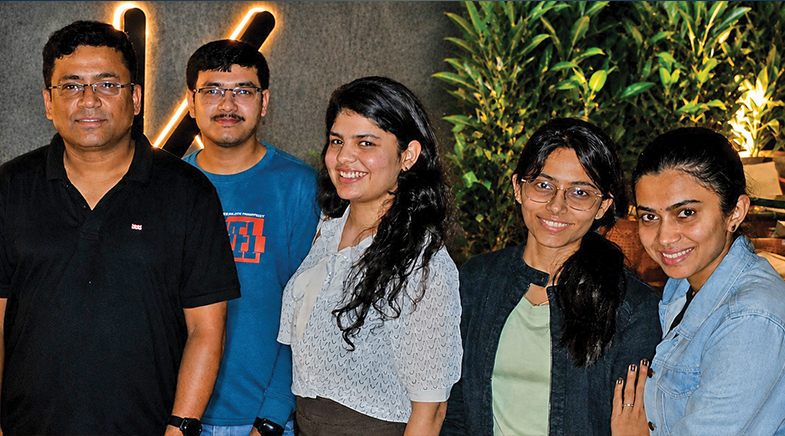
Work on an old theory yields new results.
Researchers have made a major discovery that questions a 150-year-old theory governing the transport of electrical and thermal conductivity in materials. A team led by Bivas Saha, a materials scientist at the Bengaluru-based Jawaharlal Nehru Centre for Advanced Scientific Research (JNCASR), found that thin films of a semiconductor material, scandium nitride (ScN), can convert a temperature difference into an enormous amount of electrical voltage, nearly a thousand times more than what the Boltzmann Transport Theory (BTT) says is possible in a crystalline solid.
The work reported in the latest issue of Science (bit.ly/Boltzmann-question) may have several potential applications in thermal sensing and heat-to-electricity conversion.
The phenomenon at play here is known as the Seebeck effect, which states that when there is a temperature difference between the junctions of two joined but dissimilar metals or semiconductors, an electrical voltage is created. This is because heat pushes electrons from the hot side to the cold side, which forms the basis of thermocouples and thermoelectric power generators.
The Seebeck effect of a material is measured using the 'Seebeck coefficient' — the voltage created by a material per degree of temperature difference. For common metals and semiconductors, this number is very small: in the range of a few to a few hundred microvolts per Kelvin. According to BTT, the maximum limit possible for a crystalline semiconductor is a few millivolts per Kelvin.
Saha's team, which included his doctoral students Renuka Karanje and Dheemahi Rao, who contributed equally to this work, developed a material whose Seebeck coefficient exceeds 120 millivolts per Kelvin, nearly a thousand times that of conventional metals and semiconductors. More significant was the fact that the value shown by the material was very close to room temperature, Saha points out, stressing that this improves potential practical applications.
To achieve this, the team first doped ScN with n-type semiconductors and subsequently with p-type semiconductors. This resulted in an accumulation of charges in the material, which led to potential fluctuations. These fluctuations in charge potential led to a transport regime that "is really different" from the assumption of BTT, Saha says.
"In that sense we are not breaking the BTT, but just surpassing it to achieve a Seebeck coefficient which is so much higher than that found in almost all materials," he explains.
Saha adds that at higher temperatures, too, the Seebeck coefficient was very high, but it was the highest when close to room temperature.
The finding can eventually help in the development of ultra-sensitive temperature sensors, low-noise thermal imaging cameras and novel Internet of Things sensors.











Materials that cool sustainably
The hunt is on for materials that can bring temperatures down without using power.



Have a
story idea?
Tell us.
Do you have a recent research paper or an idea for a science/technology-themed article that you'd like to tell us about?
GET IN TOUCH