

Agent of change
-
- from Shaastra :: vol 05 issue 10 :: Oct 2026

Radiation creates, destroys, and transforms stellar objects.
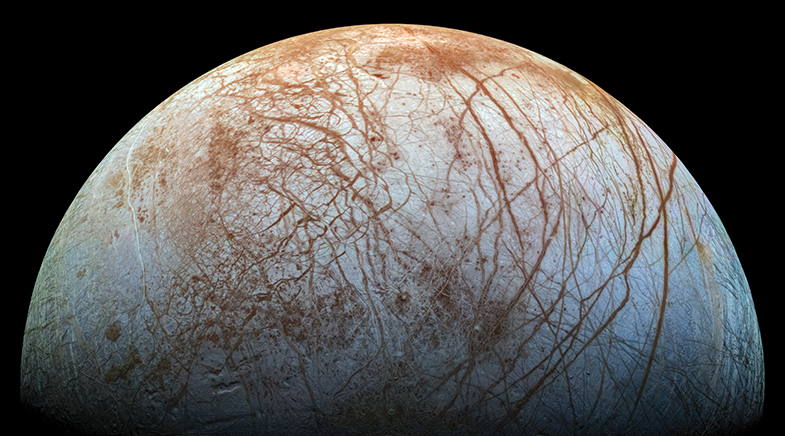
Sankhabrata Chandra studied in a boarding school at the foothills of the Ayodhya Hills in Purulia, West Bengal, a setting of pristine nature and clear, dark night skies speckled with countless stars. As a middle-school student, Chandra looked forward to the nature studies and stargazing classes organised by the school. They sparked an enduring fascination with the night sky, watching Jupiter, Saturn, and star constellations through a telescope, which eventually culminated in a career as an astrophysicist. An Associate Professor at the Saha Institute of Nuclear Physics (SINP), Kolkata, Chandra studies Europa, Jupiter's icy moon, believed to harbour an immense ocean beneath its frozen surface. Chandra joined SINP after a stint at the NASA Jet Propulsion Laboratory (JPL) and is exploring the effects of radiation on planets. "When charged particles interact with an atmosphere, a very interesting chemistry occurs, allowing us to identify potential biosignatures, such as methane and carbon disulfide, by simulating these reactions in the laboratory," says Chandra.
Radiation — energetic particles and electromagnetic energy from stars, supernovae, and other cosmic sources — constantly hits planets, moons, comets, and interstellar material. It can break apart molecules, trigger new chemical reactions, and alter the surfaces and atmospheres of planetary bodies. Chandra and other researchers are trying to understand how radiation can reshape the chemistry of worlds beyond Earth.
In a 2026 study (bit.ly/icy-planets) published in ScienceDirect, Chandra, his mentor Murthy Gudipati, and Bryana L. Henderson investigate how high-energy electron radiation alters the surface and atmospheric chemistry of icy bodies in the outer solar system, specifically Europa. They recreated Europa's radiation-rich environment in the laboratory by bombarding icy mixtures of water, carbon dioxide and simple hydrocarbons with energetic electrons. Radiation broke down simple molecules and triggered reactions that produced more complex organic compounds, which could potentially escape through cracks and plumes on Europa's surface. The study provided data that could help scientists interpret observations from missions such as NASA's Europa Clipper and the James Webb Space Telescope.
As radiation increases, simple molecules combine into complex ones. Push radiation further, and it tears those molecules apart.
Simple to complex
Gudipati, a senior research scientist at JPL, has spent nearly three decades studying the evolution of ice on planets and other stellar objects. In his laboratory, which mimics the interstellar environment, he and his colleagues investigate how complex molecules can form from simpler ingredients such as carbon dioxide, water, methanol, and ammonia in a radiation environment. The reactions may have helped build an inventory of molecules that eventually contributed to the emergence of life roughly 3.8 billion years ago.
But radiation does more than simply drive chemistry. Gudipati says that as radiation increases, it can initially help simple molecules combine into increasingly complex ones. Push the radiation further, however, and it tears those molecules apart.
Europa is a candidate for habitability as it hosts a subsurface ocean, along with energy, minerals, and other ingredients considered necessary for life. But researchers cannot drill through the 20–30-km-thick ice sheet to look for life; so, they study whether material from the subsurface can travel upward where it might be detectable.
Gudipati shares that molecules associated with life — bacteria or other material — could slowly move toward the surface. Europa receives intense radiation as Jupiter's magnetic field accelerates electrons and ions to high energies. But what happens when molecules from the subsurface manage to reach the irradiated surface? "It is almost a cosmic dance," says Gudipati. Whether radiation creates or destroys molecules depends on its energy, intensity, and how long the material is exposed to it.
Laboratory experiments and telescopic observations show radiation is crucial to the chemistry of interstellar ice. Radiation can help form complex organic and prebiotic molecules in icy grains. These molecules may later become incorporated into comets and be potentially delivered to young planets. "This is the connecting part of the process," Gudipati says, on the link between interstellar chemistry, comets, and the emergence of life.
Comets, says Gudipati, are like "deep-fried ice cream": their outer layers are exposed to the harsh space environment, while their cold interior can preserve ancient material. As a comet approaches the Sun, the ice warms and changes from a loose, porous form to denser crystalline ice. During this transition, organic molecules trapped in ice are pushed towards the surface, contributing to a hard, dark crust. Deeper inside, the comet can remain extremely cold and porous, preserving material from the early solar system. Gudipati and colleagues explore this transformation in their 2023 study (bit.ly/molecular-ice) through laboratory experiments.
They found that amorphous water ice — randomly distributed, disorganised water molecules — can trap large amounts of volatile molecules such as CO2. As amorphous ice warms, it becomes crystalline and releases the trapped molecules. The work illustrates how temperature changes the structure of astrophysical ice and alters the fate of molecules inside it.
Gudipati's team recreates interstellar ice in the laboratory, cools it to extremely low temperatures, exposes it to different forms of radiation, and studies the resulting chemical changes. "Astrophysical processes cannot always be reproduced in the laboratory under those exact astrophysical conditions," observes Gudipati. Instead, researchers create laboratory analogues that capture the essential chemistry within a practical timescale. Computer models, based on observations and theory, provide another way to simulate these environments and test molecular evolution under different conditions.
A planet's inheritance
Theoretical astrophysicist Liton Majumdar of the National Institute of Science Education and Research, Bhubaneswar, works at the interface of modelling and observations. His group works on two frontier questions: the origin and evolution of planets in our galaxy, and the formation and evolution of planets — what they are made of, and whether Earth-like planets around Sun-like stars might show atmospheric signatures linked to habitability. "Radiation plays a huge role in shaping the composition of the gas and material from which planets and their atmospheres form," says Majumdar. "Even after a planet is formed, radiation from its host star can continue to alter its atmosphere through photochemistry," he adds.
The chemistry of a planet's atmosphere is determined not only by what it is made of, but also by the radiation it gets from its star.
Using the XODIAC model, Majumdar's group developed a model of sulfur chemistry in Venus and Venus-like exoplanet atmospheres in a 2026 study (bit.ly/venus-sulphur) published in The Astrophysical Journal. Although the model could explain most of the sulfur compounds in Venus's atmosphere, it could not account for the presence of S3 and S4, molecules made of three and four sulfur atoms. Researchers suggested an unknown source of sulfur near the planet's surface could be responsible. "There might be a hidden source of sulfur in the deep atmosphere of Venus," says Majumdar. NASA's future mission such as DAVINCI could test the idea, he adds.
Researchers worked to see how Venus's atmosphere might change if the planet orbited different stars. They exposed a Venus-like planet to various levels of stellar radiation and found the atmosphere could differ markedly depending on its chemical composition.
"The incoming radiation reaching the atmosphere plays a huge role in controlling the chemical composition," says Majumdar. In other words, a planet's atmospheric chemistry depends not only on what it is made of, but also on the radiation it receives from its star.
Majumdar's interest in Venus grew out of his broader work on exoplanets. He desired to find whether Venus was once hospitable to life and, if so, what changed. Could Earth meet the same fate? "We should be more concerned about our neighbour," says Majumdar.
From the irradiated surface of Europa to ice in comets and the atmospheres of Venus-like planets, radiation emerges as the energy capable of building, transforming, and tearing apart molecules. Gudipati observes that three decades of studying the universe have changed his view of life on Earth — how valuable it is.
See also









How AI can 'cure' healthcare
Artificial intelligence applications hold out the promise of a wholesale transformation of healthcare practices across the spectrum.



The many wonders of life
Raghuveer Parthasarathy's book has as much thought-provoking material for the practising scientist as it does for the lay reader.



Have a
story idea?
Tell us.
Do you have a recent research paper or an idea for a science/technology-themed article that you'd like to tell us about?
GET IN TOUCH

