

Beat the heat
-
- from Shaastra :: vol 05 issue 06 :: Jun 2026
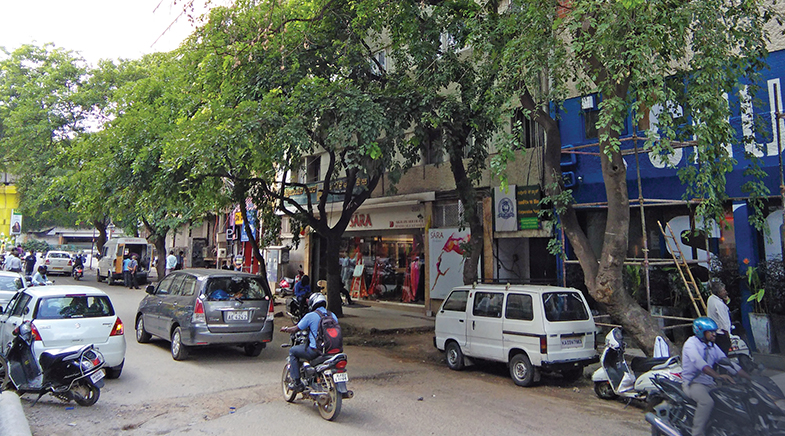
Studies on urban greening spring some surprises.
It's been a blistering summer in most parts of India — and in patches across the world, too. Daytime temperatures exceeding 45° Celsius no longer surprise North India. People have been preparing for survival in an increasingly hot world — as the spiralling sales of air coolers and air conditioners indicate.
One such solution that has found nationwide — and even global — acceptance is tree planting. From the northern to the southern hemisphere, across tropical and temperate climates, and in cities with big and small budgets, tree planting and greening are go-to strategies to manage heat.
Intuitively, this is an easy-to-grasp idea for anyone who has sought shelter under a tree on a hot day. In reality, though, urban greening and consequent cooling are not always directly connected. Some caveats make urban greening an effective cooling strategy — and increasingly, research is unpacking those nuances.
HUMID HEAT
In a recent study (bit.ly/green-perception) in Nature Communications, researchers from the Indian Institute of Technology (IIT) Gandhinagar analysed data from 138 Indian cities to understand how green cover affects perceptions of heat. In particular, the study examined how heat perception varies with humidity. The researchers used data from every city on Leaf Area Index (LAI), Enhanced Vegetation Index (EVI), and Fraction of Absorbed Photosynthetically Active Radiation (fPAR) to understand vegetation structures and examine how it interacted with urban morphology to influence the city's temperature. LAI is a measure of the total green leaf area per unit ground surface, EVI measures vegetation health and density, and fPAR is the fraction of photosynthetically active solar radiation absorbed by plants.
Two major ways drive the cooling effect of green cover: shading the built surface from the Sun's rays, and transpiration.
"What was totally surprising for us is that LAI, EVI and fPAR interact with each other non-linearly," says Udit Bhatia, lead author of the study and Pandya-Shivpuri Chair Associate Professor of Civil Engineering at the institute. "The same portion of leaf canopy combined with vegetation activity would have a different effect on cooling from one place to another." It is not just the presence or absence of trees that matters; "the type of canopy, how densely trees are packed" have to be factored in, too.
Two major ways drive the cooling effect of green cover: shading the built surface from the Sun's rays, and transpiration. Plant transpiration is like sweating. In humid conditions, microscopic pores (stomata) on leaves open, allowing water to evaporate. The Sun's thermal energy has to be absorbed for the evaporation to happen, which in turn cools the plant surface and can also cool the area surrounding the plant. "However, in humid or poorly ventilated environments, the same evapotranspiration adds moisture to the air faster than it can be dispersed, reducing the net cooling benefit or even intensifying perceived heat," the researchers note in the study.
Gandhinagar in Gujarat, for instance, has a dry, semi-arid climate. In such areas, increasing the green cover and consequently having high values of EVI, LAI, and fPAR would bring down the heat and provide thermal comfort. "I would not have the same recommendation for Chennai or Mumbai," Bhatia says. In these coastal, high-humidity cities, it is important to select trees keeping in mind their "vegetation activity", as that will contribute to humidity-associated thermal discomfort. Bhatia and his colleagues are now working on developing what they call "thermodynamically coupled urban models" to understand "which trees would have what thermal effect in the areas with high humidity, low humidity, and so on."
MULTIPLE STRATEGIES
Jayanarayanan Kuttippurath, Associate Professor at the Centre for Ocean, River, Atmosphere and Land Sciences, IIT Kharagpur, is looking at urban heat in conjunction with urban air pollution. In a recent study (bit.ly/Delhi-regions) on Delhi, Kuttippurath and his colleagues compared pollution and heat indices to identify vulnerable areas. A green cover not only mitigates heat but also reduces pollution. The study found that Central Delhi, where a part of the ridge — a vast urban forest — is located, has lower heat and pollution. Areas such as Lutyens Delhi and Chanakyapuri in Central Delhi are less affected by both heat and pollution; Rohini in the Northwest, Shahadra in the East, Najafgarh in the Southwest, and Badarpur in the Southeast experience higher heat and pollution stress. The high-stress regions have low greenery, dense built-up areas, and high traffic or industrial concentration.
TRUNK CALL
- A 2015 study in Nature (bit.ly/trees-stats) estimates that there are approximately 3.04 trillion trees worldwide. Of these, about 1.30 trillion trees exist in tropical and subtropical forests, with 0.74 trillion in boreal regions and 0.66 trillion in temperate regions. Over 15 billion trees are cut every year, and the global number of trees has fallen by approximately 46% since the start of human civilisation.
- A 2022 study (bit.ly/tree-types) in PNAS estimates that there are about 73,000 tree species worldwide, of which about 9,000 remain to be identified. Roughly 40% of undiscovered tree species are in South America; they are also very few in number and only found in remote locations. A recently released urban tree database of India notes that there are 742 urban tree species in India.
- According to the India State of Forest Report 2023, trees outside forests occupy 1,12,014 square kilometres — 3.4% of the country's total area.
The areas with lower heat and pollution stress were also the more affluent neighbourhoods. A recent study (bit.ly/rich-nations) in Nature Communications, which examined nearly 9,000 urban areas worldwide, found that heat mitigation from green cover is greater in high-income countries and suburbs, and that greening efforts should expand into densely settled, low-income urban areas to achieve equitable urban heat island mitigation. The study also found that, on a global scale, trees in urban environments reduce the urban heat island effect by half. However, by about mid-century, the same number of trees will reduce the heat by just 11%, says Tirthankar Chakraborty, one of the authors of the paper and an Earth Scientist at the Pacific Northwest National Laboratory in the U.S. "Even if you increase trees to the maximum possible within these cities, that's going to reduce mid-century warming by 20%," he adds. Chakraborty warns that despite many benefits associated with greening, it may not be enough, and that diverse solutions are needed to address rising heat.
A study has found that, on a global scale, trees in urban environments reduce the urban heat island effect by half.
Warming projections across the globe, including in India, paint a grim picture. A May 2026 study in Frontiers in Environmental Health (bit.ly/heat-danger) estimates that a single day of extreme heat causes approximately 3,400 excess deaths nationally; a five-day heatwave causes nearly 30,000. "By mapping heat-induced mortality risk to individual districts, this study finds that Uttar Pradesh alone accounts for approximately 8,100 excess deaths during a five-day heatwave, and districts such as Ahmedabad, Jaipur, and Surat each exceed 250 excess deaths in a single event," the study notes.
Clearly, the need for effective heat-mitigation strategies and thermal comfort is high. And, at least partially, this need can be fulfilled via greening if executed correctly.








The unfolding world of robotics
The art of origami gives shape to cutting-edge technology.

Space-age Entrepreneurs
A cluster of start-ups led by young engineers is making a mark in India's newly unlocked aerospace market.
Turning up the heat
Researchers are looking at multiple ways to capture, store, and release thermal energy.



Have a
story idea?
Tell us.
Do you have a recent research paper or an idea for a science/technology-themed article that you'd like to tell us about?
GET IN TOUCH