

How does your garden grow?
-
- from Shaastra :: vol 05 issue 03 :: Mar 2026
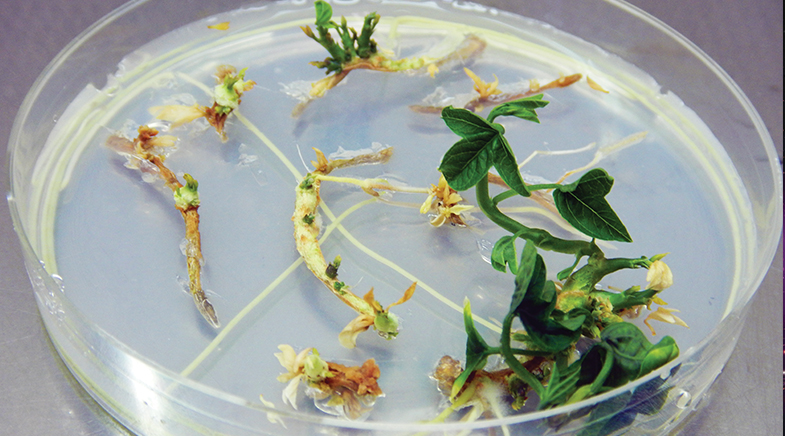
Cellular processes that clear damage from injury may lead to regeneration.
Anyone with even a passing interest in growing plants will know about their remarkable ability to regenerate. Just a stem cutting of a rose or a hibiscus plant, for instance, can give birth to new roots and shoots. Or take the hardy Bryophyllum: even a detached leaf can produce many new plants. Plants, clearly, have a higher regenerative capacity than animals — a unique ability that has generated considerable research over the years.
A new study (bit.ly/Regeneration-Mechanism) in Proceedings of the National Academy of Sciences (PNAS) has found the biological mechanism that enables plants to regenerate. Working with the plant Arabidopsis thaliana, commonly used in laboratories because of its short life cycle and ease of growth, the researchers discovered that the biological mechanisms that mitigate stress and trigger the clearance of stress-induced damage also enable plants to regenerate.
Think of a stem cutting placed in soil. The cut surface is a wound. Cells at this site experience intense stress and produce reactive oxygen species (ROS) — molecules that can damage cellular components. Yet it is precisely from this stressed tissue that new roots often emerge.
The researchers show that wounding triggers a burst of ROS that serves as an early signal. However, regeneration depends on keeping ROS within a particular range: too much blocks regrowth, and too little impairs it, too. Achieving this delicate balance requires autophagy — a cellular 'clean-up' process conserved across living organisms, in which damaged proteins and organelles are degraded and recycled.
At the heart of this process are the PLETHORA (PLT) transcription factors, which have long been known to regulate root development. Several past studies have shown that PLETHORA genes play a role in plant healing, but their ability to activate autophagy-related genes is a new finding. "People in our own lab have studied the role of PLETHORA genes in plant-healing (in the past), but we never knew that it could bring the stress level down through autophagy access," says Kalika Prasad, Professor at the Indian Institute of Science Education and Research Pune, and one of the authors of the PNAS paper.
Further, the researchers found that disrupting PLETHORA's role in triggering autophagy severely impaired the clearance of damaged organelles, increased stress, and led to the accumulation of ROS. However, when PLETHORA-mediated autophagy happened optimally, the ROS levels were also optimal, which in turn enabled stem-cell regulators to regenerate new roots. The researchers also noted that although the specific PLETHORA-dependent mechanism was plant-specific, the broader coupling between ROS signalling and autophagy during tissue repair was similar to that observed in animal wound responses. The fundamental principle — that controlled stress responses can enable regeneration — is common to both plant and animal kingdoms.
Utpal Nath, Professor in the Department of Microbiology & Cell Biology at the Indian Institute of Science, Bengaluru, points out that while both autophagy and ROS signalling have been extensively studied in plants and animals, this work links them hierarchically with PLT transcription factors in the specific context of regeneration. "If you think of the genes as stars, there are millions of them. But this study identifies the combination of stars that come together to make a constellation," he says.
Prasad notes that the improved understanding of the cellular mechanisms underlying regeneration may have practical consequences. Plants that fail to regenerate after injury or in tissue culture include many crucial crops such as cereals, pulses, and several tree species. Advanced biotechnology tools allow researchers to make genetic changes in a single plant cell with relative ease. But regenerating a whole plant from the modified cell is a challenge, especially in recalcitrant plants. "If you understand the mechanism [of regeneration], you can tweak it to make even those [recalcitrant] plants regenerate better," Prasad says. By fine-tuning the stress response and autophagy, researchers may be able to push plants into regenerative mode. "The path to regeneration goes via managing stress," he says.
See Also:









Green, screen & clean
AI-ML saves water, and aids farmers and viewers.

A not-so-smooth ride for driverless cars
Self-driving cars are revving their engines, but safety concerns linger.
Blowing hot and cold
Dealing with a double whammy of El Niño and climate change.



Have a
story idea?
Tell us.
Do you have a recent research paper or an idea for a science/technology-themed article that you'd like to tell us about?
GET IN TOUCH