

Hurray for moiré
-
- from Shaastra :: vol 05 issue 08 :: Aug 2026
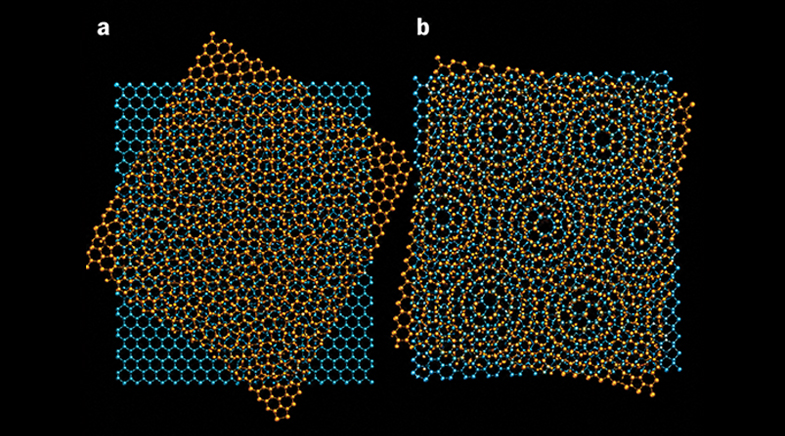
Moiré patterns are opening doors — to quantum materials, microscopy, and more.
Rainer Heintzmann slowly rotated a grid-patterned sheet over another, and the image of a bearded man suddenly appeared from the seemingly messy grids. Heintzmann's face lit up at the sight of the pattern emerging from apparent randomness — the essence of what is known as a moiré pattern. These structures form when two grids overlap in a somewhat mismatched fashion. The physicist at the Leibniz Institute of Photonic Technology in Jena, Germany, demonstrated one such pattern to Shaastra in a recent online interview.
The word moiré — from the French for "watered textile" — came from French textile workers, who noticed shimmering wavy patterns on layered silk fabrics. The geometry created by the mismatches has led to breakthroughs in areas ranging from superconductivity and quantum materials to microscopy, signal processing, and architecture.
Heintzmann is one of the pioneers of a moiré-based imaging technique called Structured Illumination Microscopy (SIM), which enables high-resolution imaging beyond the conventional limits of light microscopy. On Christmas Day in 1997, Heintzmann realised how to uncover hidden information in moiré patterns, an insight that led to modern super-resolution microscopy. Three decades on, he continues to refine the technology. In March 2026, he filed a patent application for an advanced form of SIM designed to make the technique more robust, practical, and easier to use. In a 2025 study (bit.ly/automated-moire), Heintzmann's team reported it had developed a fully automated, two-colour SIM system that used relatively inexpensive components while delivering significantly sharper images than conventional microscopes.
In microscopy, moiré interference helps scientists see structures smaller than the normal limit of light resolution. In SIM, a sample is illuminated with a fine striped pattern. When this pattern overlaps with tiny structures in the sample, it creates larger moiré fringes that the microscope can detect more easily. These fringes act like carriers, translating information from structures that are too small to see directly into patterns that the microscope can record. By capturing several images with slightly shifted illumination patterns and combining them mathematically, researchers can reconstruct details that would otherwise remain hidden.
The approach has helped researchers reveal biological structures that were previously difficult to observe — such as transport networks inside cell nuclei and ring-like actin structures in neurons. "SIM did not necessarily show entirely new structures but made them obvious enough for scientists to recognise their biological significance," Heintzmann says.
Traditional SIM systems are highly sensitive to imperfections such as dust and optical distortions. The new system reduces dependence on perfectly regular illumination patterns and flawless optics, making high-resolution imaging easier to achieve in real-world laboratory conditions.
TWIST AND TURN
The geometry that helps microscopes see finer details also transforms the behaviour of electrons inside materials. The moiré patterns act as amplifiers. Twisting two slides of graphene sheets at a 1.1°-angle, or the "magic angle", could transform materials into super-materials. Graphene is an ultra-thin sheet of carbon atoms packed in a honeycomb pattern, just one atom thick. American theoretical physicist Allan H. MacDonald predicted this transformation in 2011. MacDonald was awarded the prestigious Kavli Prize for Nanoscience 2026 for his contribution to a field called twistronics. "Twisted graphene is only the tip of the iceberg," MacDonald says.
Researchers report in a recent paper (bit.ly/sheets-twist) that they studied what happened when two atom-thin sheets of molybdenum diselenide (MoSe2) were placed on top of each other with a slight twist. This created a large repeating moiré pattern. As the atoms slowly shifted to settle into their most stable arrangement, the team discovered a completely new type of light-generated particle called a trion, that is, an exciton with an extra electric charge. An exciton, formed when light excites a material, is an electron and a positively charged 'hole'.
MacDonald and his collaborators have shown that moiré patterns do much more than change how electrons move. They can create entirely new particles that do not exist in ordinary materials. Understanding and controlling these particles could help scientists design better light-based devices, improve quantum technologies, and develop new ways to manipulate information using light and electrons, opening new possibilities for quantum optics, advanced photonic devices, and future quantum technologies.
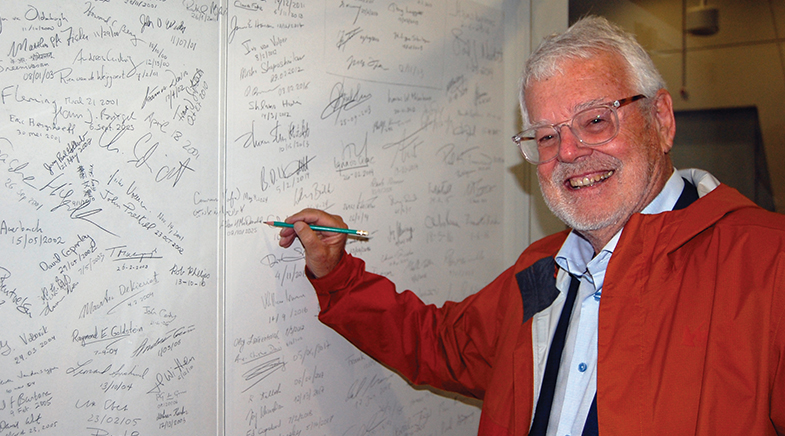
"One of the most remarkable aspects of moiré materials is that the same ingredients can produce completely different kinds of quantum behaviour simply by changing their geometry," MacDonald explains. For instance, stacking and twisting two layers of transition metal dichalcogenides (TMDCs) — one-atom-thick semiconductor materials — creates a class of materials, while combining two different TMDCs produces an entirely different one. To MacDonald, this shows that geometry is as powerful a design tool as chemistry for creating new materials.
ULTRASENSITIVE MOIRÉ
Using the same twisted layers of TMDCs, Zhenglu Li and his group from the University of Southern California show how to develop ultrasensitive quantum sensors (bit.ly/sensor-quantum). The researchers explored a special electronic state known as a generalised Wigner crystal in moiré materials. The moiré pattern acts like a giant egg carton for electrons. When a small number of electrons is added or removed, they no longer spread out evenly; they arrange themselves into an orderly pattern, with each "pocket" in the moiré lattice either occupied by a single electron or left empty. This creates an even larger repeating pattern than the original moiré lattice. "It's either one or zero," says Li, referring to whether each moiré site contains one electron or none.
The team investigated what happens to excitons in a generalised Wigner crystal, a quantum solid made of electrons. It found that the moiré materials were extremely responsive to small external disturbances. A slight change in the electric field, magnetic field, strain or even the number of electrons could dramatically change their quantum state. The work shows that excitons can faithfully reflect these changes because they inherit the unusual quantum properties of the underlying electrons.
Moiré patterns can create particles that do not exist in ordinary materials, and help scientists design light-based devices.
In the future, scientists may shine a laser on a moiré material and analyse the emitted light. Because excitons respond to even minute changes in their surroundings, they could enable exceptionally sensitive quantum sensors for detecting weak electric and magnetic fields, nanoscale imaging, quantum communication, biomedical sensing, environmental monitoring, GPS-free navigation, and reading out quantum computers.
A HIDDEN WORLD
"Twistability gives us enormous freedom. It is my choice how I arrange the layers, and that changes the material's properties completely," says Anindya Das, a physicist at the Indian Institute of Science (IISc), Bengaluru. Das and his colleagues have found that two very different kinds of electrons can coexist in the same system (bit.ly/thermopower-graphene). Some electrons remain trapped within the moiré pattern, while others continue moving through the material almost freely. Theorists had predicted this coexistence earlier, but Das says his group's experiments provided some of the strongest evidence of it. The trapped electrons also behave like tiny magnets whose fluctuating spins strongly influence the material's quantum properties.
In ordinary graphene, electrons move freely between carbon atoms. But when two graphene layers are twisted relative to one another, the resulting moiré pattern creates a new landscape for electrons. In some regions, electrons become trapped and can no longer travel freely. Because many electrons are crowded into these confined regions, they begin to interact strongly with one another, producing quantum behaviours that do not exist in either layer alone.
Das's group has been exploring the strange metallic property of twisted bilayer graphene. A strange metal is a material that conducts electricity like a metal but whose electrons defy conventional theories that explain ordinary metals. They found an unusual metallic behaviour in twisted bilayer graphene. He says scientists are trying to understand why these materials behave very differently from ordinary metals. In normal metals, electrons are usually thought of as tiny particles moving through a large "sea" of electrons. This picture helps scientists explain how electricity flows through materials.
In another study (bit.ly/fermiology-moire), researchers from the Massachusetts Institute of Technology, U.S., have shown that when two slightly mismatched atomic lattices overlap, they create moiré superlattices that dramatically alter how electrons move. Under strong magnetic fields, electrons inside these crystals behaved in ways predicted for hypothetical four-dimensional quantum materials. The researchers described this as electrons moving through a "synthetic" extra dimension created by the geometry of the moiré pattern itself. The work will enable scientists to study exotic forms of superconductivity and other quantum properties that were earlier hidden in the material's geometry.
LIGHT ON MOIRÉ
Akshay Singh, a physicist at IISc, says that a slowly varying moiré pattern may have "dramatic consequences" for the physics of a material. His group, which studies twisted layers of MoSe2 and tungsten diselenide (WSe2), investigated how moiré patterns trap excitons, and how these trapped particles give rise to unusual optical and quantum effects.
The team fired some short ultrafast laser pulses to excite excitons in the moiré lattice. While tracking their dynamics, the team observed (bit.ly/quantum-siphoning) an unusual effect that Singh calls "quantum siphoning". Normally, when a laser excites an excitonic state, the number of excitons rises and then gradually decays. However, under certain conditions, the researchers observed the opposite behaviour: the number of a particular state initially dropped before recovering later. Singh explains that the laser appeared to drain excitons from one energy level and transfer them to another. He compares the process to a siphon, where water suddenly flows from one container to another once it reaches a certain level.
Researchers have developed a neutron interferometer that uses moiré patterns instead of large, perfectly aligned crystals.
Although researchers do not yet fully understand the underlying mechanism, the discovery offers a new window into the complex interactions that emerge inside moiré lattices.
ART MEETS SCIENCE
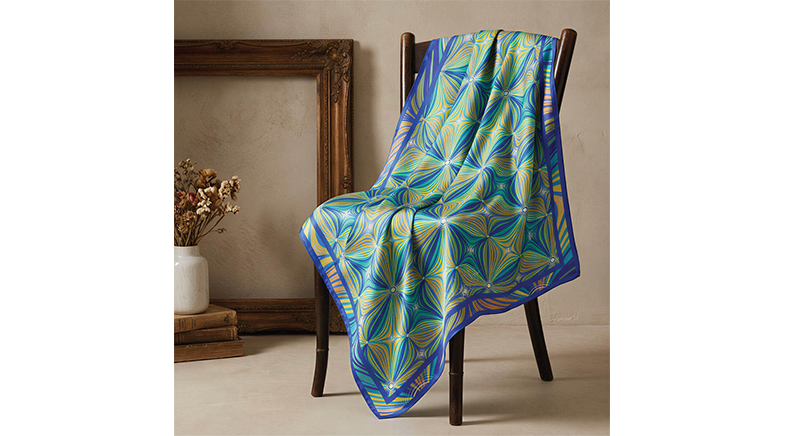
Maciej Zworski, a mathematician at the University of California, Berkley, recently presented his mother with a silk scarf. The speciality of the scarf lies in its intricate design, a pattern that emerged from research conducted by Zworski's group. A Paris-based artist, Ban Zheng, who runs an initiative called Art4sciences, collaborated with Zworski and turned the pattern into a work of art (bit.ly/magic-angles).
In a 2024 paper (bit.ly/create-move), Zworski's group showed that applying a magnetic field parallel to twisted bilayer graphene could dramatically reshape its electronic behaviour. They found that the field could create, move, merge, or split special locations called Dirac points — points where electrons lose their usual effective mass and travel through the material extremely easily, almost as if they were massless. As the twist angle and magnetic field change, the Dirac points follow intricate geometric paths, meeting at certain locations, splitting apart, and branching into new patterns before moving again. The researchers showed that the underlying moiré governed these geometric changes.
The study introduces the in-plane magnetic field as a new way to control moiré materials, alongside the twist angle and electric field. Since the Dirac points strongly influence remarkable phenomena such as superconductivity and other exotic quantum states, the ability to manipulate them gives scientists a powerful new tool to explore these behaviours and design future quantum materials and devices.
GEOMETRY, THE HERO
Geometry is opening doors to the hidden world of superconductivity, from quantum sensors and microscopes to interferometers. Dusan Sarenac and his colleagues at the University of Waterloo, Canada, in recent research, developed a new type of neutron interferometer that uses moiré patterns instead of large, perfectly aligned crystals. A neutron interferometer splits a beam of neutrons into two paths and then brings them back together. The resulting interference pattern reveals how gravity, magnetic fields, or materials affect the neutrons. The researchers suggest that, as the technique is refined, it could enable more precise measurements of gravity and Newton's gravitational constant, and provide a powerful new tool for studying the internal structure of materials. The work shows that the moiré effect can significantly improve one of the most important instruments used to explore the quantum world.
"We've learned that geometry isn't just a mathematical idea; it can be a powerful tool for discovering new materials and new physics," says MacDonald.
Once treated as a visual effect, moiré patterns have become one of the most powerful ideas in modern science. A simple geometric pattern, born from two overlapping grids, is now helping scientists uncover hidden quantum worlds, and may one day reshape the technologies of the future.
Also read









Teaching AI to reason
In the search for reliably autonomous artificial intelligence, researchers are layering AI with rationality.
Out of this world
India's first inflatable space habitat is all set to take flight, taking space tech prowess to new heights.

The best of engineering and medicine
Emerging techniques from engineering are set to revolutionise the way medicine is practised and taught in the future.



Have a
story idea?
Tell us.
Do you have a recent research paper or an idea for a science/technology-themed article that you'd like to tell us about?
GET IN TOUCH