

Jurassic colours
-
- from Shaastra :: vol 05 issue 04 :: Apr 2026
Well-preserved fossils bring dinosaur colours to life.
Dippy the dinosaur graced the Hintze Hall of London's Natural History Museum with its presence for decades. Walking next to this skeletal replica of a Diplodocus gave wide-eyed museum visitors a true sense of its enormous size — an extremely long neck supporting a small head and a long, whip-like tail. In life, a Diplodocus carrying this 292-bone skeleton would have weighed 15 tonnes as it moved on all its fours about 150 million years ago. For comparison, the formidable Tyrannosaurus rex, with its hopelessly small arms, weighed in at 10 tonnes.
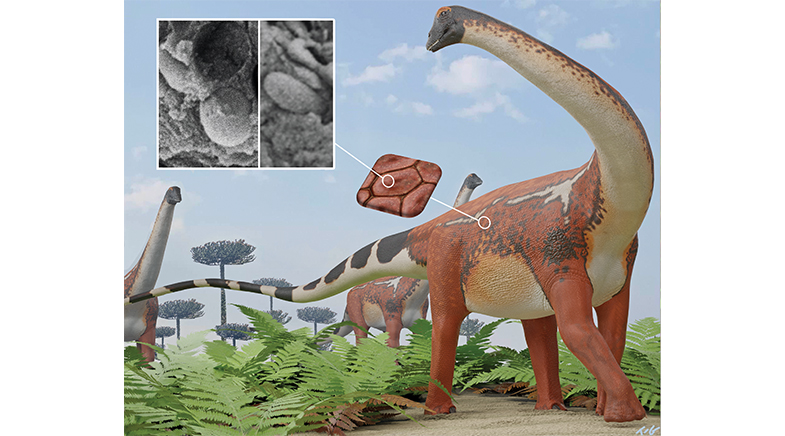
If palaeo-artists of today were to fashion a skin for Dippy, which arrived at the museum in 1905, it would be covered in a patchwork of scales of all shapes and sizes — complete with a dusting of colour.
Palaeontologists have been reconstructing the colours of extinct dinosaurs based on tiny details preserved in their fossils and comparisons with living dinosaurs — birds. But until now, there was no proof of colour in sauropod dinosaurs such as the iconic Dippy, which is currently not at the museum. Sauropods, a group of giant, plant-eating dinosaurs famous for their long necks and tails, include, apart from Diplodocus, classics such as the Brontosaurus and Brachiosaurus.
In a recent study published in Royal Society Open Science, scientists reported the first evidence of colour in the scaly skin of a sauropod (bit.ly/speckled-skin). They discovered cellular structures that store the pigment melanin — called melanosomes — in the specimens. These 145-million-year-old fossils come from a graveyard of dinosaurs unearthed in an American quarry.
It is believed that in the Late Jurassic period, a herd of young sauropods died at a water source that had dried up. Their skeletons and skin eventually washed away and were buried in the debris, ending up as fossils in what is today the Mother's Day Quarry in Montana, U.S. According to current understanding, the quarry's fossils are primarily Diplodocus, but a taxonomic reshuffling might be underway.
Using scanning electron microscopy, scientists found melanosomes in scales they had carefully scraped off the fossil Diplodocus skin. Melanosomes are organelles that are responsible for the colour of one's skin, hair and eyes, says Tess Gallagher, first author of the study, who was a Master's student in the Department of Palaeobiology, University of Bristol, U.K., at the time of research. Bird feathers also get their colours from melanin-bearing melanosomes (in addition to other pigments and structures).
Gallagher identified two types of melanosomes in the dinosaur scales. One somewhat resembles a type of melanosome present in colourful, modern-day birds. In brightly coloured birds, these melanosomes are stacked, creating a larger reflective surface for iridescence in a feather, she explains. But the melanosomes in Diplodocus scales were smaller and organised differently, being intermixed with another type. "So, we don't suspect in our specimens that they were super colourful or iridescent," she says. But the grouping of the two types indicates that sauropods had speckled scales.
"What colour those speckles were, we don't really know," says Gallagher. Even so, she thinks the discovery is bizarre. "For a very long time, it was thought that birds are special for having super-diverse melanosome shapes and that these diverse melanosome shapes are tied to their feathers." So far, sauropods have turned up no evidence of feathers. And feathers have been crucial in unlocking the colour of dinosaurs.
FEATHERS MAKE A SPLASH
Dinosaurs are divided into three groups: sauropods (four-legged herbivores), ornithischians (two-legged herbivores and armoured dinosaurs), and theropods (flesh-eating dinosaurs and the ancestors of birds). The first evidence of colour in non-avian dinosaurs — in the form of prehistoric melanosomes — came from theropods, the group that features T. rex.
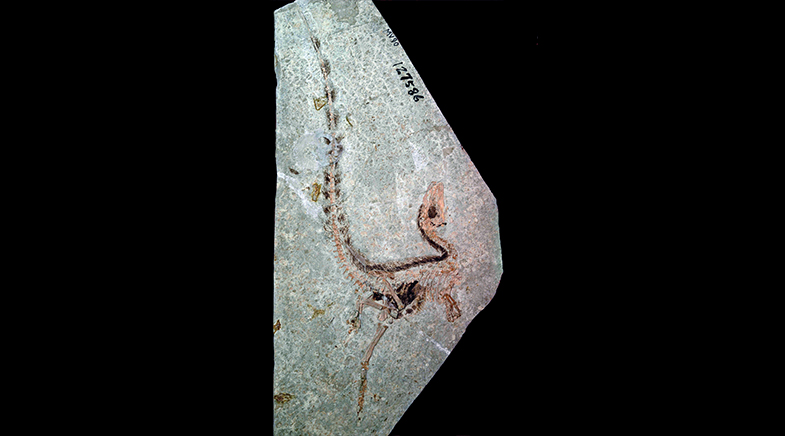
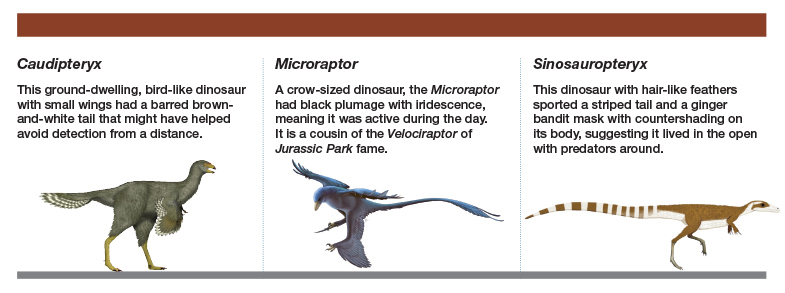
"Twenty years ago, of course, people would say you could never find the colour of any extinct animal, especially a dinosaur," says palaeontologist Michael J. Benton. That changed in 2010, when Benton and his collaborators published their findings of colour in Sinosauropteryx and other theropods, based on exceptionally preserved fossils from northeastern China. They chose to study the Sinosauropteryx in particular because it was the first feathered dinosaur to be named — and it wasn't closely related to birds. "So, there is no question it's a dinosaur," Benton says. This Early Cretaceous dinosaur had bristle-like feathers on the neck, head, body and tail, some of which the scientists examined. They reported that stripes on its tail and feathers down its back were reddish-brown in colour (bit.ly/theropods).
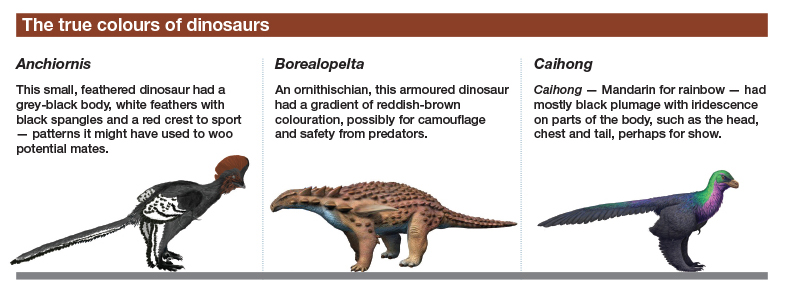
Simultaneously, another team of scientists independently reconstructed the plumage colouration of Anchiornis, a feathered and winged theropod from the Late Jurassic period. They worked out that this tiny bird-like dinosaur was multicoloured with black, grey, red and white feathers that gave it a mottled look (bit.ly/Anchiornis). "We were able to reconstruct the colours from a whole dinosaur," says palaeontologist Jakob Vinther.
"It was as if palaeontologists had solved an impossible problem — we knew the colour of dinosaurs," adds Benton.
The two competing research groups predicted the colour of dinosaurs for the first time by comparing their fossil melanosomes with those found in bird feathers. "People had already been studying melanosomes in modern bird feathers for a long time, and in mammal hair," says Benton. "And they had noticed there are these two chemical forms of melanin."
The black, brown and yellow tones of the skin and hair of humans and other mammals, as well as bird feathers, come from eumelanin. Phaeomelanin is the pigment that gives red squirrels and red pandas their hue, and a reddish-brown tint to bird feathers and 'ginger' hair in humans. The melanosomes that contain the black eumelanin, called eumelanosomes, are rod-shaped, whereas the ones with the reddish-brown phaeomelanin, the phaeomelanosomes, are spherical. In the tail of Sinosauropteryx, Benton identified spherical phaeomelanosomes, giving it a reddish-brown or ginger colour.
Other than the chemical form of melanin, what determines the colour is its amount. A small amount of eumelanin, for instance, results in blonde, a medium amount gives it a brown hue, and a large amount means black. When you get old, says Benton, pointing at his hair, you lose melanin and your hair turns transparent. "We call it white, but it's actually transparent — no colour," he says. "When we were preparing to write the paper, we were reading lots of articles in journals of hairdressing."
What led to the discoveries of colour in dinosaurs was proof that melanosomes could survive fossilisation. And it had come just two years earlier, in 2008, from fossil birds — including a 100-million-year-old feather and a 55-million-year-old bird skull with feathers (bit.ly/bird-fossils). Until then, melanosomes were thought to be fossilised bacteria.
These first studies of melanosomes in fossil birds and theropods created the perfect palette for colouring in other extinct dinosaurs. With analytical tools, scientists were even able to detect melanin in the fossils. In organic residues from a fossil of the armoured dinosaur Borealopelta from the Early Cretaceous, Vinther and colleagues identified chemical signatures of phaeomelanin (bit.ly/fossil-melanin). Melanin survives fossilisation because it is a "ridiculously resilient" pigment, says Gallagher. "Think about what melanin does for our skin. It protects us from UV rays."
In addition to pigmentation, iridescence — the metallic lustre seen in some modern birds — has been reported in feathered dinosaurs such as the Microraptor, Caihong and Wulong. Iridescence is a type of structural colouration resulting from the interaction of light with layers of melanin and keratin. However, as keratin in feathers does not survive fossilisation, the specific colours of the iridescence cannot be determined. Even so, the melanosomes in iridescent feathers are unique, says Vinther.
THE STORIES COLOURS TELL
Scientists can infer a lot about dinosaurs from fossils — from the strength of their bone-crushing jaws to their running speeds or what they ate for lunch.
"We want to accurately depict dinosaurs and understand dinosaur biology," says Vinodkumar Saranathan, Junior Chair Professor at CNRS-University of Tours, France. For that, knowing how they look is important, says Saranathan, who studies the colours of animals, both living and extinct. "Birds are living dinosaurs," he says. If dinosaurs show the same kind of colours and body patterns as modern birds, "then we can posit that they were using them in the same kind of context".
The black tips on the white feathers of modern seagulls protect the feathers from wear and tear by strengthening them. They probably did the same for feathered dinosaurs such as Anchiornis, which also sported white feathers ending in black. "Melanin is a tough molecule," says Benton. Additionally, the overall spangled patterning of Anchiornis could be an adaptation for living in trees, where light is dappled. Sinosauropteryx, meanwhile, likely evolved its ginger-and-white striped tail as a warning signal or to impress potential partners.
Years after Benton gave a ginger colour to its stripes, Vinther and colleagues found that Sinosauropteryx donned a ginger bandit mask, which could have helped camouflage its eyes from predators and prey (bit.ly/bandit-mask).
The feathered Sinosauropteryx and the armoured Borealopelta both show countershading — a gradient of colour with a dark upper body and pale underbelly — for camouflage. "It tells us that back in those days there were very scary predators, which of course is true," says Vinther.
In Diplodocus, Gallagher says, it's too early to explain why they have colour-bearing melanosomes. One hypothesis is that it had a feathered ancestor. An alternative idea is that in vertebrates, diverse melanosome shapes are tied to metabolism.
Sauropods grew at a rate similar to that of mammals and birds. But while mammals and birds stop growing after a few years, sauropods probably stopped at the age of 15 or 20. An animal growing that fast is probably going to be eating a lot of food, Gallagher says. A baby sauropod would be no bigger than a Chihuahua, but by age 15, it would be larger than an elephant — maybe two elephants, she says. "Our study on dinosaur colour, oddly enough, acts as… potential indirect evidence that juvenile sauropods had a high metabolic rate."
Melanosomes may provide clues about Diplodocus, but the question of its colour in life still eludes scientists. "True colours are very complex," Gallagher admits. Moreover, the melanosomes were present in scales and not feathers. To limit the destruction on such rare skin fossils, her team sampled only four scales with scanning electron microscopy.
NEW COLOUR SCHEMES
While investigating the colours of dinosaurs, scientists made some discoveries about modern birds. One is how birds make the colour grey.
In mammals, grey comes through when white hair mixes with pigmented hair, says Vinther. "You just have some hair without melanin and some hair with melanin." But birds can make feathers that are grey in colour because they have a unique melanosome. "That's something that we didn't know about birds," he says. "When we sampled birds with grey feathers, we realised that they have very big, fat melanosomes." Then, researchers asked if the melanosomes that make bird feathers iridescent are unique. "It turned out that they are," Vinther says. "They have different shapes, which is how we can tell iridescence in fossils... They're longer and skinnier, or they can be flat or hollow."
The discovery of iridescence in the fossils of feathered dinosaurs and ancient birds lends credence to the newly proposed idea that the ancestor of all living birds was iridescent (bit.ly/colour-transition).
Colours weren't just for show; their use in communication may have played a role in the evolution of complex feathers (bit.ly/fossil-colour). The feathers provided warmth, of course, says Saranathan, but they were also this new palette for colouration.
What's more, the detection of melanin in the first dinosaur fossils helped resolve the decades-long debate about whether there truly were feathers in dinosaurs, says Vinther, and cemented the hypothesis that dinosaurs gave rise to birds.








Planets' progress
A rare glimpse of a stage of planetary evolution may help fill gaps in some cosmic theories.

Harry Potter and the metamaterials
Metamaterials are paving the way for groundbreaking advancements, including with modern-day 'invisibility cloaks'.

India's tryst with 5G
With a collaborative tech development project, India has begun its efforts to become a serious global telecom player.



Have a
story idea?
Tell us.
Do you have a recent research paper or an idea for a science/technology-themed article that you'd like to tell us about?
GET IN TOUCH