

Managing diabetes without drugs
-
- from Shaastra :: vol 05 issue 11 :: Nov 2026
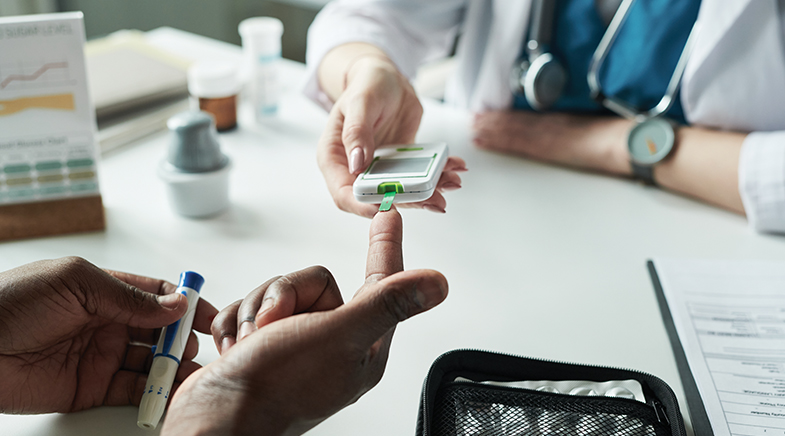
A wireless implant lowers blood glucose in diabetic mice.
Nearly 100 million diabetic Indians rely on a pill or an injection daily to keep their blood glucose stable. One in nine adults globally has diabetes, a condition where the body cannot maintain blood glucose levels, leading to lifelong dependence on medicines. The long-term use of life-saving drugs comes with side effects.
Researchers from the Department of Biosystems Science and Engineering, at ETH Zurich, in Switzerland, have developed a wireless, electronic implant — tested in vitro only on cells and mice till now — to manage blood glucose without drugs.
The device, called ECHO (electrocatalytic closed-loop health optimisation), contains platinum-decorated gold nanoclusters embedded in a porous graphite matrix that can be powered wirelessly. The device is implanted under the skin of diabetic and obese mice, and when powered with 10 milliamperes of current at 0.75 volts, catalyses the conversion of glucose into gluconate, which is cleared by the kidneys in urine.
The choice of catalyst is important, explains Debasis Maity, first author of the paper and Oberassistent (Established Researcher) at the University of Basel. It should be biocompatible and trigger the reaction at an appropriate low voltage.
Over a six-week test period, the lowered blood glucose shifted whole-body metabolism of treated mice to use stored fat, and their triglyceride levels and body weight dropped. No detectable adverse physiological, inflammatory, or behavioural effects in the treated mice were observed by the researchers who published their findings in Science (bit.ly/diabetes-implant).
Although the device has not yet been tested in humans, researchers note that connecting the implant to a standard continuous glucose monitor (CGM) can create an autonomous closed-loop system: the CGM monitors blood glucose and signals the implant to remove excess glucose from the blood. The conversion can be precise: the CGM indicates the exact elevation in blood sugar, and the implant triggers a commensurate correction, keeping blood glucose at the right level.
The technology, notes Maity, has far wider implications than managing blood glucose. It is a "platform technology", he says, and by choosing a "different catalyst one can target different biomolecules".



Lost in translation
India’s R&D spending is modest, which is why it must get more bang for its buck. Here’s how that can be done.

Designing buildings of tomorrow
Construction solutions that rely on digital tools and satellite data pave the way for a nature-friendly world, says digital technologist Will Cavendish.

For a sea change
Minerals from the ocean bed are luring explorers to its depths. But the red flags advise caution.



Have a
story idea?
Tell us.
Do you have a recent research paper or an idea for a science/technology-themed article that you'd like to tell us about?
GET IN TOUCH