

Now you see it; now you don't
-
- from Shaastra :: vol 05 issue 01 :: Jan 2026
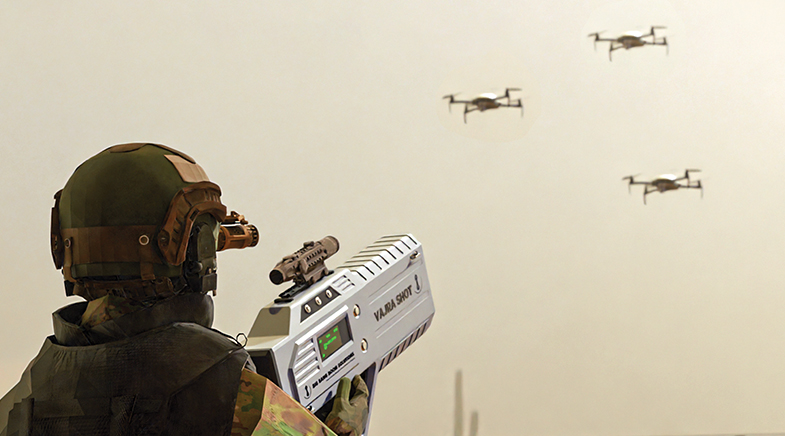
The new military race is in counter-drone technology, and Indian start-ups are gearing up for it.
Colonel Aravind Mulimani (Retd) has witnessed the changing nature of air defence. Throughout his service as an Army Air Defence officer, his work revolved around studying and neutralising aerial threats. He worked on Akash, India's indigenous medium-range missile system and, in 2022, on the Quick Reaction Surface-to-Air Missile system for mobile air defence. And he observed how air defence threats had changed from conventional aircraft and missiles to small, low-cost drones and unmanned systems.
Drone attacks are becoming increasingly common in conflict zones, nowhere more apparent than in Russia and Ukraine. The threat came closer to home in the India-Pakistan military conflict of May 2025. Both countries launched drones at the other's military airbases. "Drones are being exploited as a cheap option against superior forces to gain an asymmetric advantage by a weaker adversary," says Col. Mulimani.
The new military race, then, is in counter-drone technology. Governments around the world are encouraging partnerships with indigenous companies building this technology. In India, along with the Defence Research and Development Organisation, the state-owned Bharat Electronics Limited produced the D4 system that thwarted drones in the recent military conflict with Pakistan. Private companies, too, have strengthened research in this field. Mumbai-based Grene Robotics developed the Indrajaal Ranger, an anti-drone patrol vehicle. Zen Technologies, where Col. Mulimani is now Vice President Projects (Air Defence), received an order of about ₹37 crore from the Ministry of Defence for its anti-drone systems. Col. Mulimani is now building the company's suite of Counter-Unmanned Aerial Systems (C-UAS).
ELECTRONIC TAKEDOWN
Conventionally, C-UAS systems operate in three stages: detection, classification, and countering of drones. Drones emit signals in radio frequency (RF) to communicate with the control centre and even transmit videos. So, techniques such as radar sensing and RF detection help triangulate the source of these signals. Once the threat is detected, it needs to be classified — for example, whether it is a surveillance drone or a strike drone. Electro-optic and infrared imaging can be used to examine its payload.
The drones are then countered by methods such as jamming, in which strong signals — in the same frequency range as the drones — are directed at them, creating noise loud enough to drown out their control commands. Or, in a technique called GPS spoofing, systems can broadcast false GPS signals to throw the drone off course and force it to crash-land.
In military parlance, employing these electronic measures to take down a drone is called a 'soft-kill'. Bhopal-based start-up Rodella Aerospace Labs manufactures hunter drones that track targets and then move close enough to employ their soft-kill solutions. But if soft-kill solutions do not work, the drone exercises other options, says Founder Vasu Gupta. "Let's say the target drone is completely autonomous: it is in zero radio contact with the operator and is not using GPS for its navigation. Then we employ a hard-kill solution, wherein our hunter drone throws a net over it or uses projectiles to take it down."
The decision to 'hard-kill' or physically take down drones is based partially on the drone's communication system. Some drones might fly blind, with GPS waypoints fixed in their flight path. Rodella has worked with the Indian Army to kill such drones carrying payloads of drugs and ammunition over the borders of Punjab.
The countermeasures taken also depend on the territory in which the drones are flying. In urban environments, GPS spoofing risks interfering with other GPS-enabled devices and vehicles, whereas using ballistic weapons to destroy drones would result in harmful debris and collateral damage on the ground. "Also, when you physically take down a drone, you risk the chance of damaging the forensic evidence it might carry: information about where it has taken off from, where the radio operator with whom it's in contact is, its past flight logs and so on," says Gupta.
BATTLE OF ECONOMICS
A drone doesn't have to carry ammunition to cause damage, Gupta points out. "A cheap drone flying towards us, even if it carries almost zero risk, can force us to expend a certain amount of our aerial defence system. Then it becomes a battle of economics," he says.
To combat sophisticated drone systems, there is a need to develop specialised counter-drone measures, which differ from the larger and more expensive static aerial defence systems that primarily target aircraft and missiles. According to R. Shivaraman, Co-Founder of Big Bang Boom Solutions, a typical man-portable air-defence system (MANPAD) — portable shoulder-launched surface-to-air missiles — costs around $3,000, whereas a drone costs around $1,500. "So, the cheapest air defence system is still more expensive than an average drone," he points out. For the Chennai-based defence start-up, anti-drone systems have become its biggest-selling product.
The drone and counter-drone industries are in the early stages of development, but are rapidly evolving, with each shaping the rise of the other.
The drone and counter-drone industries are in the early stages of development, but are rapidly evolving, with each shaping the rise of the other, Shivaraman stresses. To evade RF jamming, for instance, there has been an increase in wired drones that spool out fibre-optic communication cables as they fly. These are being used in the Russia-Ukraine war. Most drone communication modules today also perform high-speed frequency hopping to confuse jammers. Drones are also circumventing GPS spoofing by becoming autonomous, flying based on AI-driven visual imagery and pre-loaded maps, and switching to alternative navigation systems such as China's BeiDou.
Countermeasures need to keep pace with drones, which are becoming more and more innovative. "The core challenge is no longer 'Can we stop a drone?' but 'Can we stop many drones, cheaply, reliably, and continuously?'" Col. Mulimani says. Countering modern drones starts with sensor-fusion algorithms that integrate data from pulse-Doppler radar, infrared cameras, and others. Artificial intelligence (AI) also plays a role in training the system on visual data to understand the nature of a payload, classify threats, and respond accordingly. The retired Colonel also points to research on AI-driven precision jamming rather than brute-force RF jamming to overcome the frequency hopping of drones.
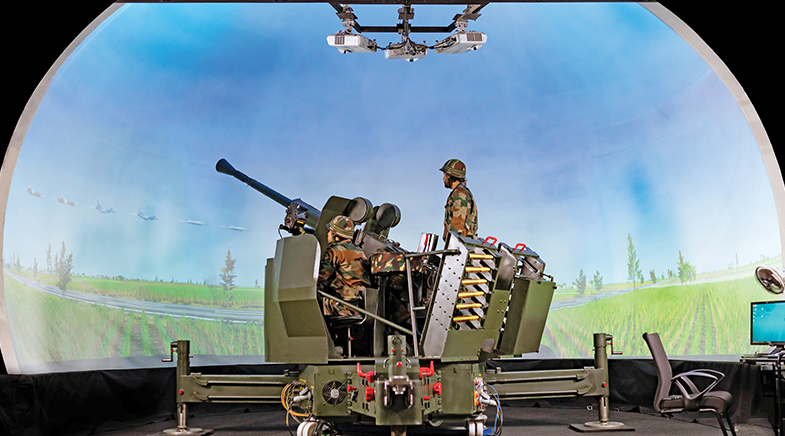
The cost-effectiveness of drones has spawned their proliferation. Many drone manufacturing companies, in fact, import sub-assemblies from countries such as China and then put them together. Gupta stresses the need for more companies to manufacture electronic systems indigenously to enhance the effectiveness of counter-drone technology. "Manufacturing is the only way you can bring down the cost," he says. Rodella's roots were laid at the Indian Institute of Technology Madras, where Gupta, as a researcher in 2020, would import circuitry from Germany. Today, the company makes its own system, which has even opened up export opportunities for Indian counter-drone companies.
For Shivaraman, the future of counter-drone technology lies in ultra-portability and accessibility — in making anti-drone electronics as commonplace as drones themselves. Apart from a vehicle-mounted C-UAS system, such as Indrajaal's Ranger, which mounts the entire system on a vehicle that can patrol areas, man-portable systems are also being developed. In September 2025, Bengaluru-based AXISCADES Technologies received a contract from the Indian Army to provide a man-portable counter-drone system for ground troops to detect hostile drones from a distance of 5 km.
Shivaraman is working on effective anti-drone systems for soldiers. He envisions a handheld drone-awareness suite: a jammer that can auto-neutralise hostile drones if they come too close, or a targeting system. "If we can equip every soldier with that basic level of domain awareness and countermeasure capability, we will have done some service to the nation," he says.
See also:









Mars mission... to Ladakh
Mars is a prime candidate in the search for extraterrestrial life. Ladakh helps in the quest.


Growing green
India's compelling need is to grow its economy and provide energy security while also moving away from fossil fuels.



Have a
story idea?
Tell us.
Do you have a recent research paper or an idea for a science/technology-themed article that you'd like to tell us about?
GET IN TOUCH