

Game-changing moves
-
- from Shaastra :: vol 05 issue 07 :: Jul 2026

The lens is on detection, imaging, and therapy.
ENLIFE RESEARCH
Founders: Deepak Nair, Jojo Jacob and Anish Mathew
Year: 2025
Big idea: Developing diagnostic tools for neurodegenerative diseases
At a get-together with two schoolmates, Deepak Nair, Professor at the Centre for Neuroscience at the Indian Institute of Science (IISc), Bengaluru, mentioned the research he was conducting in his laboratory. He asked if the work could be turned into a commercial enterprise — and the other two jumped at the idea. So, with Jojo Jacob, an Indian Army veteran, and Anish Mathew, who had an engineering and finance background, Nair set up eNLife Research to develop diagnostic tools for neurodegenerative diseases such as Alzheimer's disease (AD).
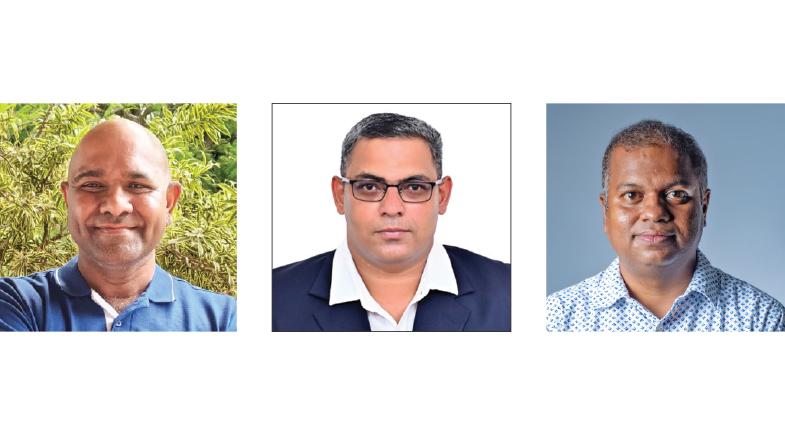
"At the laboratory, I was trying to understand how the brain's synapse (the smallest functional connectivity in the organ) works, and what is the basis for the failure in synaptic communication," says Nair, who completed his Master's in Physics from the Indian Institute of Technology Madras and PhD from the Leibniz Institute for Neurobiology in Germany. The research identified smaller units that functioned as nanomachines within a single synapse.
Nair says the nanomachines precede the onset of AD, and their regulation will be vital for early detection and treatment. One of the big gaps with AD is in therapeutics, he adds. Drugs are mostly administered after a patient is diagnosed with AD. "It would help if it were possible to understand who was likely to get the disease," Nair says. Research in his lab had shown that many steps led to AD. Nair looked at the tests that were available and found there were only a few that could predict the onset of Alzheimer's.
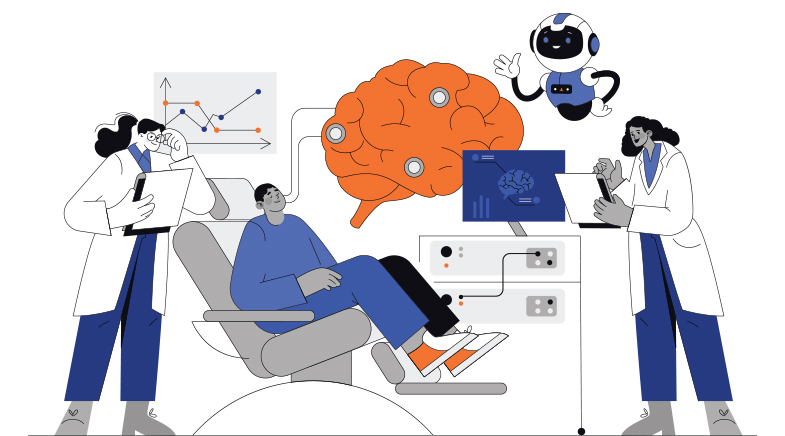
He says their start-up seeks to determine whether the markers available in blood samples can predict the onset of AD. Similar attempts had been made elsewhere, but, he says, most of them relied on research-grade equipment. "Our idea was to get a highly sensitive test, one that could be used in every blood testing centre in the country. For that, we need a binder, an electronic read-out platform and an analytics platform," Nair says.
Incubated at the IISc's Foundation for Science Innovation and Development, eNLife Research is working to develop a table-top device that can be used for testing blood samples for AD and other neurodegenerative diseases. It will look at markers that are specific to Indian conditions, apart from those that are currently available. The company is at Technology Readiness Level 4, and the prototype is getting ready, he adds. The system will be scalable, enabling it to be used with a host of markers to diagnose brain-related disorders, he adds.
FLUORESIGHT BIOPROBES
Founders: Subhadeep Banerjee and Nivedita Sarkar
Year: 2022
Big idea: To develop photostable fluorescent dyes for high-res imaging
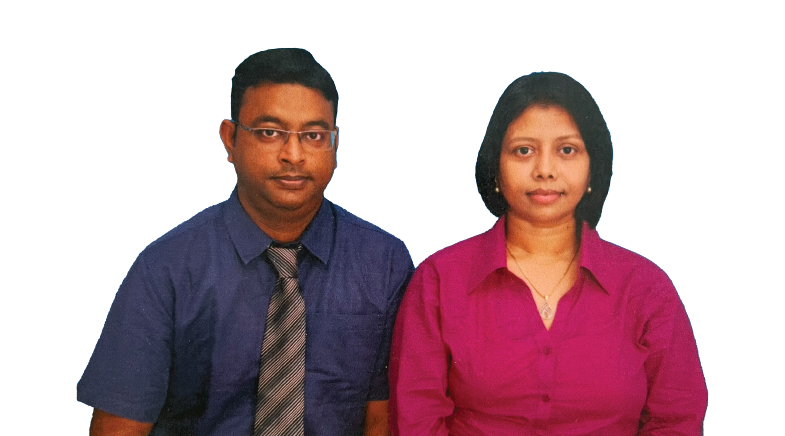
The husband-wife duo of Subhadeep Banerjee and Nivedita Sarkar carry complementary skills to their start-up, Fluoresight Bioprobes. Banerjee, who graduated in chemistry from Calcutta University and went to the U.S. for his Master's and PhD in Organic Chemistry, is a Professor at the BITS Pilani Goa campus. Sarkar's PhD in Life Sciences from the Chittaranjan National Cancer Institute in Kolkata was in toxicology and cancer.
Sarkar used fluorescent dyes during her PhD and found that some were more photostable and brighter than others. Banerjee, who had trained in the chemistry of fluorescent dyes, realised the photostable dyes could be used for fluorescence microscopy. "That is how we started talking about how we could take this forward," Banerjee says. Their company was incubated at the Goa campus of the Birla Institute of Technology and Science (BITS) Pilani.
Banerjee explains that fluorescent dyes, or fluorophores, are critical to fluorescence microscopy, which is used to tag specific cellular components for high-resolution bioimaging. Fluorescent dyes, Banerjee adds, exhibit a property called the Stokes shift, in which the energy of fluorescence emission is lower than that of absorption, resulting in emission at longer wavelengths. In many available dyes, the separation between the absorption and the emission is small, he says. This results in a lack of clarity and lower-quality images, because a certain fraction of the emission is reabsorbed. "I saw that if the commercial dyes had a Stokes shift of 10-25 nanometres, my dyes had a Stokes shift of 100-150 nanometres, with clear separation between the two spectra: the absorption spectra and the emission spectra," he says. Banerjee adds that they realised this would be a game-changer for high-resolution imaging.
The duo determined which structural types would be good for imaging in light cells, for painting the entire cell, and then for localising the fluorescent dye inside the cells. "We found the chemistry to be reliable, and that we could make decent quantities of the dye. Based on these facts, we understood that here was a platform that could be scaled up in terms of wide-ranging business applications," Banerjee says.
The next step for them, he says, was to understand the challenges. Some of the important issues were the global supply chain, the cost and the time it took for the probes to be delivered. Banerjee says their start-up's dyes are target-specific for each subcellular component, based on their physicochemical properties. They launched their dyes in 2024, targeting scientists and researchers as customers. "It is a niche product," he says, for it doesn't have large-scale commercial application at present.
LIFESPARK TECHNOLOGIES
Founders: Amey Desai and Devendra Desai
Year: 2018
Big idea: Building wearable devices for neurological conditions
Amey Desai was spending the final semester of his Electrical Engineering course from BITS Pilani at the University of Leeds in the U.K. when he learned that his grandfather had had a fall and fractured his hip. It made him wonder how technology could help prevent falls among older people. Amey was also studying biofeedback mechanisms and how they could be used to alter muscle function. He had learnt about freezing gait — inability to move — and how that led to falls when he came across a challenge initiated by The Michael J. Fox Foundation for Parkinson's Research, based in the U.S. He started working on Parkinson's disease (PD) after learning of the challenge, and then teamed up with his father, Devendra Desai, a gastroenterologist, to start Lifespark Technologies.
PHOTO: BY SPECIAL ARRANGEMENT
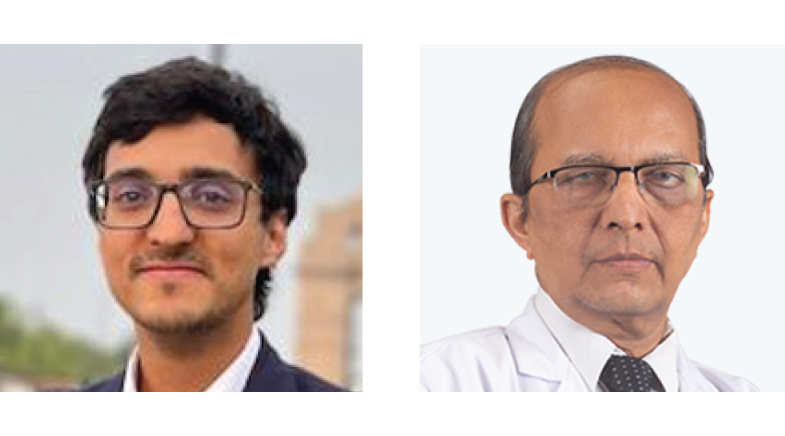
Amey Desai (left) and Devendra Desai, Founders of Lifespark Technologies.
Incubated at the Society for Innovation and Entrepreneurship (SINE) at the Indian Institute of Technology Bombay, Lifespark Technologies has developed a wearable device, called WALK, to help people with PD walk freely. Amey says the device reduces freezing of gait, which is one of the reasons people with PD fall. The band worn on the legs collects data and tracks symptoms that may lead to falls. When it detects that a limb is about to freeze, WALK sends mild electrical stimuli to the leg muscles. These reset the spinal cord's control, helping in uninterrupted movement. According to him, sensors on WALK continuously track and analyse walking patterns, and when the device detects gait irregularities, it sends mild vibrations and electrical pulses to the thigh muscles. This stimulation primarily targets the spinal cord, bypassing the poor communication between the brain and the rest of the body caused by Parkinson's. Users can customise settings, track progress, and do specific exercises through a mobile app, while doctors can remotely monitor them.
In PD patients, communication between the brain and the spinal cord is affected, particularly within the central pattern generators, which are responsible for movement. The person freezes while walking, even as the rest of the body continues to move, resulting in a fall. Next to the muscle and the tendon is the Golgi tendon organ, a sensory fibre that carries information from the leg to the brain. When stimulated, this sensory fibre modulates the neurons, which in turn weigh how much importance to give to different sensory inputs.
PHOTO: BY SPECIAL ARRANGEMENT
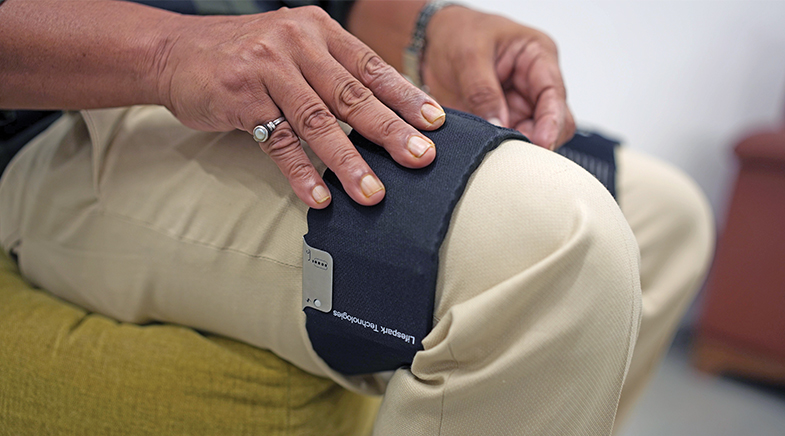
A wearable device to help people with PD walk.
Amey says Lifespark conducted studies on two patient groups and found the results encouraging. It took them up to two-and-a-half years to develop the device. The bands stimulate specific afferent fibres that convey information to the spinal cord to modulate spinal excitability. This modulation reduces freezing and other gait issues. The company started selling its product in July 2024. It sells directly to PD patients by working with neurologists. The company will start trials on using the device for other chronic neurological conditions.









The travel bug
Tracking gut bugs among migrant tribal community members.

Why big science spends must go on
This is as good a time as any to look deeply into the significance of all our activities and the rationale for doing them.



Have a
story idea?
Tell us.
Do you have a recent research paper or an idea for a science/technology-themed article that you'd like to tell us about?
GET IN TOUCH