

Forecast is forewarned
-
- from Shaastra :: vol 05 issue 07 :: Jul 2026
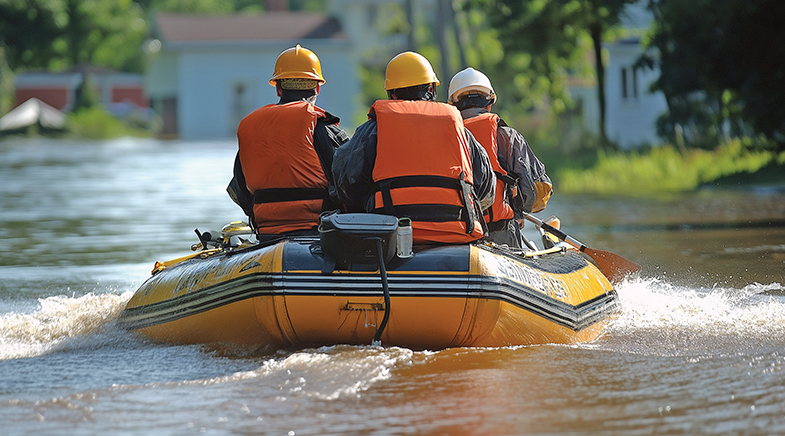
Researchers have developed a model that predicts monsoon patterns months ahead.
The El Niño-Southern Oscillation (ENSO), an ocean surface-atmospheric interaction in the Pacific Ocean, is regarded as the main determinant of the performance of the Indian monsoon. Climate scientists watch its development and then announce the first forecast of that year's monsoon in mid-April or so. As the phenomenon develops, forecasters refine their predictions. This is exactly how it unfolded for the current monsoon.
Would administrations have more time to prepare for excessive or below-normal rains if forecasters predicted the monsoon's outcome earlier? Researchers in India have developed a model that can predict the monsoon up to 18 months in advance (bit.ly/monsoon-forecast).
Several global phenomena are studied in the preparation of monsoon forecasts. These include the Indian Ocean Dipole, snow cover of the Himalayas and even the Alps, and land surface temperatures, in addition to ENSO. The researchers, however, led by B.N. Goswami, a climate scientist and Professor of Excellence at Gauhati University, analysed subsurface temperature changes across all tropical waters — Atlantic, Indian and Pacific Oceans — and devised an algorithm for forecasting the monsoon.
Several global phenomena are studied for monsoon forecasts.
"The sea surface is directly in connection with the atmosphere, which is chaotic by nature," says Devabrat Sharma, co-author and a postdoctoral researcher at the Indian Institute of Technology Madras. The data, therefore, have a lot of noise. Below the surface, the more robust data give a clearer signal, Sharma says. The researchers ran their model to produce forecasts up to 48 months, but found high accuracy at up to 18 months.
Goswami points out that the monsoon pattern is changing. "We note a shift [of the monsoon trough] towards India's north-western region, with less rain in the North-East. This can be good for India, if authorities plan water management well," he says. With climate change, the humid heat stress is rising, making the periods between rains "unbearable", he adds. "An advance prediction of the monsoon's performance gives planners and administrators time to prepare for contingencies," he holds.
Their system challenges the Pacific-focused view and could be a game-changer in forecasting. It could also find opposition as it challenges the current method.
Also read
Blowing hot and cold








The Standard Model of particle physics
Tracing the evolution of the theoretical framework that laid the foundation for a broader understanding of matter. It seems ripe for a ‘rejig’.
The Indian effort to decode the SARS-COV-2 virus
Indian biologists are working to understand the coronavirus better, and are hoping to use that knowledge to develop better vaccines for the future.




Have a
story idea?
Tell us.
Do you have a recent research paper or an idea for a science/technology-themed article that you'd like to tell us about?
GET IN TOUCH