

Clean chemistry at work
-
- from Shaastra :: vol 05 issue 08 :: Aug 2026
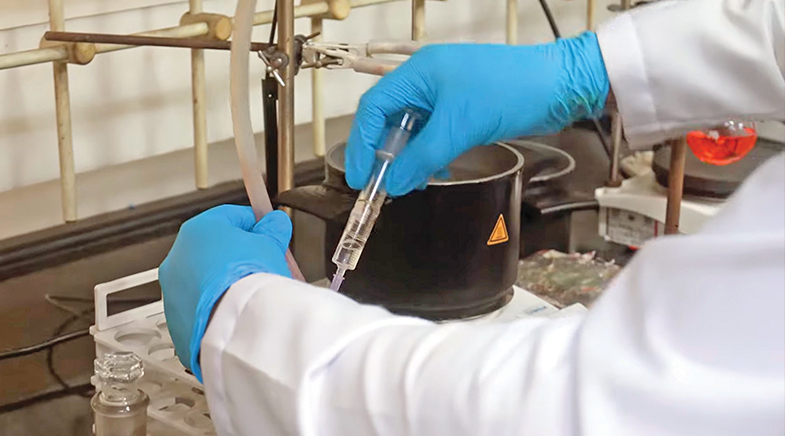
Chemists decode greener ways to produce olefin, diene molecules.
Organic chemistry could hardly get cleaner; chemists at the Indian Institute of Technology (IIT) Roorkee have devised a new technique — cheap, flexible, and waste-cutting — to synthesise valuable double-bond-containing molecules directly from renewable, plant-or bio-derived alcohols. Developed by a team led by Debasis Banerjee, Professor of Chemistry, the method does not rely on petroleum-derived starting materials or expensive metal catalysts and leaves only water and hydrogen gas as byproducts.
In their study (bit.ly/Debasis-olefins) published in Nature Communications, the scientists reported a greener way to produce olefins and dienes, a class of molecules and critical building blocks for complex chemicals used to make medicines, fragrances, plastics, and speciality chemicals. Olefins and dienes are currently synthesised from petroleum-based starting materials using old methods such as the Wittig reaction or Mizoroki-Heck coupling, which need expensive or toxic ingredients and go through multiple reaction steps. The class of phosphine-based catalysts, for instance, is not just expensive, but also strong cellular and mitochondrial poisons. The prevalent techniques produce ample chemical waste products.
PAST ISSUES - Free to Read











This glass may be scratch-proof
A graphene oxide-based coating promises to make glass scratch-resistant.




Have a
story idea?
Tell us.
Do you have a recent research paper or an idea for a science/technology-themed article that you'd like to tell us about?
GET IN TOUCH