

Match on the mind
-
- from Shaastra :: vol 05 issue 11 :: Nov 2026
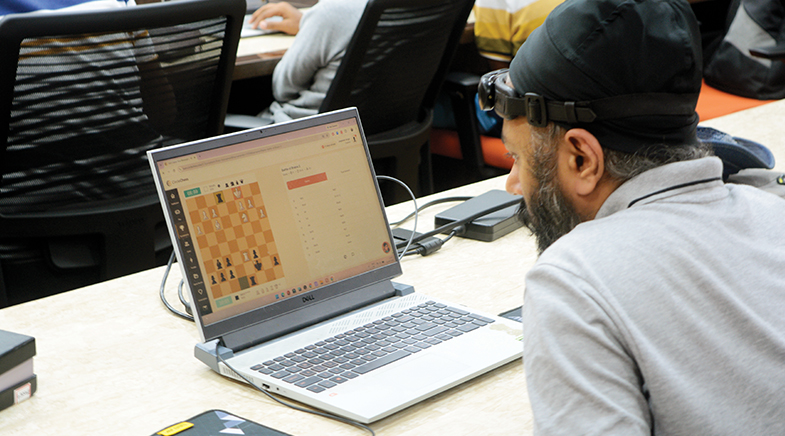
Wearable devices measure cognitive states while athletes play.
Siblings, chess players, and coaches, Gowtham and Ragul Aruldass travel from Erode, their hometown, to wherever the game takes them; their latest pit stop is a tournament that piqued their curiosity. The conference room at the Indian Institute of Technology (IIT) Madras is unlike any match setting. They are among 24 players, with a FIDE (International Chess Federation) rating of over 1400, set to play a digital match. But before they made their move, they had to wear a headband that glowed blue at the temple. The Aruldass brothers had heard about the appendage, but it was their first match wearing one; the device would measure their brain's electrical activity, and record instances when they were distracted, stressed, or complacent. As curious students of the game, dissecting a performance came naturally to them.
Gowtham won the first three games, and then stumbled. His mind wandered after the early wins. The monitor displayed his cognitive endurance score — a drop from the third place to the tenth. "I realised that winning back-to-back made me less focused," he says. His brother had a challenging start, but settled in to give solid performances. "Often, you feel you are giving 100% and still lose. The cognitive report was an X-ray into my brain; proof of what was going wrong," says Gowtham.
The tournament — Battle of Brains — is an experiment to test the lengths of time that players can maintain peak cognitive endurance and focus. Held across universities in India and the U.S. by Chennai-based start-up Neurostellar and chess academy CircleChess, cognitive performance is measured at the tournament through devices that combine brain sensing with physiological measurements. "The idea was to build wearable devices that could measure mental and cognitive states, and help people achieve and sustain peak mental performance," says Karthik Raghavendran, Co-Founder of Neurostellar. Data gathered by the headbands are used to train the start-up's machine-learning models to identify patterns in cognitive performance.
Wearable devices have so far tracked metrics such as sleep, calories burnt, heart rate, strength, and recovery, aspects of physical health. Raghavendran focused on mental fitness. Neurostellar's headband — Orbit — uses EEG (electroencephalography) to measure electrical activity of the brain. For instance, if a player registered increased frontal theta activity, but took longer to respond and made more errors, it may indicate mental fatigue. The device also records PPG (photoplethysmography) to derive heart rate variability and breathing rate. The underlying technology is not new, but Raghavendran says artificial intelligence has made longitudinal data analysis and its contextual interpretation easier.
The experiment tests how long players can maintain peak cognitive endurance.
The start-up is the latest company to offer neurofeedback training for precision sports, aviation, coding, and entrepreneurship. "These are activities where high-performance matters," says Raghavendran. U.S.-based companies such as Muse and Flowtime introduced headbands a while ago; Indian companies are new to the field. In October, Deepinder Goyal, Founder of food aggregating platform Zomato, launched Temple, a neurotech company, to develop light-based sensing devices that stick to the side of the forehead and track cerebral blood flow.
Neurostellar has drawn the attention of chess players in India, including Grandmaster Vishnu Prasanna, former coach of D. Gukesh, the reigning FIDE world champion. "As a coach, you don't have a lot of data to back up your assessment of a player's psychological state. You often make subjective judgements based on experience, which could be right or wrong," explains Prasanna. The games of top athletes, he says, are influenced more by psychological factors than by a lack of technical ability. A coach should then be able to judge a player's cognitive reactions under duress or time crunch.
"I've seen recurring error patterns in my games and those of my students. Once they gain an advantage, they sometimes settle in and don't focus as much as they did," he says. "You're better able to convince players when you have evidence." Prasanna has been using Orbit headbands on a few of his students for up to 200 games. The device gave him insights into the players' endurance levels and when they peaked; it also recorded their speed or reaction time.
Motion, disruption
Raghavendran is in talks with athletes engaged in sports low on physical movement — archery, golf, shooting, and esports — on using the headband. Movement, and the consequent sweating, challenge brain electrodes regardless of the material or gel used. Mohanasankar Sivaprakasam, Professor of Electrical Engineering at IIT Madras, and Head, Sudha Gopalakrishnan Brain Centre, explains the issue of motion artefact — disruption of data collection — in brain scans. "When the body moves, it affects the electrochemical interface between the electrode and the skin. EEG measurements reflect activity over relatively broad areas of the scalp with signals that are difficult to localise precisely," he says.
The solution, he adds, could be in larger datasets: baselines for the same person under different conditions. "The fundamental challenge is that sports science in India is still underdeveloped. There are hardly 10 laboratories doing this kind of work," he says.
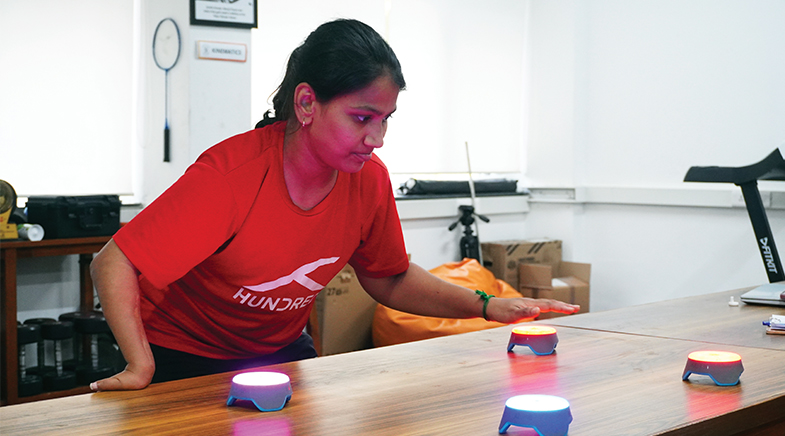
In 2021, Sivaprakasam and his former student Preejith S.P. started Acrophase, a sports research centre that uses precision data to help athletes improve performance. The centre works with 170 professional athletes, including around 80 para-athletes. "Most of the athletes we work with are not yet at the very top in their fields, but are progressing towards that. They include those preparing for the 2036 Olympics," says Preejith.
New athletes at Acrophase are put through a battery of biomechanical, physiological, genetic, and cognitive assessment tests. "Stress monitoring is a critical component of sports performance," says Preejith. "Many athletes perform well during training, but problems arise in competition, when they are under stress." Researchers use EEG and functional near-infrared spectroscopy (fNIRS) to take baseline measurements in the lab rather than on the field. The fNIRS examines the more oxygenated parts of the brain to understand activities in areas that are responsible for decision-making.
These devices still need to be backed up by scientific evidence and demonstrable outcomes.
On the field, athletes wear bands with two sensors. One tests their reaction time, especially when tired. Sweat glands, when activated, impact the electrical properties of the skin, which can be measured to assess stress levels. Another sensor picks up heart-rate variability. The human heart is not a perfect metronome; it beats irregularly, and higher variability indicates better stress resilience.
Science to back up
Consumer neurotechnology remains a niche market, and Sivaprakasam is not optimistic about sports alone driving its development. "That's why you have companies positioning neurotechnology as a lifestyle product. Their idea is to create the equivalent of a heart-rate measurement for brain health," he says. A major hurdle remains: the devices still need to be backed up by scientific evidence and demonstrable outcomes. "If consumers are convinced of the value, and claims are backed by evidence, the technology could reach a wider market."
Cognitive feedback such as EEG, however, is not definitive. The EEG measures activity through sensors placed on the scalp, and since it collects signals from a large area, researchers cannot isolate activity at a specific point in the brain with the same precision as an invasive technique does. Establishing causality — scientific evidence means connecting an observation to an outcome — becomes difficult.
At Eywa Neuro, a spin-off from the Decision Lab at IIT Kanpur, Kaustubh Deshpande, CEO, wants to go beyond EEGs and develop neural interfaces. A former engineer with Neuralink, Deshpande builds India-made devices that can be implanted inside the brain to record activity from multiple locations. "We can capture signals from individual neurons, including local field potentials," he says.
In brain-computer interfaces, researchers record activity from specific neurons while a person or an animal performs a task. They assign weights to the firing activity recorded on particular channels and use those signals to reproduce the task or stimulate the brain to recreate an effect. Given its invasive nature, the application has not found wide-ranging use. Brain surgery not being a proposition healthy people leap at, the implant is currently used on animal brains of a fly, for instance. Invasive neural interfaces in India are largely used for patients with Parkinson's disease and epilepsy.
Deshpande, however, is not convinced about EEG-based consumer technologies. "You're collecting a lot of signals, many of which are weak and susceptible to noise," he says. "That said, the field is developing, and the jury is out. If researchers identify a biomarker or electrical-activity signature and correlate it reliably with an outcome, there could be a useful application," he adds.


The robot revolution
Robots will reshape the economy; the challenge is to ensure that humans remain at the centre of the transformation.



Have a
story idea?
Tell us.
Do you have a recent research paper or an idea for a science/technology-themed article that you'd like to tell us about?
GET IN TOUCH