

Monsoons are off course
-
- from Shaastra :: vol 05 issue 11 :: Nov 2026
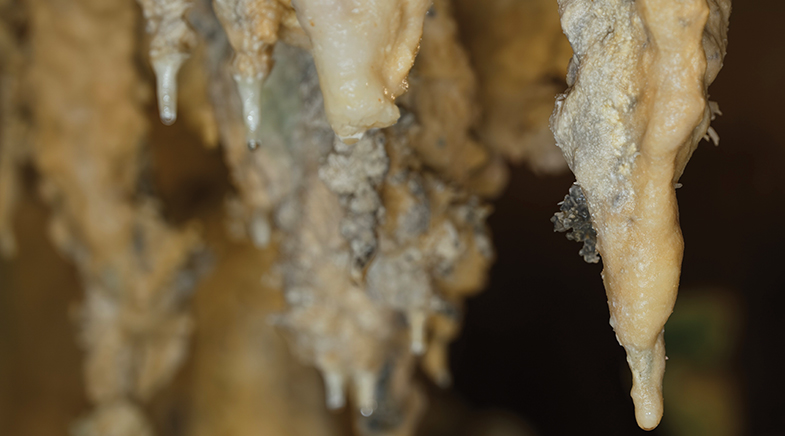
Peruvian caves reveal disruptions in ancient rain patterns.
Ancient caves of Peru have yielded new clues about epochal monsoons. Cave speleothems (stalactites and stalagmites) show disruptions in the synchronicity between the summer monsoons of the Northern and Southern hemispheres during periods of rapid warming, such as the end of a glacial period, and extended warming. These insights are significant because the Earth is undergoing sudden, intense warming.
Monsoons and their intensity are dictated by several factors, chiefly incoming solar radiation — insolation — which changes periodically due to shifts in the Earth's position and orientation toward the Sun. These shifts — Milankovitch cycles — have three components: the Earth wobbles on its axis over a 23,000-year cycle, determining which hemisphere points closest to the Sun during summer. The Earth's axial tilt shifts between 22.1° and 24.5° over a 41,000-year cycle. The shape of the orbit around the Sun changes from circular to elliptical over cycles of one lakh to four lakh years.
Typically, the hemisphere with greater insolation undergoes a strong monsoon phase. Thus, monsoon intensity seesaws between the two hemispheres across various timescales. While the palaeomonsoon in the Northern Hemisphere is well studied, with records going back to 6.9 lakh years, data from the Southern Hemisphere go back only 2 lakh years.
Researchers led by Elizabeth Olson at Wesleyan University, U.S., explored the caves of the Peruvian Andes, a core southern monsoon zone, and extracted speleothems to study oxygen isotope records and reconstruct monsoons back to 4.5 lakh years. Scientists study the ratio of the two oxygen isotopes 18O and 16O; higher 18O values indicate weaker monsoons and vice versa.
"We found ten events, each lasting between 100 and 2,000 years, during which the seesaw pattern was disrupted. In eight events, both monsoons had weakened; in two, both became more intense," says Olson. For comparison with the Northern Hemisphere, they used existing palaeomonsoon data from caves in China (bit.ly/peru-caves).
The Atlantic meridional overturning circulation and the Pacific Walker circulation influence the monsoons, and both are impacted by warming. Warming caused the simultaneous weakening of monsoons in both hemispheres. Strong glaciation resulted in simultaneous monsoon enhancement. Changes in greenhouse gas concentrations, cross-equatorial thermal gradient, and sea surface temperatures over the Atlantic and the Pacific oceans influence these events. "Given that two-thirds of humanity depend directly on the monsoon, the new understanding should help us prepare better," says Olson.
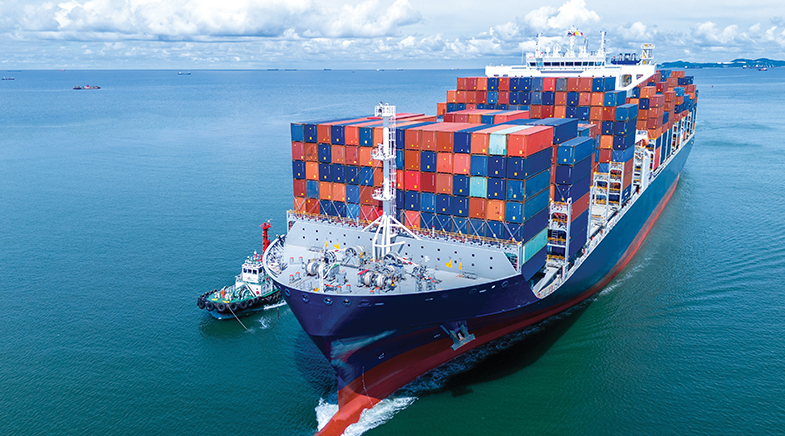


Uncharted waters
The shipping industry must cut its emissions at sea. Solutions abound in the form of new fuels, transit routes and onboard carbon capture.

Son of the soil
Danish polymath laid the groundwork for modern geology.
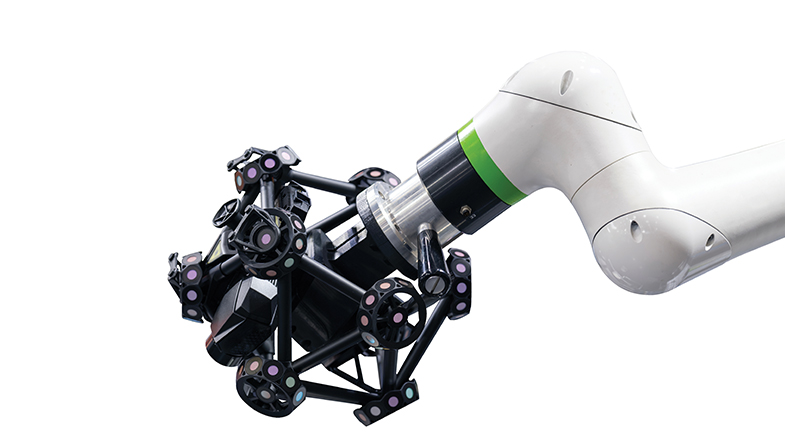
The robot revolution
Robots will reshape the economy; the challenge is to ensure that humans remain at the centre of the transformation.



Have a
story idea?
Tell us.
Do you have a recent research paper or an idea for a science/technology-themed article that you'd like to tell us about?
GET IN TOUCH