

Step on the gas
-
- from Shaastra :: vol 05 issue 10 :: Oct 2026
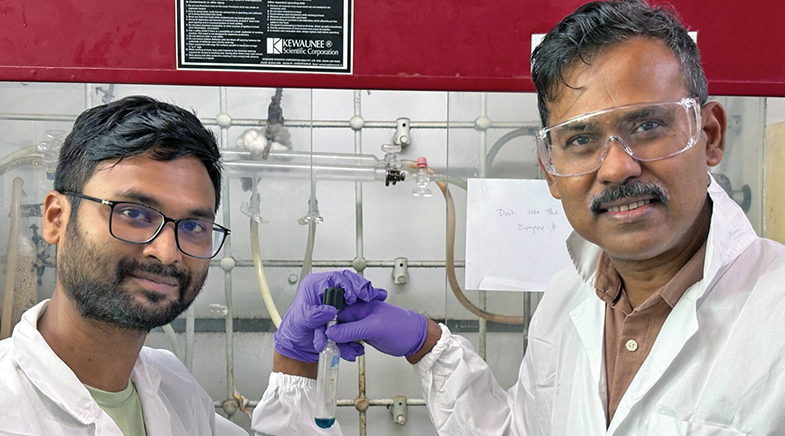
A process to eliminate expensive metal catalysts in drug synthesis.
In sealed glass tubes in a laboratory near Kolkata, a pungent gas helps chemists make medicines — by ferrying electrons from one molecule to another. Over about a year, three pharmaceutical compounds have emerged from their tubes: benzocaine, a local anaesthetic; lapatinib, an oral drug to treat advanced breast cancer; and apixaban, a blood thinner.
That was the start. Chemist Swadhin Mandal and his students at the Indian Institute of Science Education and Research (IISER) Kolkata decided to see how far the idea could go. Research scholars Partha Protim Dey and Paramita Datta expanded their experiments, producing two more anaesthetic drugs, two additional anti-cancer drugs, and aripiprazole, used to treat schizophrenia. After eight compounds, Mandal told his students it was time to make their work public. Their study was published in August 2026 (bit.ly/gas-catalyst).
The compounds and the chemical reactions are not new. But the team is the first to demonstrate that sulphur dioxide (SO2) — a gas at room temperature — can replace standard metal catalysts to transport electrons in the synthesis of compounds.
"When we did these experiments for the first time, we didn't believe our chemical reactions," says Mandal, a Professor in the Department of Chemical Sciences. "The students repeated them many times to be sure the results were exactly what we were seeing."
Catalysts — substances that facilitate chemical reactions but get regenerated during the reaction — have been known for more than 200 years. But almost all of the hundreds of catalyst types routinely employed across industries to make useful products are solids or liquids. Gases are not unknown as chemical catalysts. Decades ago, atmospheric chemists showed that gaseous molecules could participate in catalytic cycles high above Earth. But using a gas as an electron-transfer mediator inside a synthetic reaction vessel is a different proposition.
"One key role in catalytic processes is electron transfer: the catalyst supplies electrons to facilitate a chemical reaction, then takes them back, remaining essentially unchanged and ready to be used again," Mandal says. While a catalyst is not used up in the chemical reaction, it can get deactivated by deposits on its surface, physical damage, or high temperatures.
He recalled a University of California Riverside paper of 1972 that described how SO2, in certain electrochemical reactions, could accept electrons. Inspired by this, the Kolkata team began to evaluate its electron-transfer capacity in the synthesis of chemical compounds.
The researchers introduced the gas from a cylinder into sealed glass tubes containing an organic solvent, dimethylformamide, and an amine, a nitrogen-containing organic compound. The amine is an electron donor, and the SO2 accepts the electron.
In the reactions they studied, an amine donates an electron to SO2, which then transfers it to the molecule being transformed, helping drive the reaction before returning to its original state. They selected nitrogen-based compounds used in pharmaceutical syntheses that currently rely on metal catalysts and showed that SO2 could be used instead. The gas helped avert a problem associated with metal-mediated reactions: the resulting products may contain tiny amounts of residual metal that, Mandal says, have to be removed through additional processing.
"This work demonstrates a conceptually new idea of using sulphur dioxide as a recyclable electron-transfer mediator, allowing difficult reactions to proceed without transition metal catalysts," says Daniel Werz, Professor and Chair of Organic Chemistry at the Albert Ludwigs University Freiburg in Germany. Werz, who was not involved but is familiar with Mandal's work, says the successful syntheses of gram-scale pharmaceutical compounds appear to open new directions in chemical synthesis. "But challenges remain ahead in gas handling and scaling the processes up for industrial applications."
The early proof-of-concept experiments involved synthesising milligram-level compounds, but, in subsequent experiments, the team scaled the reactions up to produce 3–5 grams of the target pharmaceutical compounds. Mandal agrees with Werz: "For industries to get interested, the concept will need to be scaled up to tens or even hundreds of kilograms."
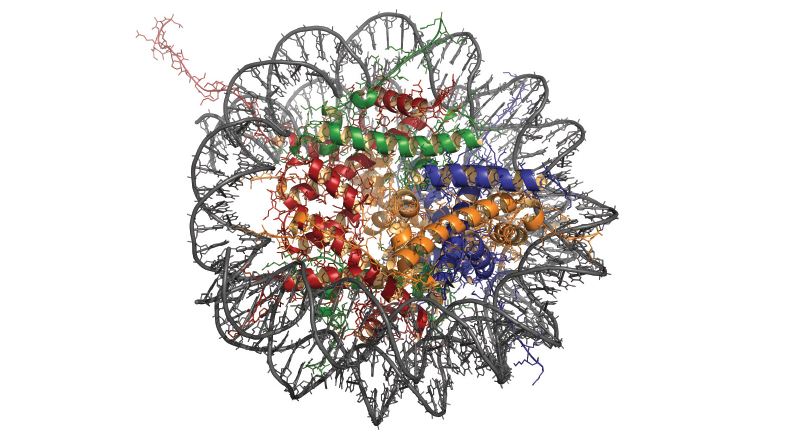








Outside the DNA
Research shows epigenetics is important for both our health and that of the next generation.

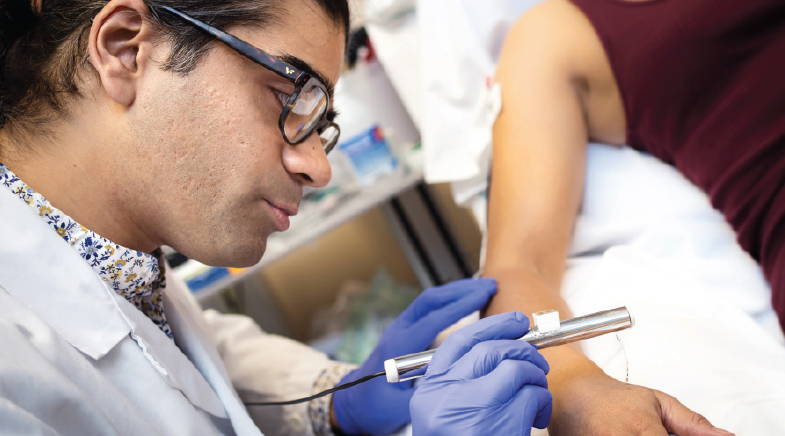
The magic touch
A pioneering study on touch busts some myths.



Have a
story idea?
Tell us.
Do you have a recent research paper or an idea for a science/technology-themed article that you'd like to tell us about?
GET IN TOUCH

