

In sync with the future
-
- from Shaastra :: vol 05 issue 08 :: Aug 2026
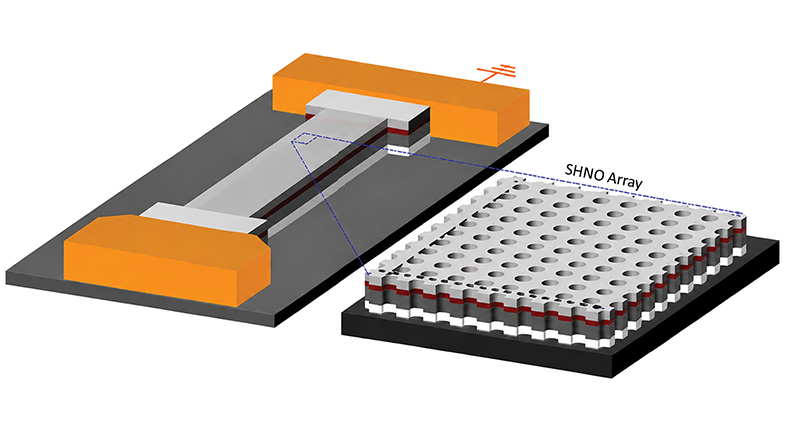
Spinning up to a potentially novel computing platform.
Nilamani Behera, until recently a postdoctoral researcher in physicist Johan Åkerman's lab at the University of Gothenburg, Sweden, is elated – for a reason. With his colleagues from India, Sweden and Japan, Behera, currently an Assistant Professor at the Indian Institute of Technology (IIT) Bhubaneswar, succeeded in getting more than 100,000 nanoscale oscillators patterned in a continuous magnetic film to dance in unison, paving the way for a new class of computer.
With today's digital computers, based on the Turing machine paradigm, approaching the limits of performance scaling, scientists are increasingly exploring computing platforms based on physical systems. These unconventional computing paradigms, still largely in the experimental stage, employ waves, spins, photons, qubits or molecules to represent and process information. They are expected to be more energy-efficient and better suited for complex tasks such as speech and image recognition, data mining and optimisation.
In the current work, published in Nature Nanotechnology (bit.ly/nano-oscillators), the team led by Åkerman exploited spin-wave-mediated interactions in a class of magnetic materials. The devices used by the researchers are called spin Hall nano-oscillators (SHNOs). SHNOs convert direct electric current into high-frequency microwave oscillations using electron spin rather than conventional charge-based electronics. They could serve as building blocks for spintronics, wireless communications, and unconventional computing architectures such as magnonic (spin-wave) and neuromorphic systems.
Each SHNO is a nanoscopic constriction — a narrow pinch point — in a multilayer stack of magnetic materials, measuring only 10-20 nanometres across. When an electric current is passed through it, the SHNO oscillates, emitting a microwave signal. Individual oscillators are noisy and weak on their own, but when many are placed in close proximity, they can "talk" to one another through spin waves and lock into a single, unified rhythm — a phenomenon known as mutual synchronisation.
The work is significant on several counts. It represents the largest array of mutually synchronised nano-oscillators ever built — a more than 1,000-fold increase over the previous record of 64 nano-oscillators, achieved by the laboratory in 2019. The real breakthrough, however, goes beyond the sheer number of oscillators. It lies in how quickly these SHNOs synchronise and what that speed could mean for the future of computing.
"The leap from 64 oscillators to 100,000 oscillators is significant and presents huge opportunities for these emerging oscillator networks in oscillator-based unconventional computing, including nanoscale Ising machines, reservoir computing, and even new areas such as network science using oscillator networks," says Pranaba Kishor Muduli, Professor of Physics at IIT Delhi.

Ising machines are specialised analogue computers designed to solve complex optimisation problems by allowing physical systems to settle into low-energy configurations naturally. Reservoir computing, on the other hand, is a computing approach that exploits the complex dynamics of a physical system to process information quickly and efficiently, particularly for artificial intelligence-related applications.
"The number of oscillators that can be synchronised or controlled represents the computational nodes, analogous to qubits in quantum computing," Muduli says.
An SHNO typically consists of two thin layers: a heavy-metal layer made of materials such as platinum, tungsten or tantalum, and a ferromagnetic layer. When electric current flows through the heavy-metal layer, electrons with opposite spins are deflected to the opposite sides of the material, generating a pure spin current. This spin current enters the adjacent ferromagnetic layer, eventually producing microwave-frequency electrical oscillations.
TEAM WORK
Behera, who joined Åkerman's lab in 2020, took forward the previous team's research. Two other postdoctoral researchers from India — Avinash Kumar Chaurasiya and Akash Kumar — contributed equally to the work. While Chaurasiya is now an Assistant Professor of Physics at the Indian Institute of Science Education and Research Bhopal, Kumar has taken up a similar faculty position at IIT Kharagpur.
Over the years, the team tried out different materials for the SHNO device and zeroed in on a tungsten-tantalum alloy that could serve as an efficient heavy-metal layer. These improvements reduced the operating current by nearly 40%.
With the materials challenge addressed, the team turned its attention to improving the efficiency of the nano-oscillators by substantially reducing the width of the nanoconstrictions — from 120 nanometres to just 10 nanometres. This lowered the current required for operation by more than a factor of 20 to just 26 microamperes.
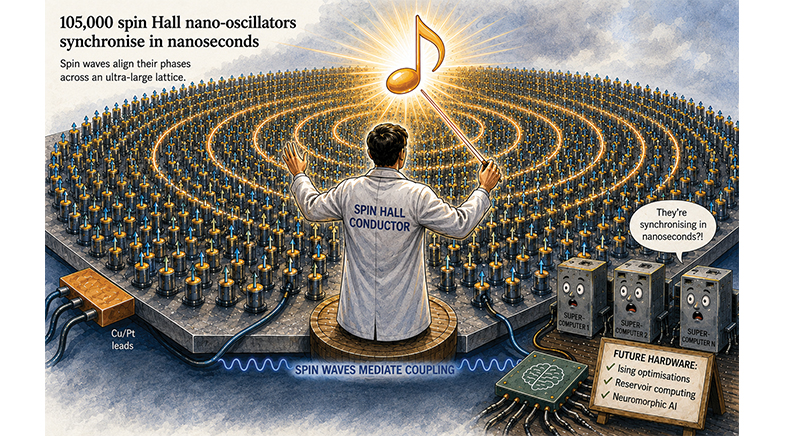
"We built as many as 176 arrays containing different numbers of SHNOs," says Behera. The latest chip, smaller than a fingernail, houses 105,000 nanoconstrictions arranged in 700 rows and 150 columns. "We could have built chips with many more oscillators. But we had to stop somewhere because the fabrication and characterisation are extremely time-consuming," says Behera.
Chaurasiya points out that going from 64 to 105,000 wasn't just a matter of printing more devices. "Three separate engineering problems had to be solved simultaneously," he says. First, the oscillators had to be packed much closer together — down to a pitch of just 24-40 nanometres — so that spin waves could readily propagate between neighbouring devices and knit the entire lattice into a coherent system. Second, the material stack had to be made significantly more energy-efficient because every nanoconstriction dissipates heat, and excessive heating disrupts stable magnetic oscillations. The team's tungsten-tantalum/cobalt-iron-boron combination was specifically chosen to minimise this waste heat. Finally, the entire array required a substrate capable of efficiently removing the accumulated heat. This was achieved by fabricating the devices on a thermally conductive silicon/aluminium oxide substrate.
According to Chaurasiya, the computing framework possesses several attractive features. It consumes very little power, operates at room temperature, delivers exceptionally high speeds, and produces remarkably clean signals. Chaurasiya carried out specialised laser-imaging experiments using Brillouin light scattering microscopy that mapped the spin-wave intensity of the oscillators and their dynamics.
SIZE AND SPEED
The SHNOs snapped into synchronisation with an astonishing speed. The researchers found that the time required for synchronisation — as little as 10 nanoseconds for arrays containing 100 oscillators and around 45 nanoseconds for the full 105,000-oscillator lattice — barely increased with array size.
"Two findings impressed us the most: a quality factor exceeding one million, and the remarkably weak dependence of the synchronisation time on network size. Increasing the number of oscillators from 100 to 105,000 increased the phase-ordering time only from about 10 to 45 nanoseconds," Åkerman explains.
The quality factor, a benchmark that puts these tiny spintronic devices in the same league and in some cases ahead of other nano-oscillators built around entirely different physics, is due to two factors: the synchronised microwave power scales up linearly with the number of oscillators and the linewidth — or the sharpness of the signal — narrows in inverse proportion to the number of oscillators.
SHNOs can serve as building blocks for spintronics, wireless communications, and unconventional computing architectures.
Such a nanosecond-scale phase synchronisation could translate into ultrafast information processing, says Muduli.
The fact that such a massive number of nanoscale oscillators can synchronise so rapidly and reliably suggests that the technology could be scaled even further, offering a compact, energy-efficient computing platform capable of operating at extremely high speeds — tens of billions of cycles per second.
However, Åkerman voices caution. "These arrays are not yet computers. The next major challenge is to make their interactions programmable, so that the same fast collective dynamics can be used in future Ising machines and reservoir computers. At the same time, they already provide a unique experimental platform for studying mutual synchronisation, network science, and a wide range of exciting collective phenomena in ultra-large oscillator arrays," he explains.
Now that Behera, Chaurasiya and Kumar are back home, more exciting results can be expected from India on the cutting-edge spintronics front.









EVs are poised for wider adoption
The electric vehicles ecosystem is close to reaching a tipping point. A clutch of factors will drive wider adoption.


Guillain-Barré syndrome: a nervous breakdown
What we know so far about the rare neurological disorder that has triggered a health alarm in parts of India.



Have a
story idea?
Tell us.
Do you have a recent research paper or an idea for a science/technology-themed article that you'd like to tell us about?
GET IN TOUCH