

Filling in the blanks
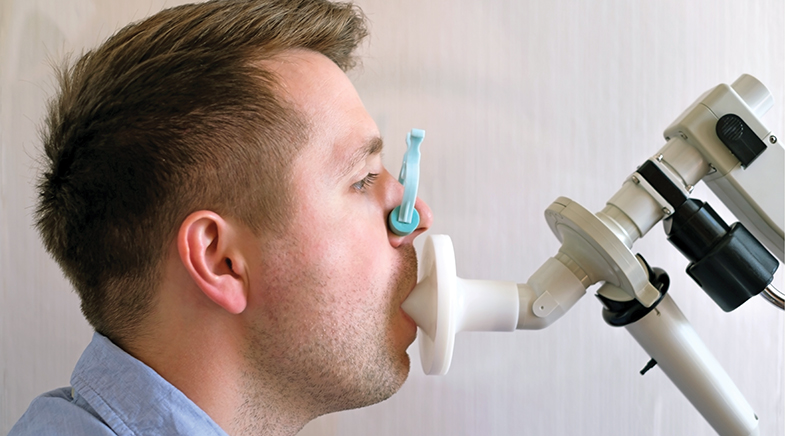
Homegrown tech solutions attempt to plug gaps in lung diagnostics.
Spirometry is a standard test that physicians use to diagnose or monitor a respiratory condition by measuring the volume of exhaled air. The test requires a patient to breathe in and out forcefully multiple times into a mouthpiece connected to the spirometry machine. Yet, many test-takers — especially older people, those with compromised lungs, and children — find this demanding and difficult to perform.
Bengaluru’s iCaltech Innovations has engineered an alternative. Its device, the Antlia Pro, relies on forced oscillation technique (FOT), which superimposes gentle pressure waves or ‘oscillations’ into a patient’s airway during normal, tidal breathing. It measures lung function by calculating the resulting ‘impedance’ or resistance of the lung and chest wall to the airflow, doing away with the need for forceful breathing. iCaltech’s co-founder Rajeshri Kamath says it is the first to manufacture such a device in the country and that it is far more economical than importing one. iCaltech is an instance of how Indian technology companies are plugging gaps in lung diagnostics.
A SURGICAL GUIDE
In March 2026, Vadodara-based L&T Technology Services (LTTS) launched a proprietary digital twin platform, powered by artificial intelligence (AI), to aid bronchoscopy procedures. In this procedure, a doctor inserts a narrow, lighted tube with a camera into the lung via the nose or the mouth. It is used to visually observe the lung and its structures, retrieve samples such as liquid or tissue for biopsies and other tests, and ablate tumours.
Navigating the trachea into the lung is a precarious process, says Rupam Chaudhury, Chief Segment Officer, MedTech, LTTS. Further, patients’ airways differ. LTTS’s platform uses deep learning to create a detailed three-dimensional structural map of a person’s lungs, including airways, lung lobes, and blood vessels, from static computed tomography (CT) images. This serves two purposes. One, it supports pre-surgery planning, such as choosing an instrument with the right size and bendability to access the target location. Two, it enables optical video-based navigation, guiding the surgeon during the procedure by correlating live lung images with the structurally reconstructed lung. The technology is expected to reduce iterations and help doctors perform more procedures with the time saved. The technology could later even be used by surgical robots. It could also allow doctors to correlate compromised lung-function metrics with structural changes in different regions of the lung for improved diagnosis.
JUST GETTING STARTED
iCaltech sees a global opportunity for Antlia Pro. The technology is currently aimed at diagnosing an obstructive airway disease such as asthma; the company is looking to use it for lung cancer and other diseases. It sees potential for a version to screen at-risk populations such as cigarette smokers or workers exposed to industrial pollution. Kamath says it is also using test data, in compliance with patient-data privacy guidelines, to build a clinically validated, assisted-diagnosis AI tool for doctors new to FOT. For LTTS, the opportunity is global from the get-go. The software is being made available to respiratory health and surgical equipment companies in the U.S.
The ecosystem to address lung disease in India is beginning to mature, says pulmonologist Anurag Agrawal, Dean of BioSciences and Health Research at the Trivedi School of Biosciences, and Head of the Koita Centre for Digital Health, Ashoka University, Sonipat. Agrawal’s institution is involved in grant-supported research aimed at using AI to predict exacerbations in asthma and Chronic Obstructive Pulmonary Disease. Predicting flare-ups helps manage these conditions better with fewer hospital visits.
Over 15 years, post-graduate training programmes in pulmonology have shored up the number of practising lung specialists, says Agrawal. More treatments are being brought to patients, and diagnostic procedures are covered by insurance. Indians are living longer, which makes them more likely to develop lung disease. “Where there are patients, there will be devices and drugs,” Agrawal says.
See also:









Lifesaver doctor gave a shock to the system
Heart surgeon Claude Beck pioneered the electric defibrillation technique.

Perils on your plate
Carbohydrates at the centre of the typical Indian meal raise the risk of diabetes.



Have a
story idea?
Tell us.
Do you have a recent research paper or an idea for a science/technology-themed article that you'd like to tell us about?
GET IN TOUCH

