

Dr Dog on the job
-
- from Shaastra :: vol 05 issue 09 :: Sep 2026
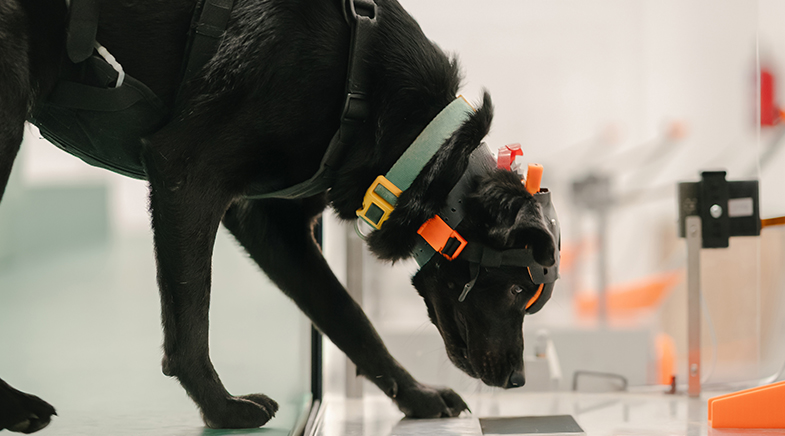
It's not often that an employee gets regular treats at work. But at Dognosis — and the name is a dead giveaway — a treat is a daily event. For its special 15-member canine team, a one-hour shift ends with a sniff and a treat. And presumably a wag.
The dogs are the stars at the Bengaluru-based start-up, which, with a team of 50 humans, is developing modalities for detecting cancer. The dogs — some from ethical breeders and some rescued — don't have to submit their CVs to enlist. They need to be playful, comfortable with human companions, and interested in sniffing — and, of course, love treats. They are 'recruited' after they clear a one-month programme, which trains them to detect malignant cells.
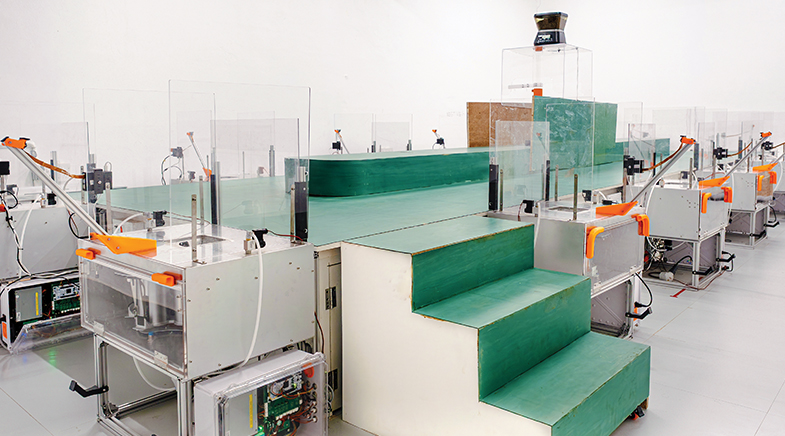
A typical shift involves walking through a series of sniff stations and smelling masks that contain the odour print, or breath, of a person being tested. "The dogs walk in with the handler. They climb up the platform, and when the handler signals them to go, they immediately launch as if there's nothing else in the world that they care about," says Manal Shakeel, Communications Lead at Dognosis. After each task, the dogs receive a treat to reinforce the behaviour.
The dogs wear a helmet that captures data via an EEG reading. A smart harness records movement and respiration data.
That dogs can gauge the smell of cancer is largely anecdotal, but has been studied at length. In 1989, two British dermatologists described in The Lancet the case of a woman who had developed a mole on her thigh. Her pet dog wouldn't leave it alone and kept trying to sniff it. The dog's unusual behaviour led to a medical examination — and the mole was diagnosed as skin cancer. Following this report, several other studies have underscored the canine ability to sniff out cancer. Dogs have millions of smell receptors, giving them a highly developed sense of smell, and enabling them to detect unique volatile chemicals that cancerous cells emit.
And yet, in the decades since The Lancet report, there has been no formal, dog-based cancer detection methodology in clinics. Dognosis is trying to change this. In a recent study (bit.ly/cancer-dogs) published in the Journal of Clinical Oncology, the Dognosis team reported the results of a phase II trial in which dogs were used to detect untreated, biopsy-confirmed head and neck, breast, lung, gynaecologic, gastrointestinal tract, and genitourinary cancers. The dogs correctly identified over 90% of cancers and over 91% of non-cancers. The trial studied 1,502 people, 283 of whom had cancer.
The dogs sniffed the breath samples of the people recruited for the trial. The breath was collected using cotton surgical masks and stored under -20° Celsius cold-chain conditions until the trained dogs evaluated it. Seven dogs took part in the study: four beagles, one Labrador, one Labrador-Indie mix, and one Dutch Shepherd-Belgian Malinois mix. The dogs were trained for over 10 weeks using reward-based methods.
While the dog's nose acts as a sensor, a tech layer on its head assesses its response to each sample. When a dog walks across the sniff stations, it wears a helmet that captures its neurophysiological data via an electroencephalogram (EEG) reading. A smart harness records movement and respiration data, while cameras capture facial expressions and general behaviour. The data are then fed into a machine-learning model that produces a final prediction of cancer presence.
Integrating machine-learning tools with canine perception has helped Dognosis reduce the behavioural variability that each dog brings to such detection systems. For example, a particular dog may indicate the presence of a certain smell by scratching the floor; another may do so by shaking its head. Humans have to read these responses correctly. Biological variability has often hampered animal-dependent diagnostic modalities. By introducing technology, the Dognosis platform examines the dog's behaviour alongside several physiological parameters to assess its response, tailoring the assessment to each dog's unique traits.
BEYOND CANCER AND DOGS
The detection platform relies on the animal's superior olfactory abilities. In the last few decades, several studies have shown that dogs can be trained to detect a variety of diseases and not just cancer. A 2025 study (bit.ly/dogs-PD) in the Journal of Parkinson's Disease demonstrated that dogs could be trained to identify Parkinson's disease (PD). The researchers involved in the study trained two dogs to distinguish between dry skin swabs from people with PD and from those without. After 38-53 weeks of training on 205 samples, the dogs were tested in a double-blind trial using 60 control and 40 PD samples. The dogs correctly identified PD samples 70% and 80% of the time, and non-PD samples 90% and 98% of the time. Other studies have shown that dogs can be trained to identify epileptic seizures, sugar level fluctuations in people with diabetes, and even infectious diseases such as malaria.
Since 2007, global not-for-profit organisation APOPO, in collaboration with African researchers, has been using African giant pouched rats to detect tuberculosis (TB) in African nations. These rats are called HeroRATs. A 2023 paper by APOPO researchers (bit.ly/rats-TB) in Public Health Action notes: "By the end of 2021, HeroRATS had screened 805,263 sputum samples collected from presumptive TB patients, and found 23,298 additional TB patients that were missed in routine TB programme activities. The missed TB case-finding averted 231,675 potential TB infections in three high TB burden countries (Ethiopia, Mozambique and Tanzania)."
Accubits Invent is developing a device that assesses the chemical composition of breath to predict disease.
MACHINE OLFACTION
In yet another example of harnessing olfaction, researchers are learning from animals to create artificial/machine olfaction tools (Passing the sniff test). U.S.-based RealNose.ai is developing an electronic nose that can sniff out prostate cancer in urine in early testing (bit.ly/prostate-nose). Sweden-based VOC Diagnostics is working on an electronic nose that assesses the odour of blood to detect ovarian cancer.
In Thiruvananthapuram, Accubits Invent is developing a device that assesses the chemical composition of the breath to predict the presence or absence of a disease (Just breathe out).The start-up specialises in developing chemiresistive sensors which change their resistance based on molecular encounters in the breath. The exhaled human breath is a collection of volatile metabolic by-products produced in the body. As the body's metabolism changes, so does the volatilome. Each disease has a unique imprint that can be used to identify it, says Aswathy Udayan, Chief Technology Officer of Accubits Invent. When these volatile biomarkers "come in contact with our sensors, there is a specific resistance change" — which is how a disease is identified.
One of the company's products is an eight-sensor array that is sensitive to volatile metabolites produced in lung cancer. The company is currently running a clinical validation study in collaboration with the Malabar Cancer Centre, Thalassery, on detecting lung cancer. This initial study will have 50 lung cancer patients and 100 healthy individuals. Getting patients for the validation study has not been easy: patients remain unaware of their disease and come for a check-up only when it has progressed.
Udayan hopes their product will address this grave problem by creating a testing modality that is easy to use, non-invasive and low-cost, and one that will help screen people for diseases at a population-wide scale. For Dognosis, too, the goal is to develop a population-level screening modality that sits atop current cancer diagnostics. Shakeel says the modality would be like a "funnel, where we sit at the top as a screening method and flag high-risk individuals", who can then pursue regular diagnostics. In a country such as India, which reports 15 lakh new cancer cases each year, such screening tools could help save numerous lives.
See also:









User discretion is advised
For better learning, treat AI as a sparring partner and not a substitute for thought, experts suggest.
For a world-class physics research institute in India
Theoretical physicist Jainendra K. Jain on the excitement, and the challenges, of establishing privately funded research institutes in India.

Too vast to last
Fresh energy across a galaxy cluster may keep its giant glow alive.



Have a
story idea?
Tell us.
Do you have a recent research paper or an idea for a science/technology-themed article that you'd like to tell us about?
GET IN TOUCH