

Showing its mettle
-
- from Shaastra :: vol 05 issue 11 :: Nov 2026
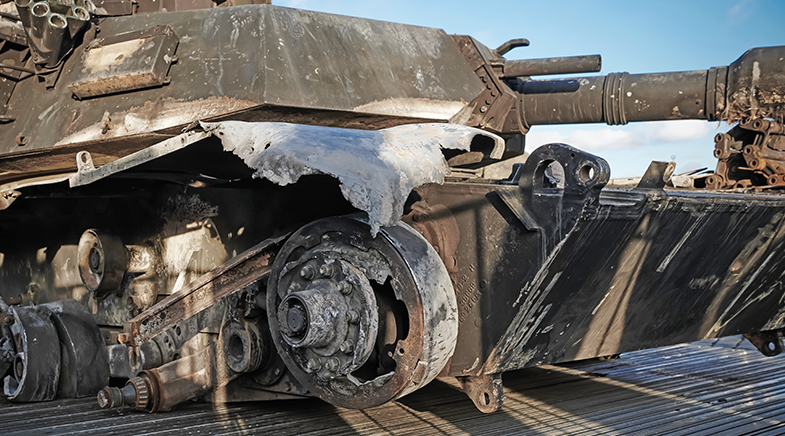
With solutions at hand, metal 3D printing is overcoming cost and quality challenges.
For war-torn Ukraine, hope came in the form of containerised metal 3D printers. Deployed near the country's frontlines in September 2023, the printers were like mini factories. As Ukraine battled Russia, it faced a massive pile of damaged defence equipment. The printers, developed by Australia-based SPEE3D, produced replacements on site in record time. That year, Norway-based Fieldmade's metal 3D printers were placed in sub-zero Arctic regions for Norwegian and Canadian armed forces posted there. In 2022, the U.S. Navy's amphibious assault ship USS Bataan installed a wire-laser metal 3D printer manufactured by Spain-based Meltio. Clearly, metal 3D printers are emerging as an indispensable tool in defence arsenals as geopolitical tensions sharpen across the world.
Closer to home, the Indian Navy, in partnership with the Bengaluru-based Intech Additive Solutions, has established a Centre of Excellence focused on metal additive manufacturing at the Naval Dockyard in Visakhapatnam to develop critical spare parts indigenously. Indian companies and researchers are also looking for ways to improve metal-printing quality while reducing costs.
These printers have multiple uses. Beyond reducing dependence on foreign sources, metal printing cuts material wastage and assembly steps, allows part consolidation, and enables customisation as well as the development of complex, lightweight, or functional designs. "Critical industries like nuclear, space, and defence have adopted it in a big way in India," says Ankit Sahu, Founder and Chief Executive Officer (CEO) of Objectify Technologies, based in Greater Noida. He adds that India's Agni-5 and Agni-6 missiles carry 3D-printed components.
When Sahu was introduced to 3D printing in 2012, as part of his Master's in Manufacturing Systems Engineering at the University of Warwick, U.K., metal printing was still struggling to deliver reliable results. Seeing industry interest in the technology, he and his brother, Arpit, who has a Master's in Physics, started Objectify to provide customers with a cost-benefit analysis of 3D printing. The company website says Objectify helped produce 40-50% lighter, topology-optimised brackets for Indian satellites.
Different materials
The metal printing market is projected to grow from $1.19 billion in 2025 to $3.62 billion by 2030 (bit.ly/metal-printing-market). But the technology is more challenging than polymer printing, which is now used in several industries. High costs impede wider adoption of metal printing. Other problems include quality issues, production speed, and certification requirements. Metals melt at extreme temperatures, and rapid melting and cooling to form layer after layer may lead to defects and residual stresses that can cause a product to crack, warp, or distort. "It has to be a very controlled process," stresses Shuchi 'S.K.' Khurana, Founder and CEO of Addiguru, a U.S.-based company that provides in situ monitoring and detection technology for additive manufacturing processes.
To enable wider adoption, researchers and start-ups are developing cheaper printers and metal powders, and new alloys for printing. They are also working to reduce or prevent defects to improve quality, optimise printing parameters, and increase printing speed and improve productivity. U.S.-based Seurat Technologies is developing a technology that can produce metal parts faster by projecting laser energy across an area rather than scanning one small spot at a time. Intech in Bengaluru has developed software that optimises layer thickness and other printing parameters to increase build rates and productivity. In February 2026, scientists at the National Institute of Standards and Technology, U.S., developed a laser-scanning method to stir molten metal during printing and produce new alloys for printing (bit.ly/alloy-for-printing). In July 2026, researchers at Wuhan University, China, said they had developed a printing method that reduced pores in layers and improved product quality and reliability (bit.ly/defect-free-metal). A consortium of U.K. researchers achieved high-speed printing with deposition rates of 15 kg per hour, up from 3 kg per hour, by combining process innovations (bit.ly/speed-printing).
Pristine products
A metal-printed part may look flawless but contain hidden defects that may adversely affect its performance or function. Deepak Marla, an Associate Professor at the Indian Institute of Technology (IIT) Bombay, is running simulations to understand the physics behind quality issues and ways to produce a flawless printed part. "Properties of the part produced are a function of your strategies that you're using for printing them," he says.
To maintain consistency and quality, metal wires or powders are produced through specialised processes.

To improve the quality of printed parts, a mechanical roller may be slid over the printed layer before adding another layer. This crushes internal pores and breaks the coarse grains to create a uniform microstructure. To understand this process, Marla and his team studied how roller rotation and friction with the metal affect metal stresses, which ultimately drive differences in quality. The simulation results showed that to keep quality consistent along a direction, the roller's rotation had to be controlled externally. The June 2026 study (bit.ly/simulating-metal-printing) provides engineers with a modelling framework to optimise factors such as roller speed and rotation, rolling force, friction, rolling location, metal temperature and cooling, and the geometry and overlap of deposited tracks for specific builds and materials.
While simulation experiments help print better parts, Addiguru provides real-time in situ monitoring of the printing process. Its product, integrated into 3D printers, comprises optical and thermal cameras, along with other sensors. An artificial intelligence-based analysis software combines data from sensors to provide feedback to the user about the quality of the build while it is being printed. Khurana says that because both the machine and the materials used for metal printing are expensive, it is important to check the process before problems arise in a product.
Reducing costs
The high cost of metal printing hampers its wider adoption in industries. To maintain consistency and quality, the metal wires or powders used in printing are produced through specialised processes, raising costs. "A 1-kg bar of stainless steel in the market will probably cost you ₹500; if you want to buy 1 kg of stainless steel powder, it will be ₹5,000," says Koushik Viswanathan, Associate Professor at the Bengaluru-based Indian Institute of Science. To test metal powders, Viswanathan and his team have developed an open-architecture Directed Energy Deposition (DED) metal printing system from scratch in his laboratory.
Metal powders must be spherical for the metal to flow and form layers, and are conventionally made using an expensive atomiser machine. An inert gas hits a liquid metal, breaking it into spherical droplets that become spherical powders. Viswanathan's team has an alternative: grind the metal in an automatic surface-grinding machine; the local heat melts the metal, then re-solidifies it into small, roughly spherical particles. "It's done at a lower temperature, the production speed is very different, and the cost is also much lower because you don't need the big infrastructure. It's also scalable," says Viswanathan. The team reports in a 2022 paper (bit.ly/cheap-metal-powder) that it has tested AISI 52100 steel powders made through this new method and demonstrated its use in multilayer metal printing. Because printed parts often need surface finishing, Viswanathan has also developed a hybrid machine set-up that can deposit, machine, and inspect a metal component on the same platform, potentially reducing the need for multiple manufacturing steps and machines.
Sahu cautions that while metal printing has applications in various industries, it should be used only where it offers a cost advantage. "It is a kind of manufacturing technology, not a magic wand. It has its own limitations, so working within a boundary condition is far better than having a wider kind of approach," he says. He adds that the technology is advancing, with the selection of the right material, process, and quality standards. "The technology is maturing further."



AI for a reason
For now, AI lacks the ability to solve problems through reason. However, a paradigm shift on that front seems imminent.

Light at the end of the tunnel
Hidden gateway into TB bacterium may inspire new drugs.



Have a
story idea?
Tell us.
Do you have a recent research paper or an idea for a science/technology-themed article that you'd like to tell us about?
GET IN TOUCH