

Saving resources, lives, and energy
-
- from Shaastra :: vol 05 issue 09 :: Sep 2026

Bolstered by AI, start-ups look at batteries, power and protein.
BIOSKY SPACE INNOVATIONS
Founders: Saurabh Kapil and Nimish Nama
Year: 2024
Big idea: A spacetech company that uses satellite imagery and AI for the power sector
Unlike many tech start-up founders, Saurabh Kapil did not have a technology background. But that did not inhibit him from founding a spacetech company. Before that, Kapil — who studied economics at Delhi University and graduated from the Indian Institute of Management (IIM) Calcutta — worked at leading consulting firms. Assignments in the space sector spurred his interest in the subject, and led him to team up with Nimish Nama, a chemical engineer from the Indian Institute of Technology (IIT) Bombay and an IIM Calcutta alum, to form BioSky Space Innovations.
Kapil says his stint in consulting coincided with the space sector being thrown open to the private sector. This was also when the renewable energy sector was expanding. State utilities wanted renewable energy generators to provide precise details on how much electricity their plants would feed into the grid to better manage power. Kapil realised there was a strong market for satellite imagery and artificial intelligence (AI) to help renewable energy generators forecast their output more accurately. "We fuse satellite Earth-observation with deep learning to forecast demand, map grid assets, and reduce operational risk," he says.
Before starting, they signed a couple of contracts to build solutions for clients and identify market-related challenges. In the past two years, they have built 10-12 GW of renewable energy generation capacity (India's installed solar and wind power capacity is about 200 GW). BioSky Space Innovations began with generation, but now has solutions for transmission and distribution, too.

The company provides renewable energy generators with a complete generation forecast. Renewable power generators must inform the utilities that buy their power how much power their plants will generate a day in advance. "We give a complete generation forecast for both solar and wind," he says. Incubated at IIT Delhi, the company uses satellite imagery and global and local weather models to generate forecasts.
The company is mapping the transmission network for the Power Grid Corporation of India in the North-East. BioSky will use satellite imagery to guide the corporation on right-of-way issues and alert it when vegetation comes into contact with power lines. It is building citywide digital twins for five distribution companies, providing precise locations of distribution transformers and substations, he says.
CELL FORGE TECHNOLOGIES
Founders: Akanksha Wakhare and Niraj Tadsare
Year: 2025
Big idea: A microbial precision fermentation system to make animal-free recombinant proteins
Akanksha Wakhare had her first brush with entrepreneurship as a B.Pharm. student at Savitribai Phule Pune University, when efforts to understand her curly hair led her to launch related products. What started as a small business became her first lesson in formulation, customer needs, and the fundamental difference between running a business and building a scalable start-up. She was interested in medical devices and, after her Master's in the subject at the National Institute of Pharmaceutical Education and Research, Ahmedabad, joined a start-up dealing with medical devices as an early team member. Niraj Tadsare had also studied at the same institutions as Wakhare, and had a Master's in Pharmacology and Toxicology.
The two set up Cell Forge Technologies in 2025. The start-up seeks to combine precision fermentation and artificial intelligence to produce accessible, affordable and animal-free recombinant proteins for the biotechnology industry. The company uses ciliates, a group of single-celled eukaryotic microorganisms, as its production host. To validate the organism's potential, the founders consulted experts and connected with Marcus Hartmann, who has more than 25 years of experience with ciliate-based protein expression systems and has founded a biopharmaceutical company in Germany. He later joined Cell Forge as scientific adviser.

Wakhare says that precision fermentation enables genetically engineered microorganisms and programmes them to make products, reducing dependence on land, water and soil associated with traditional production. The founders brought complementary strengths to the idea. Tadsare had scientific experience and hands-on expertise in working with ciliates. Wakhare shaped the science into a viable company. The name Cell Forge captures this philosophy: to "forge" cells through genetic engineering.
"The novelty of our platform lies in the microbe, through which we aim to make mammalian-grade proteins at bacterial economics," Wakhare says.
The microbial host combines rapid growth with the ability to produce structurally complex, biologically active proteins similar to those made in mammalian cell lines. The platform is also designed to avoid animal-derived components, bacterial endotoxins and viruses. An AI layer will support sequence design, strain engineering, fermentation optimisation and production. Cell Forge expects to provide samples to industry for testing within a year. Its first targets are cytokines, signalling proteins used in stem cell research, cultivated meat, biopharmaceutical development, and cell and gene therapy. The company will begin with research-grade proteins before progressing towards GMP (Good Manufacturing Practice)-grade products.
EXPONENT ENERGY
Founder: Arun Vinayak
Year: 2020
Big idea: Improving battery charging for commercial electric vehicles
PHOTO: BY SPECIAL ARRANGEMENT
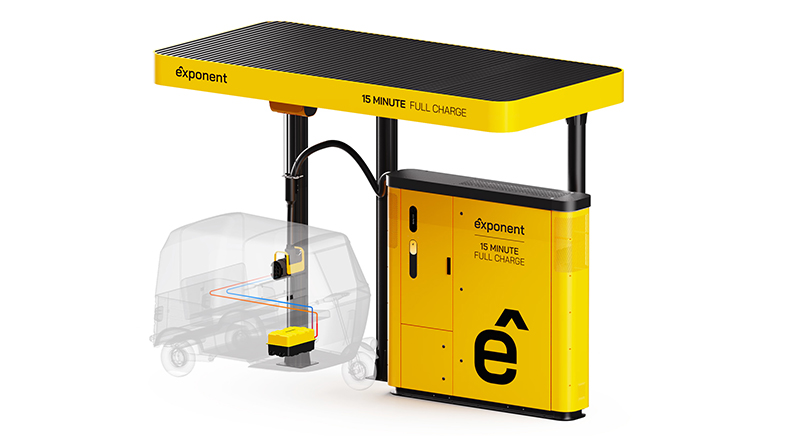
Exponent Energy Founder Arun Vinayak (below); a charging station.
While studying mechanical engineering at the Indian Institute of Technology (IIT) Madras, Arun Vinayak was part of a student-led automobile club that develops electric formula-style racing cars. The founding partner of Ather Energy, an electric two-wheeler manufacturer incubated at the institute, now heads Exponent Energy, which seeks to build an "energy ecosystem" that would encourage people to opt for an electric vehicle (EV) in the commercial vehicles sector. "What if it (an EV) is rapid, reliable and more affordable than petroleum? Then, obviously, more people will go electric," he says.
Since Vinayak's focus is on electric commercial vehicles, he has been addressing the need for fast battery charging. As these vehicles are on the road for long stretches, fast charging is an important issue. Further, energy cost counts for a lot with commercial vehicles. He says Exponent Energy has a proprietary energy stack using commercially available LFP (lithium iron phosphate) batteries. Its engineering solution combines a battery management system, thermal management, a dynamic charging algorithm, and a virtual cell model. This enables a battery to be charged in 15 minutes, he says; most other batteries take five hours to charge. The company guarantees 3,000 cycles, and has a longer warranty period, he adds.

A battery has hundreds of cells, each of which goes through multiple electrochemical reactions. While rapid charging tends to shorten a battery's lifespan, Vinayak says that Exponent Energy assesses in real time what is happening in every cell using its sensors and algorithms. "We control voltage, current and temperature," he says. This ensures that each cell is charged to the right amount. By using the right pulse technology, the company extracts the maximum performance and life from each cell.
Exponent Energy has partnered with a few major commercial vehicle manufacturers that factory-fit batteries into new vehicles. The company also retrofits CNG (compressed natural gas) or LPG (liquefied petroleum gas) vehicles to run on electricity. "We work from three-wheelers to buses. The largest vehicle is a bus. We charge a bus in 15 minutes. Our commercial vehicle operators rapid-charge on our network twice a day. So, twice every day they need a full charge," he says.
The start-up has 100 charging stations each in Bengaluru and Delhi. It is running pilots in the two cities with large vehicle manufacturers. The company will scale up operations after the pilots, Vinayak adds.










Relish that!
Explorers of the spice trail cook up a storm with research grounded in chemistry and computation.

Moving the needle
Efforts are on to make vaccination safer, easier, and less painful.



Have a
story idea?
Tell us.
Do you have a recent research paper or an idea for a science/technology-themed article that you'd like to tell us about?
GET IN TOUCH