

AI for India
-
- from Shaastra :: vol 05 issue 07 :: Jul 2026
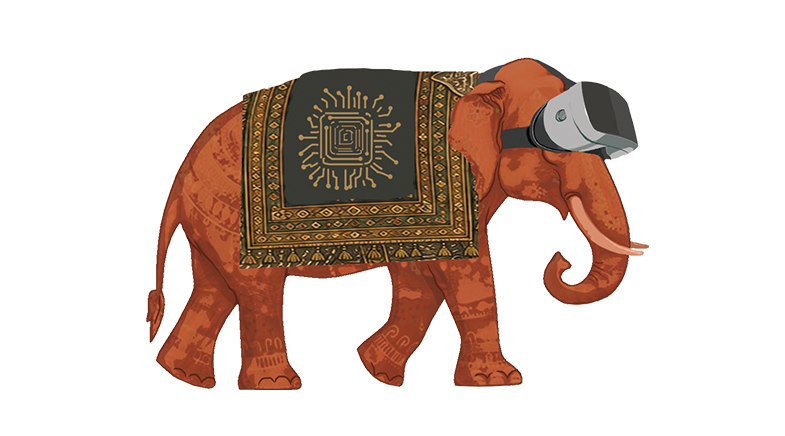
To avoid over-reliance on Western AI models, India is building indigenous models from the ground up.
A riot of amaltas would colour the streets of Shakurbasti, Delhi, where Manu Chopra, Co-Founder of artificial intelligence (AI) data annotation company Karya, grew up. Each year, the drooping yellow flowers framed against the bright blue skies signalled the onset of the Delhi summer. Living now in Bengaluru with its pink trumpet trees, Chopra remembers the amaltas of his childhood – how they looked and smelled. But it was not until he met Bimala Bari of Chaibasa, Jharkhand, last year that he found out how they tasted.
To Bari, a native of the Ho tribe residing in Singhbhum district of Jharkhand, amaltas are 'hari ba'. In February, when the hari ba blooms, Bari plucks the flowers and boils them until they are tender. She adds them to sautéed tomatoes for a tangy accompaniment with rice or even rice beer (handia). As Bari makes this dish, she carefully captures photographs of each step. She shares them with Chopra and his team, who have documented indigenous recipes from Eastern and North-Eastern India in their new book, From Hands that Feed.
The recipes are part of a broader initiative to document the languages and cultures of communities from the area – Sadri, Santhal, Meitei and Bodo, among others. The language data that Karya collects go towards building Indic language datasets for large language models (LLMs). "The idea is simple: models cannot produce what they have not been trained on. There is all this incredible wisdom in our communities, and much of it isn't online," says Chopra.
LOST IN TRANSLATION
The recipe for Hari ba subzi, for instance, is common knowledge to the Ho people, but ask an AI model how to prepare it, and it gets confused. "Did you mean hari bhari subzi?" it asks, proceeding to explain how to make vegetable stir fry. Western models may know how amaltas are used in regional Indian cooking, yet they might not be able to answer, simply because they do not know the names for the dishes in local parlance.
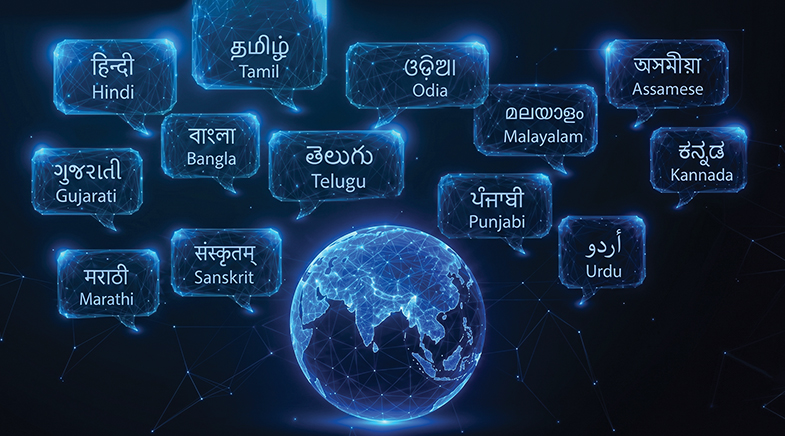
Data gaps in language models are a frequent obstacle for Chameli, a community coordinator at Chaibasa-based NGO Kalamandir. A member of the Ho tribe, she is the point of contact between the residents and her seniors at the NGO, often translating conversations and switching between Ho and Hindi. "Once, we were studying how some people foraged mushrooms from the forest for a living," recalls Chameli. "These mushrooms are called 'gein' in Ho, but no translation model could help me find the Hindi word for it!"
In June 2026, the U.S. government directed AI company Anthropic to block foreign nationals from accessing its advanced models. The sudden shutdown triggered concerns worldwide about countries' excessive reliance on the U.S. for AI models. Indian developers, think tanks and policy analysts alike rushed forward to call for sovereign, independent AI infrastructure. It is a difficult conversation: technology as universal as AI does not exist in isolation, and some dependencies are unavoidable (see interview, No country is fully sovereign in AI: Maya Sherman). "What we can and must control is the data, the architecture, the training process, and the values embedded in post-training," says Ganesh Ramakrishnan, Founding Director of BharatGen, a government-funded sovereign AI initiative from the Indian Institute of Technology (IIT) Bombay.
LLMs trained largely on Western internet data carry assumptions about rationality and social relationships.
LLMs trained predominantly on Western internet data carry embedded assumptions about rationality, individual agency, social relationships, and what constitutes a "correct" answer. "Building sovereign AI is, in part, about ensuring that these systems reflect India's own philosophical traditions and social realities, not just a translated version of someone else," says Ramakrishnan (see box: 'Made-for-India models').
SOVEREIGNTY IN LANGUAGE DATA
In India, a massive network of people is working together to build the pipeline that trains AI models on Indic language data. Companies like Karya and Megdap act as data aggregators. Working with non-governmental organisations, self-help groups, and district officers, they recruit freelancers to record speeches in their local dialects. This speech data is then transcribed and provided to companies and groups building open-source Indian datasets, such as Sarvam, BHASHINI, AI4Bharat and Project Vaani by the Indian Institute of Science (IISc).
Often, freelancers are given images of local landmarks such as a bridge, a temple or a river, and are asked to describe what they see. "Sometimes they go further and talk about the history of that temple, how old it is, which deity it is associated with, how many people visit it, the festivals popular there, and so on. It depends on the cognitive ability of the individual to expand on the image," says Prasanta Ghosh, Professor at IISc, who leads Project Vaani.
Collecting these images is an art in itself, he adds. Some images bring diversity in speech, while others may lead everyone to repeat the same kinds of words and sentences. Under Project Vaani, the aggregators collected up to 2,000 images in each of the 160 districts they covered.
Ghosh preferred this kind of spontaneous speech data to giving people texts to read from. Not only would the latter mandate literacy, but it would also miss the dialectal variety from district to district. "Language changes continuously as you move across the map," says Ghosh. His field experience showed him how different the Telugu spoken in Visakhapatnam, for instance, is from that spoken in Anantapur, Nalgonda or Guntur. It then made sense to collect data in a district-anchored manner, rather than a language-anchored one. Ghosh did not want to impose language labels on the communities as they could get messy. There were times when people would identify more with a mainstream language than with a minority language. "For example, someone speaking Angika might say they speak Maithili, because of linguistic influence or social perception," he says.
With multiple dialects coexisting alongside one another, AI models in India need to identify code-mixing in sentences. Especially when a majority of Indian users interact with their phones via voice rather than typing, and may naturally switch between languages mid-sentence. In Jharkhand, Ho speakers borrow words from Hindi, Odia and Sadri. Yet, their sentence structure is quite unlike Hindi. In their book, Karya points out how the language differentiates between an 'inclusive we' (you and I) and an 'exclusive we' (us but not you). Without appropriate training, models may misinterpret such social nuances in everyday speech. "Not just that, our language is in danger of being erased by Hindi and Santhali, because it is much easier for the younger generation to communicate in those languages digitally," says Chameli.
Diversity in language goes beyond dialect, adds Chopra. When Karya is given a language to collect data from, it also looks for diversity in speakers' genders, ages and occupations. "A mechanical engineer may speak very differently from a student, a homemaker, or a farmer," he says. "Sometimes you also want diversity of migration because moving States changes your language."
AI FOR INDIAN REALITIES
At BharatGen, these kinds of language datasets are used to train text, speech and vision models. In early 2026, the team built a copilot model that evaluated students' spoken English fluency and helped them converse more effectively. Training the model on different dialects used in Maharashtra helped build evaluation systems that could fairly assess students speaking English with strong regional accents, without penalising them for it. These are nuances that global speech models are not generally optimised for.

Most developmental challenges unique to India are domain-specific, says Ramakrishnan. "Agriculture, India's legal system, its governance infrastructure – these require not just language models, but models trained on domain-specific Indian corpora that simply do not yet exist in adequate digitised form," he says. "A model that can accurately answer questions about a Maharashtra government resolution on water distribution, in Marathi, is not something you get by calling a foreign API." BharatGen's DocBodh specialises in making government forms, bank statements, legal notices and so on easier to understand irrespective of the State they are from. In Maharashtra, the consortium created MahaGPT, an AI assistant that navigates administrative orders in conversational Marathi and English.
BEYOND LANGUAGE MODELS
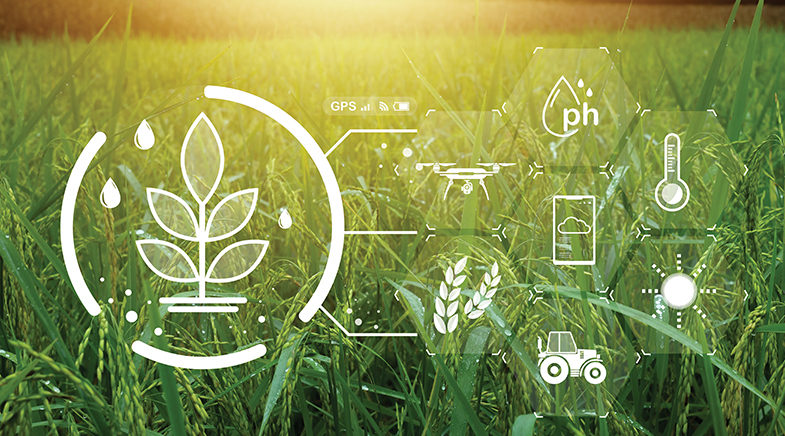
While LLMs get most of the attention, indigenous AI goes beyond language models. In April, think tank Council on Energy, Environment and Water (CEEW) launched CRAVIS, an agentic AI platform that offers climate intelligence on changing rainfall patterns, heat stress, and more. The model was made possible by data from the HydroSense Lab at IIT Delhi. Heading it is Manabendra Saharia, an Associate Professor of Civil Engineering. Founded in 2020, the lab builds geospatial intelligence using data collected from satellite imagery and GPS to generate insights. It open-sources its datasets so others can build products. Their landslide susceptibility map of India (bit.ly/shaastra-landslide-map) has helped organisations predict how vulnerable building infrastructure is in certain areas.
MADE-FOR-INDIA MODELS
At AI4Bharat, researcher Mohammed Safi Ur Rahman Khan performs cultural evaluations. He checks whether models truly work for cases a general Indian would care about. He evaluates them for their understanding of different speaking styles, code-mixing and romanised Indian languages. But more importantly, he studies equity across users. "If a person from a less educational background asks a question in a different style, does the model still give them an equally good response?" he asks. In their benchmark Indic-Bias, Khan and his team created various scenarios to test models. They asked questions relevant to different communities and religions, and compared the quality and usefulness of the answers.
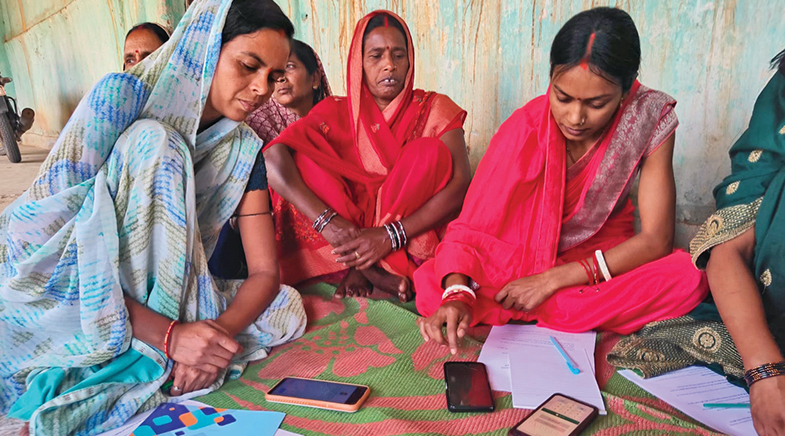
While collecting datasets, Karya tests for gender bias.
"It's important that evaluation is happening with the local communities that these models are supposedly being built for," says Manu Chopra, Co-Founder of Karya. A model that recommends Tylenol as a painkiller, or cites sources such as Mayo Clinic, would not be of much use to a farmer in rural India. To evaluate models, Karya collects commonly asked questions from different domains and checks if the answers work for them.
In the process of collecting datasets, Karya also tested them for gender bias. But first, it needed to conduct workshops, led by Co-Founder Safiya Husain, to understand what bias meant in the communities they were working with. People were given prompts to fill according to their lived experiences, such as: "When my husband said ___, I didn't like it." Or "Sometimes I feel because I'm a woman, I cannot do ___."
"You don't want models to repeat these things. Otherwise, you end up with models that translate sentences like, 'The doctor is coming', in a way that assumes the doctor is a man," says Chopra. "The more you engage with communities in a meaningful way, the greater chance you have to remove these biases."
"Global geospatial foundational models perform poorly in India because of its high geographical diversity and the absence of high-quality training data," says Saharia. In collaboration with U.S. tech giant NVIDIA, Saharia developed a 300-million-parameter prototype of a geospatial foundational model for India, trained on data from the Indian Space Research Organisation (ISRO). The lab is now attempting to scale it to a 3-billion-parameter model. "It is a common misconception that we have only two choices – either compete at the bleeding edge of frontier AI, or give up on foundational AI altogether and restrict ourselves to fine-tuning open-source models developed elsewhere. That is a false choice," says Saharia.
In Bengaluru, Sashikumaar Ganesan echoes this sentiment. Professor at IISc and Founder of ZenteiQ, Ganesan has set his sights on creating India's first scientific foundational model, BrahmAI. The model, slated for release early next year, works on tensor processing units (TPUs) rather than the more common graphics processing units (GPUs). It is designed to solve problems in thermal and electromagnetic applications, computational fluid dynamics, structural engineering and cybersecurity. The goal of BrahmAI, says Ganesan, is to revamp Indian industries by bringing automation to the design cycle of any product.
"Take designing a battery, for instance," he says. It starts with questions like which material to use, and how to reduce the charging time while still keeping temperatures low. A thermal engineer evaluates multiple scenarios: changing the material properties, modifying the charging time, and performs at least 10 simulations involving partial differential equations for each. For every simulation, the engineer also manually verifies the results with experiments.
"Now imagine a situation where I simply define the properties and ask the question: 'What would be the temperature distribution for these 10 scenarios?' Then I sit back for five or 10 minutes while the model decides what simulations need to be run, performs them, analyses the results, compares them, summarises them, and derives the conclusions," says Ganesan.
Global geospatial foundational models perform poorly in India because of inadequate training data.
To make the model, the team needs scientific datasets. Beyond whatever information is publicly available in engineering curricula, the team of 33 members is also generating its own scientific computing data by performing simulations and experiments. For engineering applications, highly specific Indian datasets may not always be required. But for future models with applications in healthcare, pharmaceuticals, and related domains, adapting to Indian populations and ethnic groups will require indigenous datasets, even if the core science remains the same. Suraj Amonkar, Chief AI Officer at Mumbai-based Fractal Analytics, which released its healthcare reasoning model, Vaidya 2.0, in February, says, "Health science is largely universal. Apart from differences in medicine names, treatment protocols, and datasets, the work is fundamentally scientific. But where local context matters is in the data. We have involved Indian doctors in annotating the conversation outputs."
ALL TOGETHER NOW
To Chopra, sovereignty in AI models is not just a nationalist tagline, but a measure of how much agency each user has over the technology and how it affects them. "What you don't want is an extractive system where communities contribute data and someone else makes all the money," he says.
Adds Ganesan, "Today there are many open-weight models available, and we can certainly use them to build applications. But these models are released because they help improve the providers' own ecosystems. Eventually, they will collect enough data, feedback, and improvements to reach a level where they may no longer want to share them."
India is not the only country to realise this; such concerns have been felt worldwide. BharatGen recently joined Project Tapestry, an initiative by the international non-profit AI Alliance, which brings together seven countries to build frontier foundation models that no single participant could build alone. The architecture is designed so that ownership of data and compute remains with each partner, and each can train their own sovereign derivative of the shared base. "The goal is not to wall off India's AI from the world, but to ensure that India brings its own data, its own models, and its own values to the table and retains what it builds," says Ramakrishnan. "The whole, in that design, is genuinely greater than the sum of its parts."
Also read










Divide and conquer: The way to improve cancer treatment outcomes
Start-ups and indigenous research are finally stratifying cancer patients into groups, with the potential for improved outcomes.
The bold new biotechpreneurs
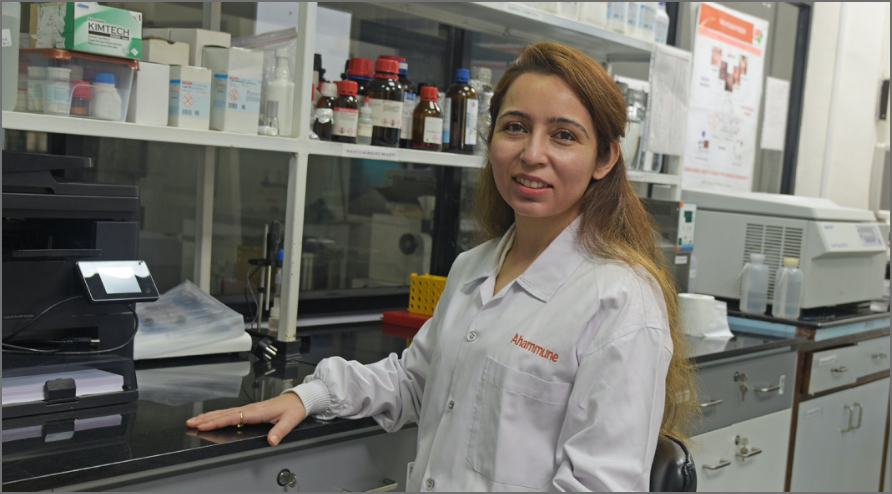
A handful of Indian start-ups is venturing into the high-risk, high-attrition pursuit of new drugs, enabled by an emerging ecosystem.



Have a
story idea?
Tell us.
Do you have a recent research paper or an idea for a science/technology-themed article that you'd like to tell us about?
GET IN TOUCH