

Back to the board
-
- from Shaastra :: vol 05 issue 09 :: Sep 2026
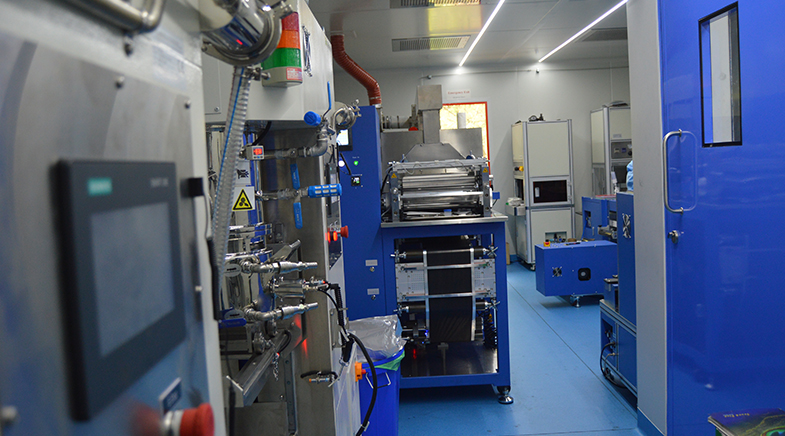
Indian companies are reinventing the battery.
For decades, scientists have searched for more efficient battery ingredients. Over the years, they have changed cathode metals, experimented with new anodes, and devised increasingly exotic electrolytes. The battery chemistry has been repeatedly reinvented. But the cell's physical architecture — how the ingredients are arranged and manufactured — has not changed much.
A small Bengaluru start-up is seeking to make a mark in this field. Rather than looking for another miracle material, e-TRNL Energy wants to redesign the battery cell itself. If its technology works at scale, a different arrangement of familiar materials could make batteries cooler, safer, and capable of charging faster, says e-TRNL Energy's Co-founder and Chief Executive Officer (CEO) Apoorv Shaligram. "We are working on battery cell technology with the focus on both improving performance through design and architecture, and improving manufacturability through a completely reinvented process," he says.
To do this, the company has reduced the number of sub-processes involved in making batteries to a third, and designed the required machines from scratch. "Typical lithium-ion battery manufacturing is a combination of 24 operations, which, with some repetitions, becomes 32 operations. We have come up with a process with just eight steps," he says. This would also significantly reduce the space required for battery manufacturing.
Shaligram and the start-up's Co-founder Uttam Kumar Sen have worked in the industry for 15-16 years. They built their first sets of conventional lithium-ion batteries at a facility at the Indian Institute of Technology (IIT) Bombay in the early 2010s. They worked briefly at Ather Energy, a battery start-up incubated at IIT Madras, before launching e-TRNL.
The e-TRNL CEO says the lithium-ion battery manufacturing process hasn't changed much in the 30-35 years since it was first made. "What was a good way of making cells back in the 1990s for portable applications, such as laptops or cameras, is not the best way of making batteries for things like electric mobility or large-scale BESS (battery energy storage systems)," Shaligram argues.
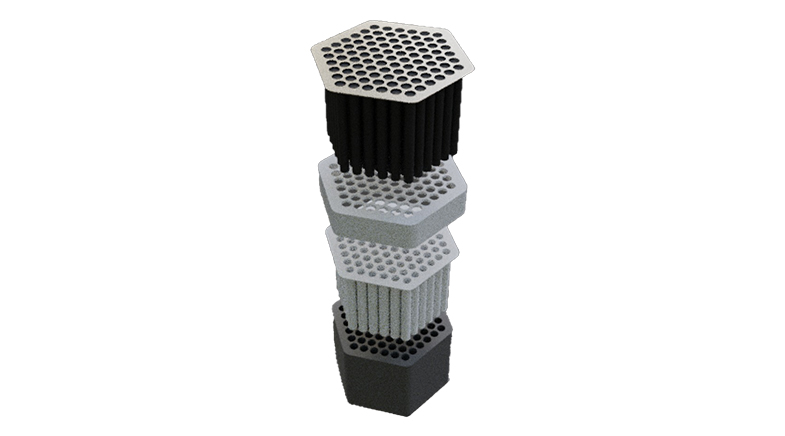
The cells that Shaligram and his team have been designing are not cylindrical, but almost flat. In this, tiny cathode pins slide into a honeycomb-shaped anode. "In one sense, each cell will be made of thousands of micro batteries, which are all connected," he says. As current travels in a straight line rather than spiralling up from the bottom to the top in a cylindrical cell, the energy loss will reduce, as will internal resistance, Shaligram claims.
The real test, however, would be reproducing laboratory performance at industrial scale while reducing costs.
The start-up says it has achieved a 50-55% reduction in heat generation on account of the lower resistance in its prototype cells. Shaligram hopes to achieve a 90% reduction in heat generation. The team has eliminated the need for copper and aluminium foils, which are used as current collectors. The cell's nickel-plated stainless steel body takes over the function.
In February 2026, e-TRNL received a seed fund of ₹27.4 crore from a consortium led by the IAN Group, an early-stage investment firm, to complete product development, validate performance and safety, and demonstrate domestic manufacturing capability. The company has a 20,000-square-foot R&D and early-manufacturing facility in Bengaluru and plans a 250-MWh pilot manufacturing facility by 2027, with a longer-term ambition to expand to 2 GWh. It recently secured additional funding of ₹94 crore from the Technology Development Board.
The technology and design architecture that e-TRNL is developing is chemistry-agnostic. "We can design any given chemistry on this architecture, on this manufacturing process," Shaligram says. While the current focus is lithium iron phosphate chemistry (LFP), e-TRNL plans to explore lithium manganese iron phosphate and sodium-ion batteries.
DIFFERENT CHEMISTRIES
While e-TRNL is reinventing cells, some companies are betting on different chemistries. Vilas Shelke, CEO of the Pune-based Rechargion Energy, is focusing on sodium-ion batteries. He and his wife Manjusha, a scientist at the National Chemical Laboratory (NCL) in Pune, founded the start-up in 2021. In 2024, they received nearly ₹7 crore in seed funding from the Ministry of Heavy Industries, the Indo-U.S. Science and Technology Forum, and a private equity fund, among others.
Rechargion produces both its hard-carbon anode and NVPF cathode material. It sourced the anode technology from NCL. Its pilot line can manufacture cells of up to 22 Ah. According to Shelke, its cells deliver around 120 Wh/kg and have demonstrated stable performance over 20,000 cycles. He says the battery life would be up to 25 years, compared with 6-7 years for lithium-ion batteries.
The company has already demonstrated sodium-ion batteries for renewable-energy storage and electric mobility. It recently deployed an India-made, 1-kWh sodium-ion battery system charged by rooftop solar panels at the Confederation of Indian Industry office in Hyderabad.
To scale up the product, Rechargion plans a 2-MWh production line in Pune, and wants to expand to 20 MWh eventually. The firm has received an expression of interest from the National Thermal Power Corporation for a 200-kWh battery pack, which it will deliver after the plant comes up by March 2027, he says. The company has an order for 500 kWh from Indian Railways. It is also developing a 3-kWh battery pack with Hero MotoCorp for electric two-wheelers.
The real test, however, would be reproducing laboratory performance at industrial scale while reducing costs to compete with Chinese batteries. Shelke believes sodium-ion technology could give India an advantage because key materials — including sodium, aluminium and hard carbon — can potentially be sourced domestically.
What unites the companies is the conviction that India doesn't have to copy the lithium-ion playbook that China perfected over two decades.
DIFFERENT ROUTE
Mumbai-based Gegadyne Energy is another major start-up taking an unconventional route into India's battery market. The company has developed what it calls a multi-ion battery, based on conventional electrochemical principles. Unlike lithium-ion batteries that rely on a single ion carrier, multi-ion technology uses multiple ion species such as potassium and sodium ions working in harmony. This enables faster ion transport and more efficient charge storage, says Jubin Varghese, CEO and Co-founder of Gegadyne.
Varghese says its batteries are now commercially available and are being deployed by Godrej & Boyce and Linde Material Handling, among others. Its first full year of commercial deployment has focused on material-handling applications such as forklifts, palletisers, tow trucks and reach trucks.
Varghese says the cells can be tailored to different applications, offering energy densities of around 120–150 Wh/kg. Gegadyne offers a minimum warranty of 5,000 cycles and claims its batteries can operate under 100% depth of discharge. Depending on the application, it estimates lifetimes of 15-20 years for stationary storage and 7-10 years for industrial batteries. The company also claims the technology performs reliably at a wide temperature range of – 40 to 65°C suitable for Indian conditions.
Varghese says that their batteries are currently priced competitively with lithium-ion products on a per-kilowatt-hour basis, while offering a longer operational life. The company is also developing a home-inverter battery with Kochi-based V-Guard Industries and sees opportunities in commercial and industrial storage, utility-scale battery systems and data centres.
With around ₹80 crore raised so far, including investment from V-Guard, Gegadyne currently has an estimated manufacturing capacity of 5-10 MWh in Mumbai and plans to expand over the next year. However, it will avoid the electric vehicle market until it achieves sufficient scale to compete economically.
That caution defines its strategy. Rather than building a giant factory before securing customers, Gegadyne has focused on getting its batteries into the hands of industrial users and learning from real-world deployment. Its larger ambition is to build a significant presence across India's rapidly expanding energy-storage and traction-battery markets.
While these start-ups are developing end-to-end capabilities around battery chemistries, many others focus more on electrodes, electrolytes, and cells suited to Indian conditions. Among them is Epsilon Advanced Materials, which produces active anode and cathode materials in the country. Currently, most advanced cell chemistry battery manufacturers depend on imports of such materials. Epsilon's expanding portfolio includes graphite anode materials, LFP cathode materials and, more recently, hard carbon for sodium-ion batteries. Such firms are essential if India is to build industry chemistry beneath batteries.
What unites e-TRNL, Rechargion, Gegadyne and Epsilon is not a shared chemistry or vision, but a conviction that India doesn't have to copy the lithium-ion playbook that China perfected over two decades. For a country that has largely watched the battery revolution happen elsewhere, these small, low-key companies represent a new vision: an attempt not just to manufacture batteries in India, but to reinvent what a battery could be.
See also:
Battery power
Taking charge
One for the road
Power to the people










The joy of learning science
To stoke young minds and light the spark of curiosity, India needs a ‘Tippe-Toppian revolution’ in education.

The worrying sound of silence
Silence is not golden when marine life is at stake: it sends out warnings of shrinking biodiversity, and of climate change.



Have a
story idea?
Tell us.
Do you have a recent research paper or an idea for a science/technology-themed article that you'd like to tell us about?
GET IN TOUCH