

One for the road
-
- from Shaastra :: vol 05 issue 09 :: Sep 2026
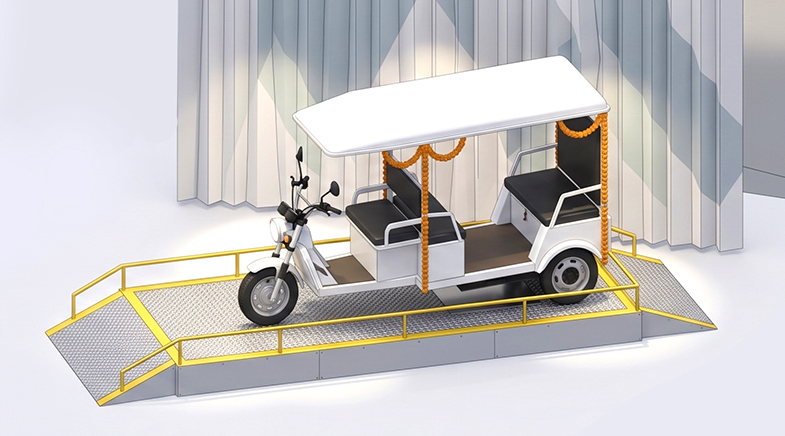
Roll over cables, plugs, and exposed connections — the future of EV charging is wireless.
A miniature electric jeep gliding down a 3-metre track laden with coils is a common sight at P. Srinivasa Rao Nayak’s laboratory at the National Institute of Technology Tiruchirappalli. Set up four years ago, this unusual indoor track allows researchers to study wireless charging in an electric vehicle (EV) by measuring how well power transfers from the coils on the ground to the vehicle as it moves at different speeds.
Nayak, an Electrical and Electronics Engineer and Associate Professor, has developed a static 2-kilowatt (kW) wireless device that can charge electric scooters and three-wheelers in three hours. He is now extending his work from static to dynamic charging. In static charging, the vehicle charges while parked over charging pads; in dynamic charging, a few kilometres of road are laden with charging pads that enable EVs to charge on the go.
While plugged chargers are convenient for homes, Nayak feels that public chargers at shopping malls, bus stops, parking areas, and highways should be wireless for convenience, automation, aesthetics, and safety. Free from cables and plugs, wireless charging, where the coil on the ground transfers power to the coil under the vehicle, offers speedy and automated charging without the risk of electrocution due to exposed electrical connections. Furthermore, thousands of EVs can be easily charged with wireless chargers without the need for personnel, he says.
The increase in EV adoption is driving growth in the global wireless EV charging market, which is expected to grow from $110 million in 2026 to $820 million by 2032, according to the consultancy firm MarketsandMarkets (bit.ly/wireless-market). Start-ups and researchers are developing reliable, safe, low-cost, high-power chargers that are faster, more efficient, and compatible with a range of vehicles and charging conditions. Israel-based Electreon, for instance, has developed high-power chargers ranging from 75 kW to 300 kW for heavy vehicles such as buses and trucks. U.S.-based WiTricity has developed bidirectional 3.6-22-kW chargers for light and medium-duty EVs such as golf carts, cabs and cars that can both charge vehicles using grid power or take power from vehicles to power the grid. In 2024, India earmarked `2,000 crore to build public EV charging infrastructure under the PM E-DRIVE scheme to accelerate EV adoption and spur research.
Researchers are developing reliable, safe, low-cost, high-power chargers that are efficient, and compatible with a range of vehicles and charging conditions.
POWER GAME
Ritesh Keshri, electronics engineer and Associate Professor at the Visvesvaraya National Institute of Technology (VNIT) Nagpur, says that while most start-ups and researchers use the same core technology — inductive resonant wireless technology — to produce chargers, their success depends on how effectively they manage energy losses and how efficiently power transfer takes place in their chargers. In this technology, the transmitter coil generates a magnetic field, and the transmitter and receiver coils are tuned to the same frequency to transfer electricity from the transmitter to the receiver coil across an air gap. The technology is, however, inefficient, as energy is wasted while electricity is converted to several forms before it is used to produce the magnetic flux for transfer. Some heat and energy are also lost as they cross the air gap due to the vehicle’s ground clearance. Keshri says that better power electronics and coil design increase the charging efficiency. Greater efficiency means higher, faster power transfer.
While working on chargers, he realised the need for a high-current, high-frequency H-bridge inverter to reduce thermal losses and increase power transfer. The H-bridge inverter is the charger’s electronic engine, converting standard electrical power into a strong magnetic flux that can be captured by the receiver coil. An advanced inverter allows high-power transfer across large air gaps and a smaller design of charging hardware. For a more efficient inverter, his team replaced the traditional silicon switches with fast silicon carbide switches, which flip thousands of times per second without overheating or being destroyed. This rapid flipping continuously generates high magnetic energy, which is pushed across the air gaps to enable higher, faster power transfer.
Keshri’s team has developed 1.5-kW and 5-kW wireless chargers that have been tested at the Centre for Development of Advanced Computing, Thiruvananthapuram. The 1.5-kW charger can charge two- and three-wheelers with a 4.8-kWh battery in three hours. The technology has been transferred to a Maharashtra-based company. The team is now working on 15-kW and 40-kW charger prototypes for heavier vehicles.
Various methods for managing heat during power transfer are being tried out. Vadodara-based Simactricals, for instance, uses a modular architecture to develop charging pads with power ranging from 1.1 kW to 26.4 kW to charge drones or heavy vehicles. Its 13.2-kW system uses four 3.3-kW modules, while the 26.4-kW charger uses eight modules. The system enables better thermal management, as heat is distributed across multiple modules rather than being concentrated in a single large converter, thereby reducing the risk of failure. Currently, it is conducting proofs of concept with leading two- and three-wheeler manufacturers.
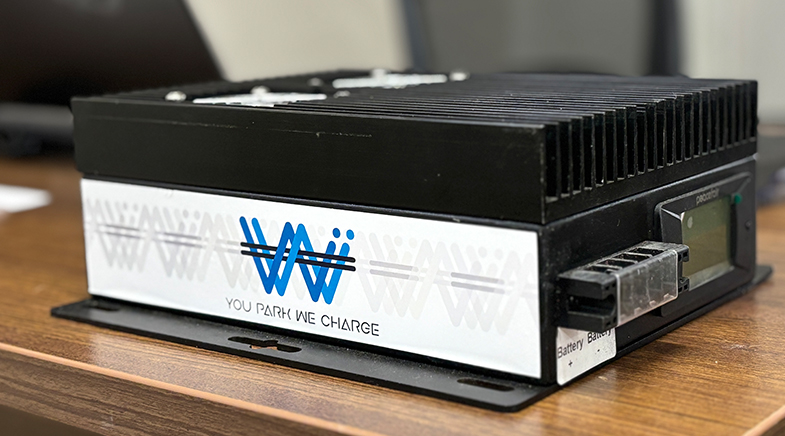
EFFICIENCY ISSUES
Misalignment between the receiver and transmitter coils is another reason wireless chargers become less efficient at transferring charge during use. “Roads are not like railway tracks, and so there is always a possibility of misalignment,” reasons Nayak, stressing that the transmitter and receiver coils are often not perfectly aligned when the car is moving over the charging pad.
To prevent this, Nayak studied three coil geometries — circular, square, and rectangular — and found that while power transfer was always affected when there was more ground clearance or when the receiver coil tilted during transfer, the extent of the efficiency drop varied across geometries. His 2025 study (bit.ly/coil-geometry) showed that the square form was the most effective for static wireless charging, as its geometry was more efficient than the others, even when the two coils were not perfectly aligned.
Start-ups are focusing on coil design, which is being seen as central to developing efficient chargers for electric vehicles.
However, in dynamic charging, the rectangular coil better tolerates misalignment due to vibration and tilting of the receiver coil during vehicle movement. For example, when the receiver coil tilts by 15 degrees, the circular coil’s performance drops by about 50%, but that of the rectangular coil drops by only 5%. Squares and rectangles are more efficient, as magnetic flux is concentrated in the upward direction, whereas in circular coils, the flux distributes in all directions and gets cancelled. Nayak is currently testing another shape — Double-D Quadrature (DDQ), where two D-shaped coils are placed side by side, with an additional coil arranged at right angles to them.
Start-ups are focusing on coil design, which is being seen as central to developing efficient chargers. New Delhi-based Dash Dynamic uses the double-D coil geometry, which tolerates 25% misalignment between the coils during power transfer. Working on both static and dynamic charging systems, the start-up has developed a 1.2-kW charger for two-wheelers, an 11-kW charger for cars, and a 700-W charger for drones. The company says its chargers are waterproof, dust-resistant, and suitable for installation even in waterlogged areas.
To comply with safety requirements for chargers, Simactricals and Dash Dynamic have added thermal sensors to their systems to monitor unsafe temperature conditions and foreign-object detection sensors to ensure that the power transfer stops if an animal or human is nearby. Simactricals chargers only start power transfer after communication to reduce the risk of accidental transfer.
Gujarat-based Watt Wave Energy has developed a 1.2-kW wireless charger for charging drones, warehouse robots, e-cycles, and bikes. Founder and Chief Executive Officer Chinmay Goswami says that wireless EV charging is in its nascent stage in India, but will change once EV manufacturers start adding receiver coils in their vehicles.
One day, wireless chargers will be self-sustaining systems, perhaps drawing power from renewable energy. From charging units, they will turn into energy storage units that coordinate with vehicles and the grid — and keep cities moving.
See also:
Battery power
Taking charge
Back to the board
Power to the people









Game, set, print
How to mend bones, prevent injury, and make green cement.

How AI helps put down forest fires
As instances of wildfires increase, AI and data are being tapped to predict, detect and manage forest fires.




Have a
story idea?
Tell us.
Do you have a recent research paper or an idea for a science/technology-themed article that you'd like to tell us about?
GET IN TOUCH